The Jaguar’s Bite Is Built to Kill With One Strike
A jaguar’s bite force hits 1,500 PSI. That’s enough to puncture a turtle shell that’s been perfecting its defense for 200 million years. One bite. That’s it.
Most predators don’t work that way. Lions throttle. Tigers suffocate. They drag out the kill, methodical and patient. The jaguar? It skips all that. One precise strike to the skull or spine, and the prey is done. No second attempt needed. No struggle. This isn’t just power — it’s a completely different approach to hunting, and the more you look at it, the weirder it gets.
Key Facts
- A jaguar’s bite force reaches 1,500 PSI, measured by Brady Barr for National Geographic in 2005.
- Lions generate roughly 650 PSI and tigers about 1,050 PSI, both well below the jaguar.
- Jaguars are documented preying on more than 85 species across their range in the Americas.
- The jaguar is the third-largest cat on Earth yet has roughly 40% more bite force per unit of body mass than larger relatives.
- The name ‘jaguar’ comes from the Tupi-Guarani word ‘yaguarete,’ meaning ‘true, fierce beast.’
In short: A jaguar bite force of 1,500 PSI lets this third-largest cat puncture turtle shells and caiman skulls in a single strike, killing instantly rather than suffocating prey. Evolution refined its wide skull and short jaws over 400,000 years, producing roughly 40% more force per body mass than lions or tigers.
Jaguar Bite Force: One Strike, Then Nothing
Biologist Alan Turner documented this after studying jaguar predatory behavior in the field. What he found was almost clinical in its efficiency. While a lion spends five or six minutes suffocating prey, a jaguar drives its canines directly through the skull into the brain. Death is instantaneous. The whole thing is so precise, so methodical, that it barely leaves room for the prey to even register what’s happening.
It’s not about raw strength. It’s calculated.
Shorter jaw levers. A skull engineered like a hydraulic press. Everything about a jaguar’s skeleton points toward one specific moment in time — the moment those teeth meet bone. Four hundred thousand years of evolution, all optimizing for something that lasts less than a second.
The Weird Engineering of a Killing Machine
The jaguar’s head is disproportionately wide. That’s not decoration. The wider the skull, the more room for the temporalis muscles — the ones that drive jaw closure. Combine that with shorter jaws that don’t sacrifice leverage the way longer ones do, and you get extraordinary compression at the canine tips.
Face-on, a jaguar head isn’t pretty. It’s a piece of machinery.
The broad forehead. The deep cheekbones. The slightly flattened snout. None of it happened by accident. It’s the result of selection pressure hammering away over hundreds of thousands of generations, always pushing toward the same single purpose. You can dig deeper into how animal anatomy shapes hunting techniques over at this-amazing-world.com — and that’s where it starts getting genuinely unsettling.
Smaller, But Meaner Per Pound
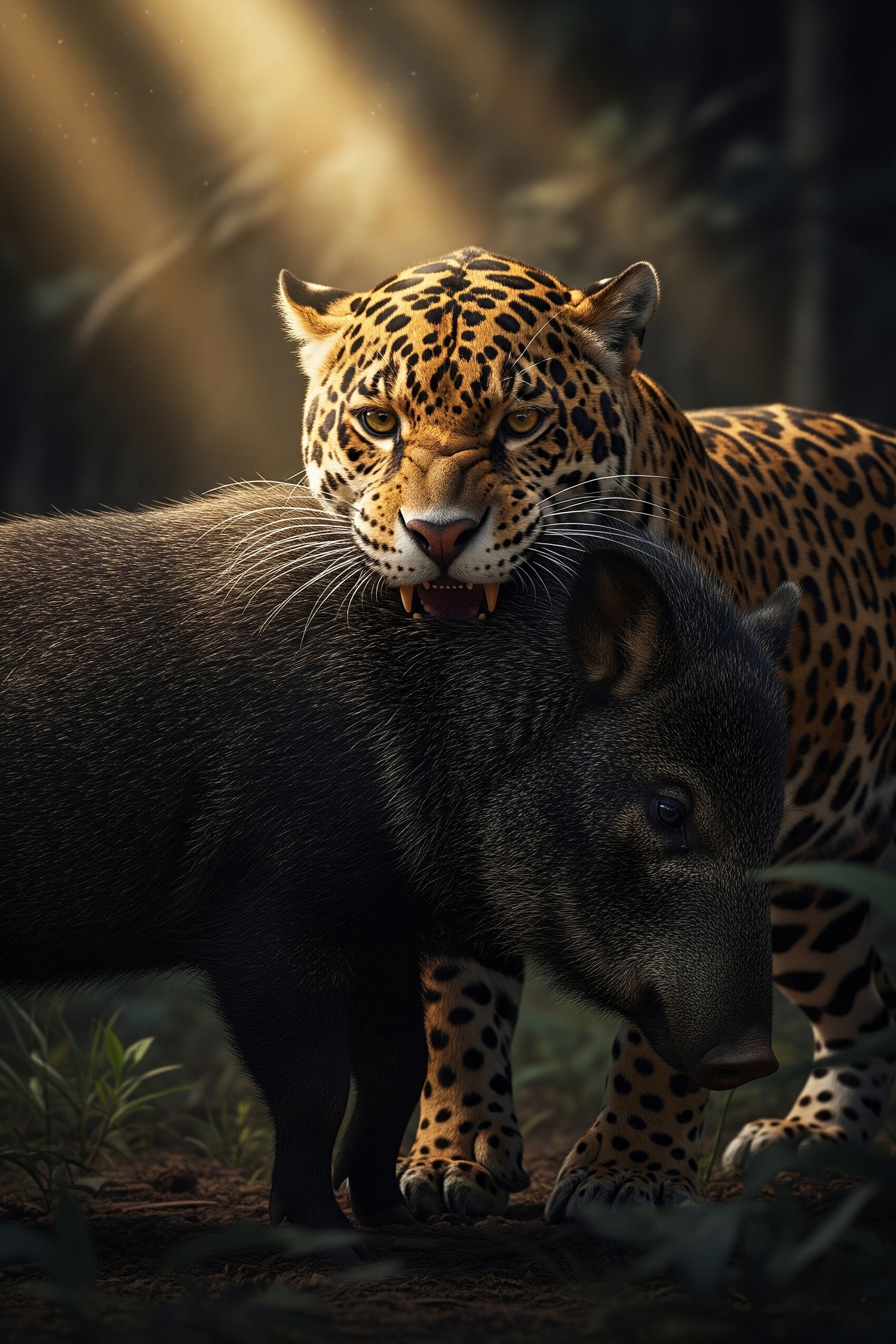
Here’s what stopped me mid-scroll at 2am: the jaguar is the third-largest cat on the planet. Smaller than lions. Smaller than tigers. And yet — pound for pound — it generates more bite force relative to skull size than either of them. A 200-pound jaguar can pierce a caiman’s skull in one strike. A 400-pound lion can’t.
Caimans.
Armored prehistoric reptiles. Sheathed in bone-hard skin. And the jaguar hunts them. Hunts them successfully. Regularly.
Then there are the giant river turtles. Evolution spent 200 million years building those shells. Tested them against predators, against time, against every pressure the Amazon could throw at them. The jaguar bites straight through. Not around a seam. Not searching for weakness. Through the shell itself.
That’s when you know something unusual is happening.
The Jungle Didn’t Leave Room for Second Chances
The jaguar evolved in dense riverine jungle, not open savanna. In the tangled undergrowth of Central and South America, you can’t afford a prolonged fight. Another predator might steal your kill. You might wreck a limb on roots and rocks. Energy doesn’t grow on trees — it’s expensive to replace. The one-strike kill isn’t just efficient. It’s survival.
The prey list proves it. Over 85 species. Deer, capybara, tapir, caiman, fish, turtles, peccaries — the variety is almost impossible to track. Every single animal on that list has a different skull shape, different bone density, different defenses. Yet the same technique works on all of them. One killing method, versatile enough to handle armored shells and soft skulls with equal lethality. That kind of adaptation doesn’t happen by luck.
By the Numbers
- 1,500 PSI — the jaguar bite force, measured by Brady Barr for National Geographic in 2005
- A lion generates roughly 650 PSI. Tigers manage about 1,050 PSI. Neither comes close.
- 85+ prey species documented across jaguar ranges — more dietary variety than any other big cat in the Americas
- Giant South American river turtles can withstand over 1,000 pounds of compressive force. A jaguar exceeds that in a single bite.
- Skull-to-body-size ratio gives jaguars roughly 40% more bite force per unit of body mass than their larger relatives
The Strange Details
- Jaguars regularly hunt underwater. Documented diving to catch submerged fish and turtles, using the same skull-strike technique on land or underwater.
- Unlike leopards, which carry kills into trees for protection, jaguars drag prey into dense undergrowth near water — their strike is too fast to need defending from competitors.
- The name “jaguar” comes from the Tupí-Guaraní word “yaguareté.” It means “true, fierce beast.” Or “he who kills with one leap.” That last translation turned out to be anatomically accurate, which kept me reading for another hour.
What Evolution Actually Looks Like
The jaguar bite force isn’t just a fact to impress people at parties. It’s evidence of how evolution actually works — not by making things bigger or faster, but by making them precise. The jaguar is the case study in biological optimization. Every millimeter of that skull was shaped by failure: missed kills, lost meals, injuries sustained in fights that dragged on too long. The animals that died before reproducing taught the survivors what not to do.
What you’re looking at when you see a jaguar is millions of failed attempts compressed into one predator that almost never fails.
Millions of tries, all condensed into one moment of contact.
The jaguar doesn’t need to be the biggest cat on Earth. Doesn’t need a long chase or a stranglehold. It needs one angle, one moment, one strike — and 400,000 years of refinement to make sure it lands. In a world built for brute force, the jaguar made a different bet. Precision over power. Engineering over size. It worked. If this kept you reading this long, you’ll want to spend some time at this-amazing-world.com — the next one is somehow even stranger.
Frequently Asked Questions
Q: How strong is a jaguar’s bite force compared to other big cats?
A jaguar’s bite force reaches about 1,500 PSI, measured by Brady Barr for National Geographic in 2005. By comparison, a lion generates roughly 650 PSI and a tiger around 1,050 PSI. Relative to skull size, the jaguar produces roughly 40% more bite force per unit of body mass than either larger cat, making it the most powerful biter among big cats in the Americas.
Q: Why does a jaguar kill prey with a single bite to the skull?
The jaguar evolved in dense riverine jungle in Central and South America, where prolonged fights risk losing a kill to competitors or sustaining injury. Instead of suffocating prey over five or six minutes like a lion, it drives its canines directly through the skull into the brain, killing instantly. This one-strike method conserves energy and works across more than 85 documented prey species with differing skull shapes.
Q: Can a jaguar really bite through a turtle shell?
Yes. Giant South American river turtles evolved shells over roughly 200 million years that can withstand more than 1,000 pounds of compressive force. A jaguar exceeds that figure in a single bite, piercing straight through the shell itself rather than searching for a weak seam. A 200-pound jaguar can also pierce a caiman’s armored skull in one strike, something a 400-pound lion cannot manage.
Q: What makes a jaguar’s skull so powerful?
The jaguar’s head is disproportionately wide, leaving more room for the temporalis muscles that drive jaw closure. Combined with shorter jaws that preserve leverage, this produces extraordinary compression at the canine tips. The broad forehead, deep cheekbones, and flattened snout result from roughly 400,000 years of selection pressure, all optimizing the skull into what biologists describe as a hydraulic press engineered for one precise moment of contact.
Illustrations are AI-generated. Article fact-checked and human-edited. Our editorial standards.