The Piper Snipers Refused to Shoot on D-Day
On June 6, 1944, a 21-year-old walked up Sword Beach carrying nothing but bagpipes and a ceremonial dagger. Machine gun fire was everywhere. He didn’t get hit once.
The sand was already red. Men were screaming, dying, scrambling up the beach in the chaos of the largest amphibious invasion ever attempted. And there’s Bill Millin — in a kilt, completely exposed, playing Scottish folk tunes like the world wasn’t actively trying to kill him. “Highland Laddie.” Then “The Road to the Isles.” Just… playing. While bullets cut through the air around him.
The thing that kept me reading about this for hours was the question at the end: why didn’t the German snipers shoot him?
Key Facts
- On June 6, 1944, 21-year-old Bill Millin played bagpipes on Sword Beach during the D-Day landings.
- Lord Lovat, commanding the 1st Special Service Brigade, ordered Millin to play despite a British Army ban on pipers in combat.
- Millin played for about four hours, covering several kilometers from Sword Beach to Pegasus Bridge.
- The 1st Special Service Brigade suffered roughly 50% casualties during the Normandy campaign, yet Millin was never hit.
- Bill Millin died in 2010 at age 88, and a statue of him now stands near Sword Beach in Normandy.
In short: Known as the Bill Millin mad piper of D-Day, this 21-year-old walked up Sword Beach on June 6, 1944, playing bagpipes under machine-gun fire on Lord Lovat’s orders, despite a ban on combat pipers. German snipers held fire because, they later admitted, they thought he was insane. He survived unharmed and died in 2010 at 88.
The Ban That Didn’t Apply
By 1944, the British Army had officially forbidden pipers from active combat. The casualties in World War I had been brutal — pipers led men forward, which made them visible targets, which made them dead. The mathematics of it was grim. But Lord Lovat, commanding the 1st Special Service Brigade, found something interesting in the wording. The ban applied to English soldiers. Millin was Scottish.
So technically…
It was audacity masquerading as legal reasoning. Lovat wanted the pipes on that beach because of what they meant to Scottish soldiers. Because sound — the right sound — could do something bullets couldn’t.
What Lovat Actually Said
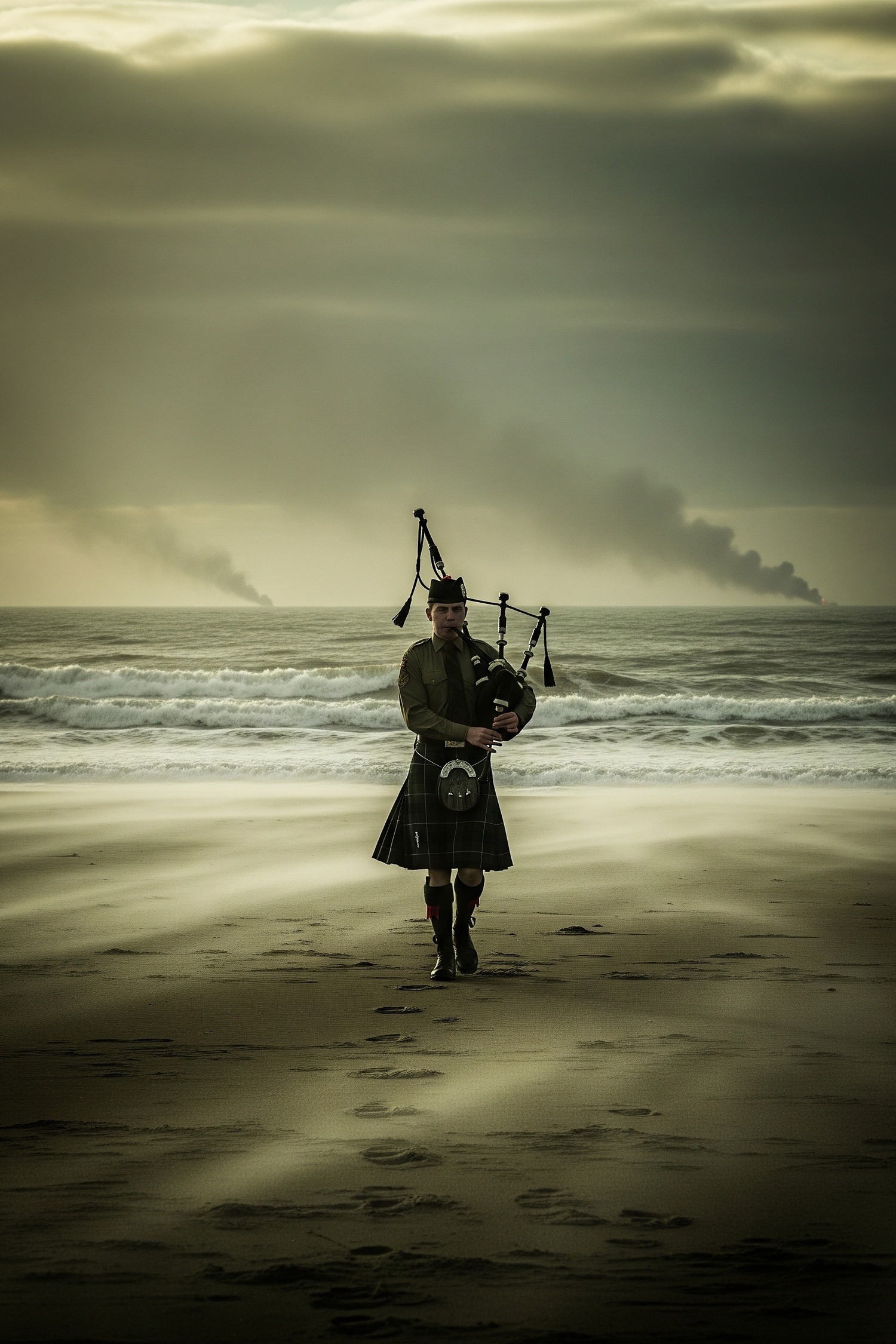
When Millin waded ashore with water up to his chest, Lovat was beside him. Walking slowly. Unhurried. Like a man heading to his country estate instead of a contested beach. He turned to Millin and said: “Give us a tune, piper.”
Millin played.
What’s interesting is that he wasn’t trying to be brave. He was following orders. He was doing his job — the same way a soldier follows a command to advance, or to hold a position, or to run. The bravery was incidental. Almost an accident. A side effect of professionalism so complete it looked, from far away, like madness.
He marched up and down the waterline. Back and forth. Completely visible. Completely exposed.
The Snipers Watched
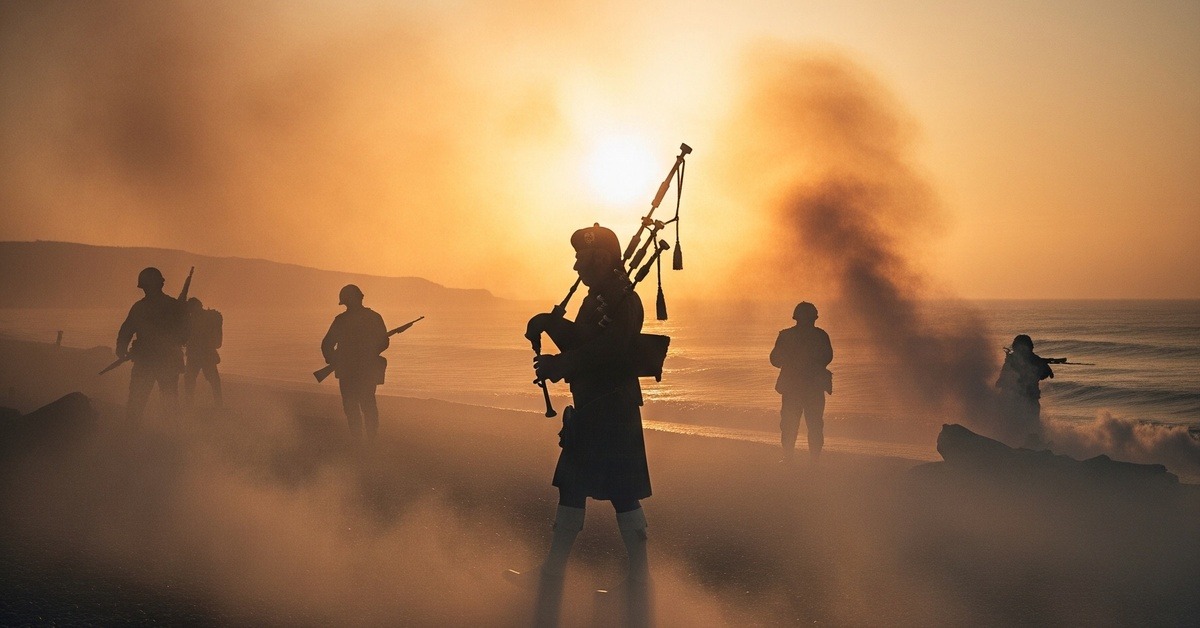
German forces had fortified the area around Sword Beach heavily. Snipers positioned at distance. Patient. They watched men scramble and fall. They watched Millin stand upright in full view — loud, visible, impossible to miss.
At that range, he was an easy shot.
They didn’t fire. Not once.
After the war, some of those German soldiers were captured. Millin encountered them. And they gave him an answer that’s stranger than any explanation involving courage or mercy. They said they thought he was insane.
Not brave. Insane. A man who walks calmly through gunfire playing bagpipes doesn’t fit any tactical category a combat sniper’s brain knows how to process. And the human mind — even under fire, even trained for killing — hesitates at things it can’t categorize. It calculates that shooting a lunatic isn’t worth the ammunition. Whether that was tactical reasoning or superstition probably depended on the man behind the scope.
By the Numbers
- Four hours of continuous playing, June 6, 1944.
- Several kilometers covered under fire — from Sword Beach all the way to Pegasus Bridge.
- The 1st Special Service Brigade: 50% casualties during the Normandy campaign. Millin was statistically far outside the norm.
- At least four distinct tunes recorded: “Highland Laddie,” “The Road to the Isles,” “Blue Bonnets over the Border,” and “All the Blue Bonnets.”
- One of the only pipers to play in active combat during World War II. Almost certainly the only one to do it on a contested beach landing at this scale. (Imperial War Museum documentation)
Details Worth Knowing
- Lord Lovat arrived at Pegasus Bridge two minutes late — and his first order was to have Millin play “Blue Bonnets over the Border” as they crossed. The paratroopers who’d been holding that bridge since midnight, exhausted and terrified, reportedly wept when they heard it.
- Millin waterproofed his pipes for the sea crossing. The moment he hit the beach, he pulled them out and started playing. Those same pipes survived the entire war and now sit in the Doune Museum in Scotland, at the Dawson Collection — actual physical evidence of this impossible day.
- The psychology of music in combat is real, measurable. Military historians have documented that music during battle triggers group synchrony — it suppresses the freeze response, gets soldiers’ nervous systems synchronized with something external. It works. Whether it works well enough to stop snipers from shooting is another question entirely.
What This Actually Tells Us
The standard version of this story lives in the “acts of bravery” folder. And sure. It belongs there. But there’s a stranger layer underneath, and it’s the part that matters more.
The German snipers didn’t spare Millin because the music moved them. They spared him because he violated every threat pattern their brains were trained to recognize. A man standing upright. Playing an instrument. In the middle of an amphibious invasion. That doesn’t compute. It doesn’t fit the categories.
And when the human brain can’t categorize something — especially under extreme stress — it hesitates.
The thing that kept him alive wasn’t armor or tactics or luck. It was category failure in the minds of the men who wanted him dead. He was too strange to shoot.
Bill Millin lived to 88. He marched in D-Day commemorations for decades, still wearing the kilt, still carrying the pipes. When he died in 2010, they put a statue of him near Sword Beach in Normandy — looking out at the water, pipes in hand, exactly as he stood that morning in 1944. One unarmed man. One impossible walk. And a question that still doesn’t have a clean answer. More stories like this — stranger ones — are waiting at this-amazing-world.com.
Frequently Asked Questions
Q: Who was Bill Millin, the mad piper of D-Day?
Bill Millin was a 21-year-old Scottish piper who landed on Sword Beach on June 6, 1944, during the D-Day invasion. He served under Lord Lovat, commander of the 1st Special Service Brigade. Armed only with bagpipes and a ceremonial dagger, he played Scottish folk tunes while completely exposed to enemy fire. He earned the nickname ‘the Mad Piper’ and died in 2010 at age 88.
Q: Why didn’t German snipers shoot Bill Millin?
German forces had fortified Sword Beach heavily with snipers positioned at distance, and Millin was an easy target marching upright in full view. They never fired at him. After the war, some captured German soldiers told Millin they had not shot him because they thought he was insane. A man calmly playing bagpipes amid an amphibious invasion did not fit any threat pattern their training recognized, so they hesitated.
Q: Why was Bill Millin allowed to play bagpipes when pipers were banned in combat?
By 1944, the British Army had forbidden pipers from active combat after heavy piper casualties in World War I, where they led men forward and became visible targets. Lord Lovat found a loophole: the ban applied specifically to English soldiers, and Millin was Scottish. Using that reasoning, Lovat ordered Millin to play on Sword Beach, telling him, ‘Give us a tune, piper,’ as they waded ashore.
Q: What happened to Bill Millin’s bagpipes after the war?
Millin waterproofed his pipes for the sea crossing and pulled them out to play the moment he reached the beach. Those same pipes survived the entire war and are now displayed in Scotland as part of the Dawson Collection at the Doune Museum. They stand as physical evidence of his day on Sword Beach. A statue of Millin was also erected near the beach in Normandy after his death in 2010.
Illustrations are AI-generated. Article fact-checked and human-edited. Our editorial standards.