He Bites Her — Then His Body Dissolves Into Hers
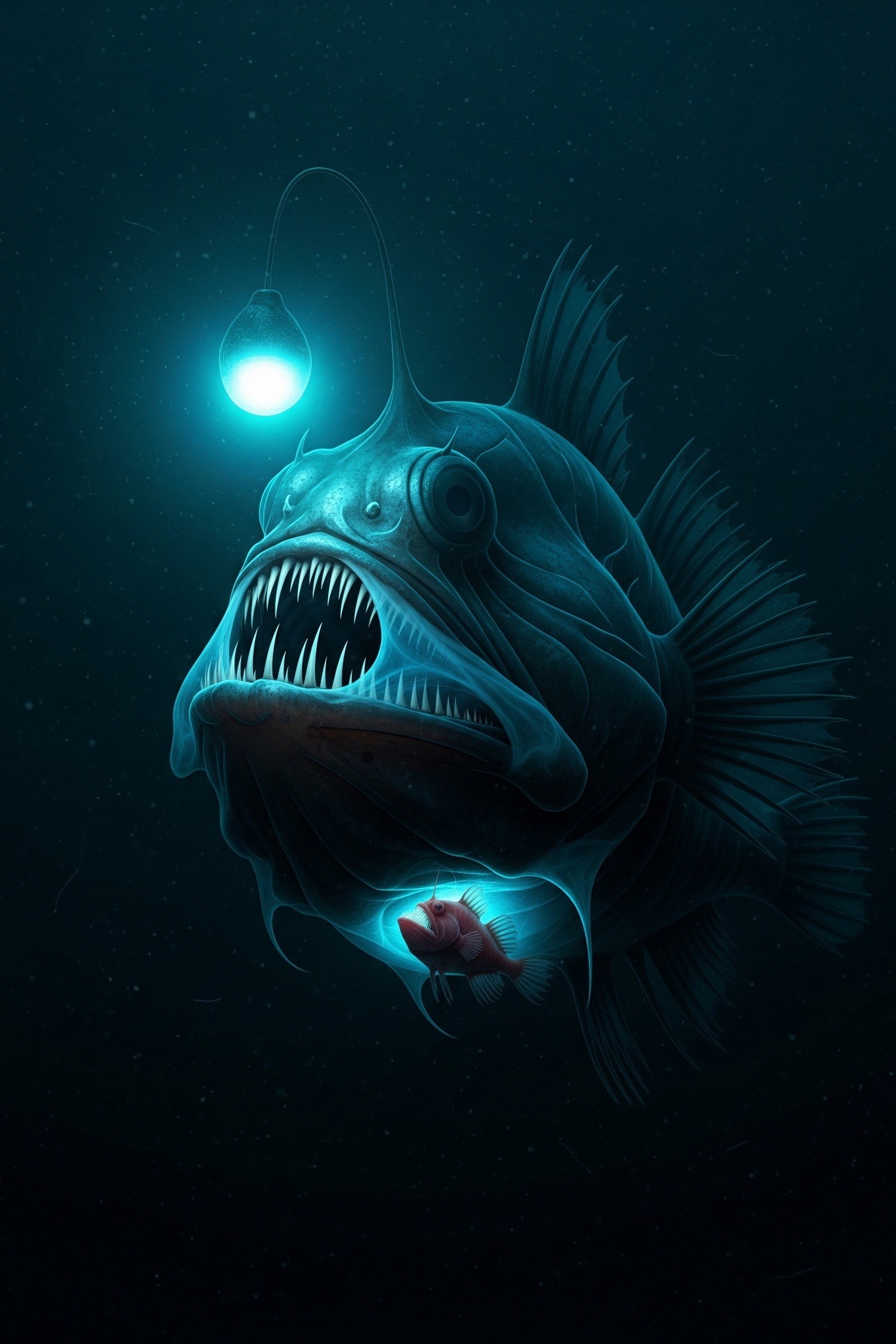
A male anglerfish bites a female in the pitch-black ocean, 1,000 meters below the surface. That bite? It’s the last independent decision he’ll ever make.
In absolute darkness where the pressure would crush you flat, two fish find each other. The odds of this happening should be impossible. When they meet, the smaller one doesn’t swim away. He doesn’t deposit sperm and leave. Instead, his body starts fusing with hers — skin to skin, vein to vein — until he’s no longer a separate animal. He’s become something the ocean invented that barely qualifies as biology anymore.
Key Facts
- Male deep-sea anglerfish can be up to 60 times smaller than females, one of vertebrate biology’s most extreme size gaps (Pietsch, 2005).
- In sexual parasitism, the male’s body fuses permanently to the female and their circulatory systems merge completely.
- A single female has been documented with eight fused males attached simultaneously.
- In 1922, Bjarni Saemundsson misidentified attached males as juveniles; Charles Tate Regan corrected this in 1924.
- Deep-sea anglerfish live below 1,000 meters, where pressure reaches around 80 atmospheres.
In short: Deep-sea anglerfish parasitism is the only known case in vertebrate life where two animals permanently share a circulatory system. A male up to 60 times smaller bites a female in the dark ocean, then fuses skin-to-skin until his eyes and organs dissolve. Scientists call it sexual parasitism, first correctly identified in 1924.
Deep-Sea Anglerfish Parasitism: What Actually Happens Inside That Fusion
The male Ceratias holboelli arrives at this moment already strange. He’s tiny — up to 60 times smaller than the female in some species. His nostrils are absurdly large, evolved to chase her chemical scent across impossible distances in total darkness. When he finds her, he bites.
Then the real part begins.
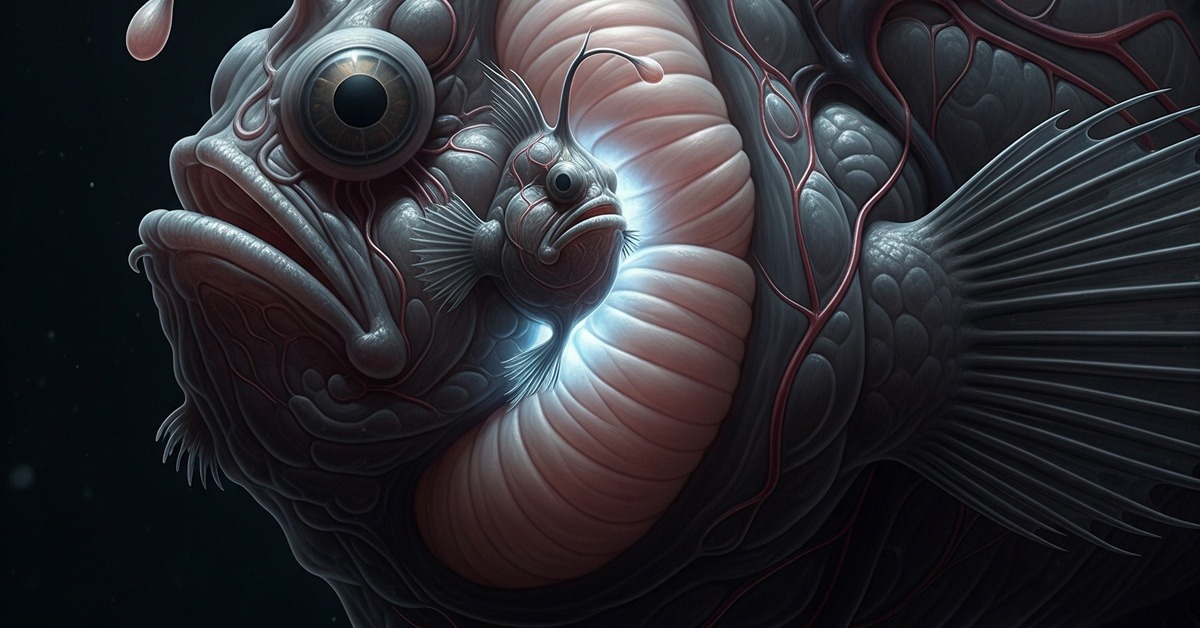
His eyes dissolve. His internal organs collapse. Most of his body becomes useless. But his heart keeps beating. His testes keep producing sperm. He’s conscious. He’s functional. He’s just… attached. Permanently.
Biologist Theodore Pietsch at the University of Washington has spent decades studying this, and he still struggles to describe it. The male’s skin grows directly into the female’s skin. Their circulatory systems merge completely. His blood becomes her blood — or rather, he stops having his own blood altogether and just taps directly into hers like a parasite that’s decided to stay forever. Scientists call it sexual parasitism. It’s the only known case in all of vertebrate life where two animals of the same species permanently share a circulatory system.
Nobody woke up and decided this was a good design. Evolution simply had no other choice.
Why the Ocean Forced This Into Existence
Below 800 meters, you’re in a place that doesn’t make intuitive sense. It’s pitch black. It’s near-freezing. The pressure there hits 80 atmospheres — enough to implode your lungs instantly. A single anglerfish might search for weeks or months without finding another one of its kind. In an ocean that vast and that dark, the odds of two fish finding each other twice are functionally zero.
So when a male finally locates a female, swimming away isn’t an option anymore. Not really.
Evolution doesn’t reward males that mate once and leave. It rewards the ones that refuse to let go. That stay. That fuse.
That accept permanent parasitism as the price of reproduction.
The Century-Old Mistake That Almost Fooled Science
It is 1922. An Icelandic biologist named Bjarni Sæmundsson hauls up a female anglerfish in his nets. Attached to her body are small, strange creatures. He publishes a paper calling them juveniles — possibly her offspring.
Two years pass.
In 1924, Charles Tate Regan finally looks at Sæmundsson’s specimen closely. Those aren’t juveniles. They’re adult males. Sexually mature. Fully formed. Just… permanently merged with the female’s body. The scientific community had been misreading the relationship for years because the male was so thoroughly transformed that he didn’t even register as an adult animal anymore.
That kept me reading for another hour.
The male anglerfish is so completely altered by the fusion that he defies categorization. He’s an adult. He’s functional. He’s capable of reproduction. And yet he looks, by every conventional standard, like something broken. Because separated from her body, he would be.
By the Numbers
- Males reach up to 60 times smaller than females — one of vertebrate biology’s most extreme size gaps (Pietsch, 2005)
- A single female has been documented with eight fused males attached simultaneously. Eight. One fish becomes a reproductive colony.
- Deep-sea anglerfish live below 1,000 meters where roughly 65% of Earth’s ocean floor remains almost completely unexplored
- The male’s free-swimming phase might last only weeks. The fused phase can continue for years — possibly his entire remaining life
The Stranger Details
- Their immune systems do something we still don’t fully understand — they suppress the rejection response that would destroy foreign tissue. Transplant researchers are paying serious attention.
- Not every anglerfish species does this. Some males mate temporarily and swim off. Permanent parasitic fusion is specific to certain families — making it rare even within the group.
- The female produces her own bioluminescent lure using light-producing bacteria in her forehead filament. The male, eyeless and fused to her body, will never see it.
Why This Matters Beyond Some Weird Deep-Sea Fish
Here’s the thing: deep-sea anglerfish parasitism reveals how extreme environments don’t just create strange animals. They create impossible solutions. Every bizarre feature down there — the fusion, the bioluminescence, the grotesque size differences — is evolution’s answer to a specific, brutal problem. And sometimes those answers contain biological mechanisms we haven’t observed anywhere else.
The immune suppression angle alone is being actively studied in transplant research.
When two genetically distinct animals can share a bloodstream indefinitely without rejection, that’s not just unusual. That’s potentially revolutionary.
We’ve mapped less than 25% of the ocean floor. The anglerfish, as strange as it is, might not even be the weirdest thing down there. It might not be close.
The deep ocean keeps producing animals that force us to reconsider what’s biologically possible. The male anglerfish dissolves into a mate he’ll never see again, in darkness we’ll never naturally experience, at pressures that would kill us instantly. And yet the system works. It’s been working for millions of years. More strange biology waits at this-amazing-world.com — and the next story is even darker than this one.
Frequently Asked Questions
Q: What is deep-sea anglerfish parasitism?
Deep-sea anglerfish parasitism, also called sexual parasitism, is a reproductive strategy in which a tiny male anglerfish permanently fuses his body to a much larger female. After biting her, his skin grows directly into hers and their circulatory systems merge completely, so he taps into her blood supply. His eyes and most internal organs dissolve, but his heart and testes keep functioning. It is the only known case in vertebrate biology of two same-species animals sharing one circulatory system.
Q: How much smaller is the male anglerfish than the female?
In some deep-sea anglerfish species, the male can be up to 60 times smaller than the female, one of the most extreme size gaps in all of vertebrate biology, as documented by biologist Theodore Pietsch in 2005. The male arrives with absurdly large nostrils evolved to track the female’s chemical scent across vast distances in total darkness. A single female has even been documented with eight fused males attached to her body at once.
Q: When did scientists first understand anglerfish sexual parasitism?
The phenomenon was misunderstood for years. In 1922, Icelandic biologist Bjarni Saemundsson hauled up a female anglerfish with small creatures attached and published a paper calling them juveniles or her offspring. In 1924, Charles Tate Regan examined the specimen closely and realized they were actually sexually mature adult males permanently merged with the female. The male was so transformed by the fusion that he no longer registered as an adult animal.
Q: Why did anglerfish evolve such an extreme mating strategy?
Deep-sea anglerfish live below 800 to 1,000 meters in pitch-black, near-freezing water under roughly 80 atmospheres of pressure. In an ocean that vast and dark, the odds of two anglerfish finding each other even once are extremely low, and finding each other twice is functionally zero. So when a male locates a female, evolution favors those that refuse to let go and fuse permanently, accepting lifelong parasitism as the price of guaranteed reproduction.
Illustrations are AI-generated. Article fact-checked and human-edited. Our editorial standards.