The Foam That Stops Bullets Better Than Steel Can
A foam made of metal stops armor-piercing rounds that shred solid steel. It weighs half as much. And nobody was expecting it to work this well.
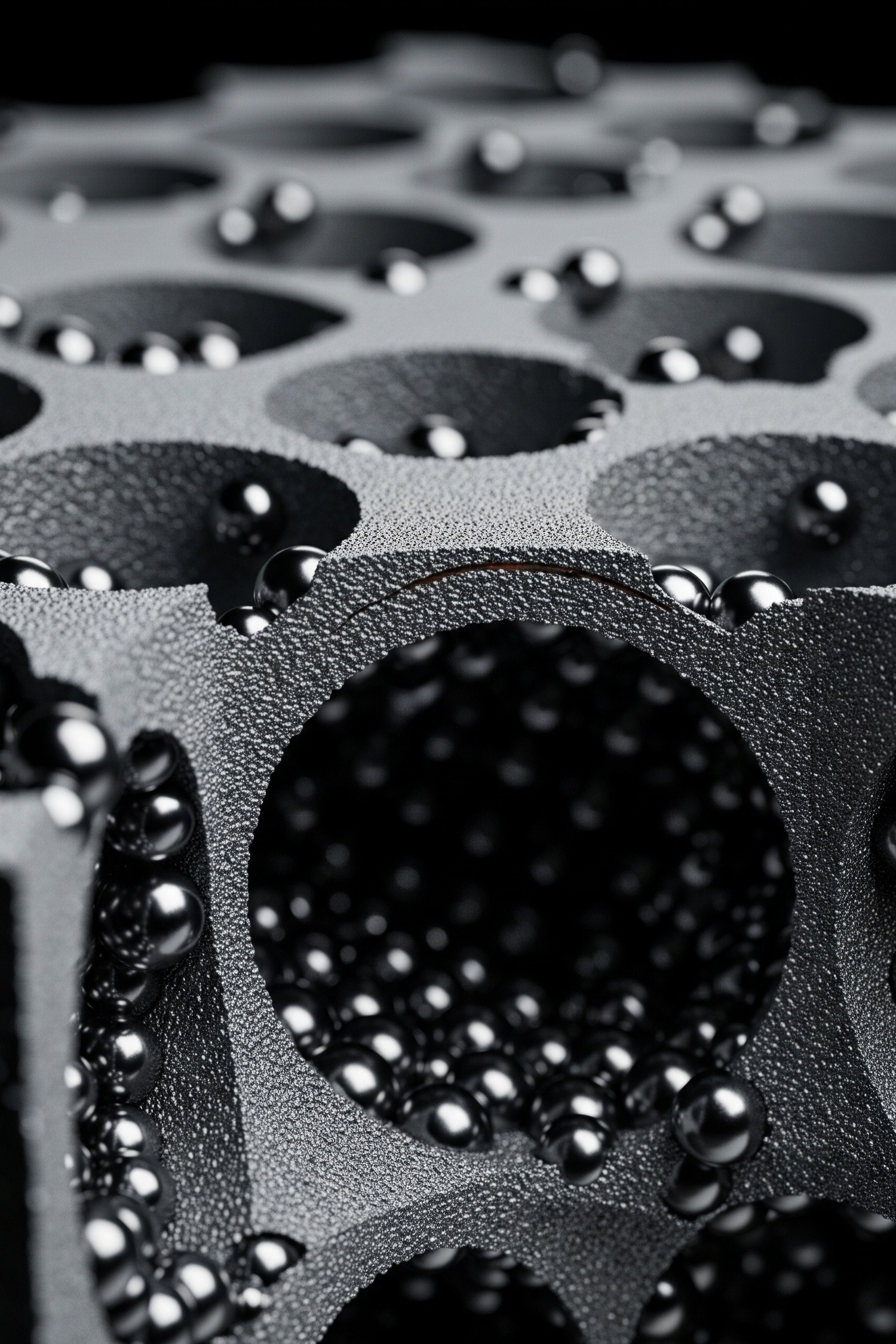
Turns out, NC State materials scientists have been quietly building something that shouldn’t exist — composite metal foam, or CMF, riddled with hollow spheres, performing better under gunfire than the solid steel we’ve trusted for decades. Dr. Afsaneh Rabiei’s team didn’t set out to revolutionize body armor. They were investigating how energy moves through porous structures. What they found instead was a material that changes who can wear protection, for how long, and whether they’ll actually survive the next shift.
Key Facts
- Composite metal foam (CMF) was developed at NC State by Dr. Afsaneh Rabiei’s team using hollow metal spheres in a metal matrix.
- In 2019 NC State tests, CMF stopped armor-piercing .30 caliber rounds with back face deformation under 8 mm versus the NATO 44 mm standard.
- Traditional military body armor weighs roughly 9 to 16 kilograms; CMF-based alternatives offer comparable protection at about half the weight.
- Metal foam structures can absorb up to 80 percent of impact energy, compared with roughly 30 to 40 percent for equivalent solid metal panels.
- CMF also blocks X-rays, gamma rays and neutron radiation, and remains effective at extreme temperatures including fire-resistance testing.
In short: Composite metal foam, developed by Dr. Afsaneh Rabiei’s team at NC State, uses hollow metal spheres inside a metal matrix to stop armor-piercing .30 caliber rounds while weighing about half as much as steel plate. NC State 2019 tests showed back face deformation under 8 mm against a 44 mm NATO limit, and the material also mitigates blast waves and radiation.
How Metal Foam Body Armor Actually Works
Picture it: tiny hollow metal spheres suspended inside a metal matrix, like bubbles frozen in ice. When a bullet hits, instead of one catastrophic impact wave, the foam collapses in thousands of tiny compressions simultaneously. Energy spreads across the entire structure. Controlled failure. Life-saving failure.
Solid steel deflects force. CMF devours it. The round doesn’t bounce off — it runs out of momentum mid-material, the way a wave loses energy crashing into wet sand instead of concrete. According to research into metal foam properties, this energy-absorption behavior is fundamentally different from how solid metals respond to impact. That distinction matters more than it sounds.
The Weight Problem
Full torso protection using ceramic and steel plate pushes past 10 kilograms. Every step. Every sprint. Every decision made while exhausted.
Studies link heavy body armor to musculoskeletal injuries, slower reaction times, mistakes made under fatigue. A soldier deciding whether to run or hold position doesn’t think in abstract terms. They think in seconds. Sometimes that’s all the margin there is.
CMF armor offers comparable protection at half the weight. For a closer look at how materials science is reshaping survival technology across multiple fields, this-amazing-world.com has been tracking these developments. The difference between traditional plate carriers and CMF alternatives isn’t theoretical — it’s measured in whether someone comes home exhausted or comes home at all.
Why Holes in Your Armor Make It Stronger
It seems backwards. Putting holes in protection should make it weaker. But here’s the thing — metal foam operates on a principle that solid materials can’t replicate. The hollow spheres act like a maze for kinetic force, redirecting and absorbing impact rather than transmitting it as a single shock wave.
Dr. Rabiei’s team tested CMF panels against armor-piercing .30 caliber rounds. The kind designed specifically to defeat military-grade protection. The material stopped them. Completely. Back face deformation — that’s the technical term for how much the armor dents inward toward your body — stayed within NATO standards.
Even if a round doesn’t penetrate, a deep enough dent causes blunt trauma injuries. CMF kept that deformation remarkably low.
That’s not just stopping the bullet. That’s protecting the person behind it.
The Results
When NC State published their data, the materials science community noticed immediately. CMF didn’t just match steel’s performance against armor-piercing rounds — in several key metrics, it exceeded it. While cutting weight by a significant margin.
The implications were obvious to anyone reading the numbers.
But something else was hiding in the test results. Something the data only hinted at. That last fact kept me reading for another hour.
It Doesn’t Just Stop Bullets
Composite metal foam’s energy-absorption properties don’t stop at ballistic protection. The same structural behavior that converts a bullet’s kinetic energy into thousands of micro-compressions makes CMF exceptionally effective against blast waves.
Explosions don’t just throw shrapnel. Pressure waves travel through solid materials and into the human body — traumatic brain injury, internal organ damage, spinal trauma. All without a single fragment making contact. CMF disrupts that pressure wave at the material level.
One material. Two injury mechanisms. Ballistic protection and blast mitigation, in one lightweight panel.
That’s not incremental. That’s a category shift.
By the Numbers
- NC State tests (2019): armor-piercing .30 caliber rounds stopped cold, back face deformation under 8mm versus the 44mm NATO standard, all while remaining significantly lighter than steel plate
- Traditional military body armor weighs between 9 and 16 kilograms. CMF-based alternatives demonstrate equivalent protection at roughly half that weight in laboratory conditions.
- A single armor-piercing round at 900+ meters per second carries kinetic energy comparable to being struck by a small car. CMF dissipates that across thousands of internal compression events rather than transmitting it as one force vector.
- Metal foam structures can absorb up to 80% of impact energy in some configurations, compared to roughly 30-40% for equivalent solid metal panels of the same thickness

The Unexpected Applications
- Radiation shielding — CMF blocks X-rays, gamma rays, and neutron radiation. The porous structure interrupts radiation pathways in ways solid lead shielding can’t replicate at equivalent weights.
- Customizable threat response. Sphere size, wall thickness, and packing density can be tuned to optimize for different threats — blunt impact, ballistics, or blast depending on what’s needed.
- High-temperature performance. Dr. Rabiei’s research demonstrated CMF’s effectiveness at extreme temperatures, including fire resistance testing. Vehicle armor applications where fire is as deadly as incoming rounds.
- Vibration dampening. The same energy absorption works against acoustic waves. Potential applications in noise-sensitive environments nobody’s explored yet.
Beyond Soldiers
Metal foam body armor isn’t a military story anymore. Law enforcement officers wear heavy plate carriers every shift. Border patrol agents. Security personnel. First responders. Global millions of people who strap on armor before walking into dangerous situations.
A material delivering superior ballistic performance at half the weight changes everything about their job. Their safety. Whether they go home.
And then there are the applications nobody talks about yet. Vehicle armor. Armored transport. Building protection. The physics doesn’t care about the application. A material that stops a round from reaching a soldier’s chest could protect an armored vehicle’s passengers. Could reinforce a checkpoint wall. Could line the door of a bank vault.
We’ve spent decades assuming that stronger protection means heavier protection. Composite metal foam breaks that assumption entirely — and the implications are still unfolding. The researchers at NC State have published their findings. The materials are being refined. The next version is already in development. If you want to know what comes next, there’s more at this-amazing-world.com.
Frequently Asked Questions
Q: How does composite metal foam stop a bullet?
Composite metal foam consists of tiny hollow metal spheres suspended inside a metal matrix, similar to bubbles frozen in ice. When a bullet strikes, instead of one catastrophic impact wave, the foam collapses in thousands of tiny compressions simultaneously, spreading energy across the structure. The hollow spheres act like a maze for kinetic force, redirecting and absorbing impact rather than transmitting it as a single shock wave. The round runs out of momentum mid-material rather than bouncing off.
Q: How does CMF compare with traditional steel armor on weight and performance?
Traditional military body armor weighs between 9 and 16 kilograms, while CMF-based alternatives demonstrate equivalent protection at roughly half that weight in laboratory conditions. In NC State 2019 testing against armor-piercing .30 caliber rounds, CMF kept back face deformation under 8 mm versus the 44 mm NATO standard. Metal foam structures can absorb up to 80 percent of impact energy, compared with roughly 30 to 40 percent for equivalent solid metal panels of the same thickness.
Q: Can composite metal foam protect against more than just bullets?
Yes. The same energy-absorbing structure that handles ballistic impacts also disrupts blast pressure waves at the material level, helping mitigate traumatic brain injury and internal organ damage from explosions. Dr. Rabiei’s research also demonstrated CMF’s effectiveness at extreme temperatures, including fire resistance, making it relevant for vehicle armor. In addition, the porous structure blocks X-rays, gamma rays and neutron radiation, and the same energy-absorption behavior offers potential for vibration and acoustic dampening.
Q: Who developed composite metal foam and what was the original goal?
Composite metal foam was developed at North Carolina State University by a team led by Dr. Afsaneh Rabiei. According to the article, the researchers did not originally set out to revolutionize body armor; they were investigating how energy moves through porous structures. What they produced was a material with hollow metal spheres inside a metal matrix that performs better under gunfire than the solid steel traditionally used in armor, while weighing roughly half as much for equivalent protection levels.
Illustrations are AI-generated. Article fact-checked and human-edited. Our editorial standards.