The Orange-Bellied Parrot: 50 Birds From Extinction
Imagine a species that survived ice ages, that crossed continents, that adapted to everything the planet threw at it for millions of years — and then nearly vanished in the span of a human lifetime. The orange-bellied parrot extinction crisis is happening right now, in real time, on a coastline most people will never visit. Fewer than 50 wild birds remain. The question isn’t whether we can save it anymore. The question is whether we’ll bother trying before the window closes entirely.
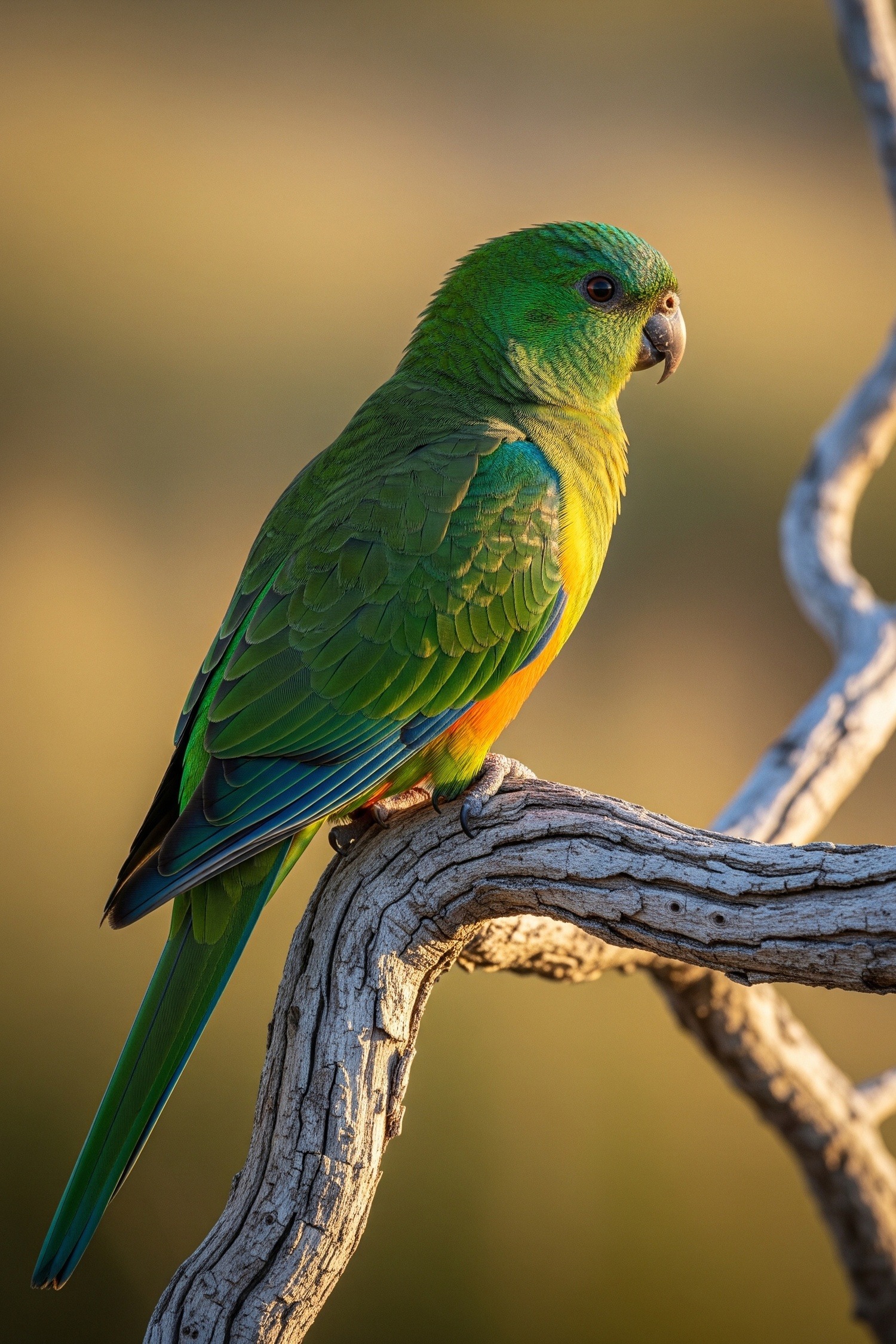
In the salt marshes and wind-scoured scrublands of southeastern Australia, one of the world’s most endangered birds spends its winters in a shrinking sliver of habitat. The orange-bellied parrot — Neophema chrysogaster — is smaller than your fist, brighter than anything that small has a right to be, and clinging to existence by the thinnest possible thread.
Conservation biologists have been watching the numbers fall for decades. What they’ve learned about why — and what it might take to reverse it — is equal parts sobering and quietly extraordinary.
Key Facts
- Fewer than 50 wild orange-bellied parrots remain, placing the species among the five rarest parrots on Earth (BirdLife Australia, 2023).
- A 2016 survey counted just 14 wild birds returning to the Tasmanian breeding grounds, the lowest count ever recorded.
- Each year the birds must cross roughly 200 km of open ocean (Bass Strait) twice, weighing less than 50 grams.
- About 70% of historical mainland coastal saltmarsh habitat has been lost to development since European settlement (Victorian DELWP assessment).
- The captive breeding program began in 1983 at Healesville Sanctuary and held over 300 individuals across eight institutions by 2023.
In short: The orange-bellied parrot extinction crisis has pushed this tiny migratory bird to fewer than 50 wild individuals, down to just 14 returning birds in 2016. Driven by the loss of about 70% of mainland saltmarsh habitat, introduced predators, and a perilous 200 km Bass Strait crossing, the species now survives largely on captive releases.
A Species Teetering: The Rarest Parrot Story
Historical records from the early twentieth century suggest the orange-bellied parrot was never abundant, but populations were stable enough to sustain themselves across a connected arc of coastal habitat stretching from South Australia through Victoria to the western fringes of New South Wales. That arc began fracturing in the mid-twentieth century as coastal development accelerated.
By 2016, a survey coordinated by the Department of the Environment and Energy in Canberra counted just 14 wild birds returning to their Tasmanian breeding grounds. Ornithologists privately described it as a functional extinction event in slow motion. The species is listed as Critically Endangered under both Australian federal law and the IUCN Red List, the most severe category before declared extinction.
What made that 2016 number so alarming wasn’t just the count — it was the trend behind it.
Recovery has been agonizingly incremental. By 2023, the wild population had climbed back toward the low-to-mid fifties, still a number that fits in a single room. Birdlife Australia attributes the partial recovery almost entirely to captive breeding releases rather than any natural rebound. A population propped up by captive releases isn’t recovering. It’s being sustained artificially while the underlying habitat problems remain largely unsolved. The wild birds that do survive are extraordinarily resilient — they just don’t have enough of anywhere left to be resilient in.
Stand in the Werribee Treatment Plant wetlands outside Melbourne on a cold July morning and you understand the stakes physically. The wind comes in off Port Phillip Bay raw and flat. The saltmarsh stretches in every direction, grey-green and low. And somewhere in it, if you’re lucky, a flash of emerald and tangerine. Small bird. Enormous absence if it’s gone.
200 Kilometres of Open Ocean, Every Year
Migration is dangerous for almost every species that attempts it. But the orange-bellied parrot’s annual journey carries a particular quality of recklessness that sets it apart even among migratory birds. Each autumn, after breeding in the remote buttongrass plains and alpine heaths of southwest Tasmania, the entire wild population must cross Bass Strait — roughly 200 kilometres of open ocean with no islands, no shelter, and no margin for error. For a bird weighing less than 50 grams, that crossing is the biological equivalent of a person swimming the English Channel in a winter storm.
Why does this crossing even matter so much? Because it’s where the system fails. Much like the sockeye salmon navigating thousands of kilometres to complete their life cycle, as explored in the story of how Alaska’s salmon runs reshape entire ecosystems, these are creatures whose survival is inseparable from the geography they move through — except the parrot’s crossing is even more precarious.
The crossing typically happens between late February and early April. Researchers from the Australian National University fitted GPS transmitters to individual birds in 2019 and 2020, tracking their flight paths across the strait. Birds don’t travel in cohesive flocks — a finding that surprised ornithologists. They cross in loose, fragmented groups, sometimes just two or three individuals together, navigating by a combination of magnetic sensing and star orientation that we still don’t fully understand. Flight duration averages between four and eight hours depending on wind conditions. Get unlucky with the weather and the birds simply don’t make it. Mortality during crossing is estimated to account for a significant proportion of annual deaths, though precise figures remain difficult to establish.
The return journey in spring carries its own risks. Birds that successfully overwinter on the mainland must cross Bass Strait again, this time heading south into the prevailing winds. Then breed. Then do it all again the following year. There’s no redundancy built in.
Habitat Loss: The Slow Emergency Behind the Numbers
Ask any conservation biologist working on the orange-bellied parrot what’s actually driving the extinction trajectory. It’s not a single threat. It’s a cascade. Coastal development on the Australian mainland has consumed an estimated 70 percent of the coastal saltmarsh habitat that the species historically relied on for overwintering — a figure documented in assessments by the Victorian Department of Environment, Land, Water and Planning.
That loss didn’t happen in a single dramatic event. It happened in thousands of incremental ones: a marina here, a road there, a coastal housing development approved on the grounds that the environmental impact would be “minimal.” Over decades, minimal adds up to catastrophic. A National Geographic investigation into global bird decline found that habitat fragmentation — not direct persecution — is now the primary driver of extinction risk for more than 60 percent of threatened bird species worldwide.
The orange-bellied parrot fits that pattern precisely, which means watching a species disappear at this speed, you stop calling it a trend — you call it a failure of will.
What makes the dynamics particularly cruel is that the remaining habitat patches are small and isolated from each other. A bird that loses its overwintering site can’t simply fly to the next one. The distances between intact saltmarsh fragments on the mainland are often too great for a bird this size to cover reliably. So individual birds that return from Tasmania are essentially navigating a patchwork of viable and non-viable habitat, with no way of knowing in advance which is which. The ones that find good habitat survive. The ones that don’t, often don’t.
Natural selection operating on a population of fifty individuals is not a process that ends well. Invasive predators compound everything. Cats and foxes — both introduced to Australia by European settlers — take a steady toll on birds foraging in low, open scrubland. Surveillance camera data collected by BirdLife Australia in 2021 confirmed cat predation at multiple mainland overwintering sites. Trapping programs exist. They’re underfunded and patchwork. The predation continues.
Can Captive Breeding Actually Save the Orange-Bellied Parrot?
One of the longest-running emergency conservation interventions in Australian history began formally in 1983, when wildlife managers at Healesville Sanctuary in Victoria recognised that wild population numbers were entering freefall. That was the orange-bellied parrot captive breeding program. By 2023, the captive population — held across eight institutions including Healesville, Adelaide Zoo, and Melbourne Zoo — numbered over 300 individuals. That’s more than six times the wild population.
The program has become the primary mechanism keeping the species’ genetic diversity alive. Researchers from the University of Melbourne’s School of BioSciences have been working to ensure that captive breeding pairs are selected to maximise genetic heterozygosity, reducing the inbreeding depression that devastates small populations over successive generations. Between 2017 and 2023, over 200 captive-bred birds were released at Melaleuca, the species’ primary breeding site in southwest Tasmania — a remote buttongrass plain accessible only by light aircraft or a multi-day wilderness hike. Captive-bred birds are released each year in a coordinated program managed by the Australian Government’s Orange-bellied Parrot Recovery Team.
Survival rates of released birds are lower than for wild-born individuals. They typically run around 40-50 percent through the first year compared to roughly 60-70 percent for wild-raised birds. That gap reflects the hard reality that captive birds lack the learned behaviours — foraging techniques, predator avoidance, migration cues — that wild birds acquire from experienced adults. But conservationists at Zoos Victoria have begun trialling “wild conditioning” programs, where captive chicks are raised in larger, more complex enclosures with reduced human contact. Early results from 2022 trials showed improved post-release survival.
It’s incremental.
But incremental is what this species has to work with.
What Pulling Back From the Edge Actually Requires
The black robin of the Chatham Islands was reduced to just five individuals — one breeding female — in 1980, and recovered to over 250 birds through intensive intervention. The California condor went to 27 birds in 1987 and now numbers over 500 in the wild. The orange-bellied parrot isn’t the only species to have approached the single-digit threshold and come back from it.
Both recoveries required not just captive breeding but the simultaneous resolution of the specific threats driving the decline. For the condor, that meant removing lead ammunition from hunting areas within the bird’s range. For the black robin, it meant eliminating introduced predators from key islands. Without addressing the root cause, the numbers simply don’t hold.
For the orange-bellied parrot, the root causes are multiple, interlocking, and politically inconvenient. Coastal development legislation in Victoria and South Australia would need to be tightened significantly to protect the remaining saltmarsh habitat. Feral predator control would need to be scaled up to a level that current funding doesn’t come close to supporting.
Climate change is already shifting the distribution and productivity of buttongrass plains in Tasmania, the species’ only breeding habitat, in ways that are difficult to model and harder to mitigate. A 2022 analysis published in Biological Conservation by researchers at Charles Darwin University projected that under mid-range warming scenarios, suitable breeding habitat in southwest Tasmania could decline by up to 35 percent by 2070. That’s not a distant abstraction. That’s within the lifespan of decisions being made right now.
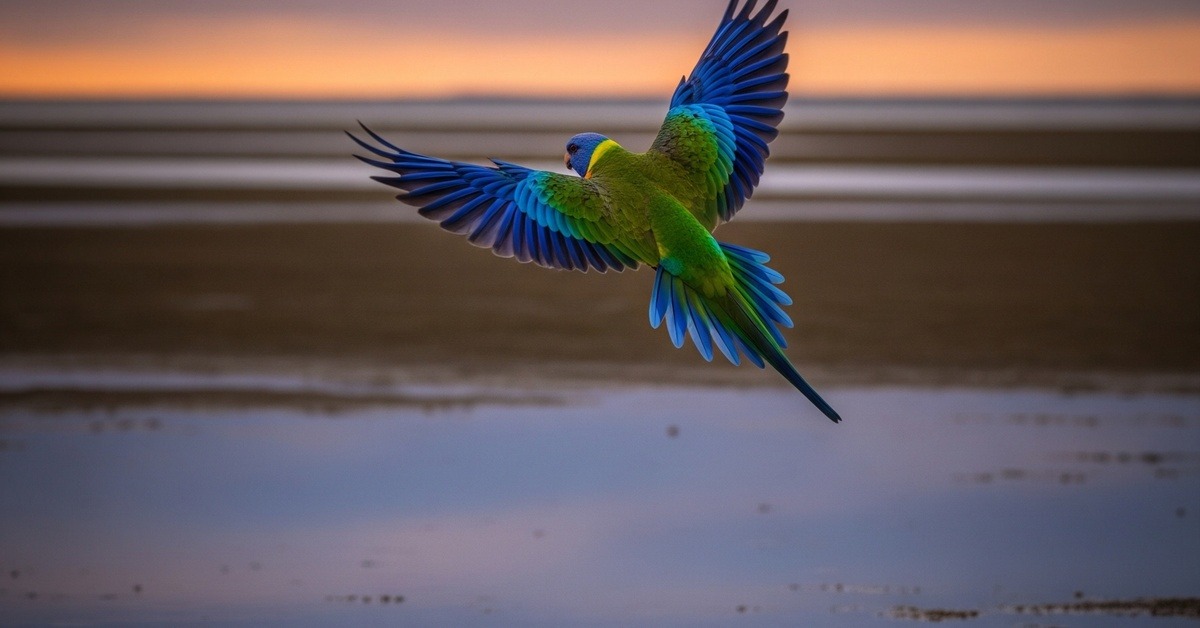
The birds themselves, stubbornly, keep crossing Bass Strait. Every spring, the tiny emerald flickers lift off from the Tasmanian coast and head north into the open sky. They don’t know about the population count. They don’t know about the habitat assessments or the funding gaps or the climate projections. They just fly. Whether there’s anything worth landing on when they arrive — that part is entirely up to us.
How It Unfolded
- 1891 — John Gould formally describes the orange-bellied parrot, with early naturalist records suggesting it was never abundant but ranged across a continuous arc of coastal southeastern Australia.
- 1983 — Healesville Sanctuary in Victoria launches the captive breeding program after population surveys indicate a steep and accelerating wild decline through the late 1970s and early 1980s.
- 2016 — Wild population monitoring at the Melaleuca breeding site records just 14 returning adults, the lowest count ever recorded, triggering emergency escalation of captive release programs.
- 2023 — Wild population estimates stabilise in the low-to-mid fifties, driven predominantly by captive releases; the Australian Government’s Recovery Team releases updated habitat protection guidelines for mainland overwintering sites.
By the Numbers
- Fewer than 50 wild individuals confirmed in most recent population surveys, placing the orange-bellied parrot among the five rarest parrots on Earth (BirdLife Australia, 2023).
- 200 km — the approximate width of Bass Strait that birds must cross twice each year, with no islands or resting points en route.
- 70% of historical mainland coastal saltmarsh habitat has been lost to development since European settlement (Victorian DELWP assessment).
- 300+ captive individuals held across eight zoo institutions — more than six times the wild population — as of 2023.
- 35% projected reduction in suitable Tasmanian breeding habitat under mid-range climate warming scenarios by 2070 (Charles Darwin University, 2022).
Field Notes
- GPS tracking data from Australian National University researchers revealed that individual birds crossing Bass Strait don’t travel in cohesive flocks — they make the 200km ocean crossing in groups as small as two or three, a finding that surprised ornithologists who had assumed the crossing provided safety in numbers (and this matters more than it sounds, because it suggests the birds are more isolated than we thought).
- Female orange-bellied parrots are just as vividly coloured as males in their green and blue plumage — only the orange-yellow belly patch is exclusive to males, making the species unusual among parrots where both sexes typically show clear plumage differences.
- The Melaleuca breeding site in southwest Tasmania is one of the most isolated wildlife monitoring stations in Australia — accessible only by light plane or a five-day wilderness walk — yet it has been staffed by volunteer bird monitors continuously during breeding seasons since 1981.
- Researchers still can’t explain why the species declined so sharply in the mid-twentieth century when much of its mainland habitat was still intact; some ornithologists suspect an undocumented disease event, but no historical specimen evidence has confirmed this, and the question remains genuinely open.
Frequently Asked Questions
Q: How many Orange-bellied Parrots are left, and what caused the extinction crisis?
Fewer than 50 wild individuals currently remain. The 2016 low of 14 birds represented the most acute point of the orange-bellied parrot extinction crisis. The decline has been driven primarily by the loss of around 70 percent of mainland coastal saltmarsh habitat to development, compounded by predation from introduced cats and foxes, and by the inherent mortality risks of an annual 200km open-ocean migration across Bass Strait.
Q: Why does the orange-bellied parrot only breed in Tasmania?
The species evolved to breed exclusively in the remote buttongrass plains and alpine heathlands of southwest Tasmania, a habitat type that provides the specific food plants — particularly the seeds of native sedges and saltmarshes — that the birds require during the breeding season. Tasmania’s southwest is one of the largest intact wilderness areas in the Southern Hemisphere, and the lack of introduced predators on key breeding sites historically gave the species a safe haven unavailable on the Australian mainland. No natural breeding outside Tasmania has ever been recorded because the birds’ fidelity to this specific habitat is absolute.
Q: Can captive breeding alone prevent the Orange-bellied Parrot’s extinction?
Captive breeding can’t save the species on its own, and conservation biologists are clear on this point. Here’s the thing: the common misconception is that keeping a captive population alive buys indefinite time. In reality, captive populations gradually lose fitness over generations without regular genetic input from wild birds, and captive-bred individuals consistently show lower post-release survival than wild-born ones. Captive breeding is a holding action, not a solution. The actual solution requires protected, connected mainland habitat and effective predator control — both of which remain significantly underfunded relative to the scale of the problem.
Editor’s Take — Alex Morgan
What stops me about this story isn’t the number fifty, shocking as it is. It’s the GPS data — a handful of birds making a 200km ocean crossing alone, in groups of two or three, navigating by stars and magnetic fields we can barely measure. We’ve built an entire civilisation on this continent and we still don’t fully understand how a 50-gram bird finds its way across open water in the dark. The least we could do is leave it somewhere to land.
The orange-bellied parrot doesn’t know it’s endangered. It doesn’t weigh its odds against Bass Strait. It just goes — every autumn, into the open sky, on the same trajectory its ancestors flew before cities existed on that coastline. What makes this story matter beyond one small bird is what it forces us to confront: that extinction isn’t usually a sudden catastrophe. It’s a thousand incremental decisions, none of them dramatic enough to feel decisive, each of them perfectly ordinary until suddenly the sky is just empty and the silence where the bird was has no end date. What are we willing to give up to make sure that silence doesn’t come?
Illustrations are AI-generated. Article fact-checked and human-edited. Our editorial standards.