The Luna Ring: A Solar Belt Around the Moon’s Equator
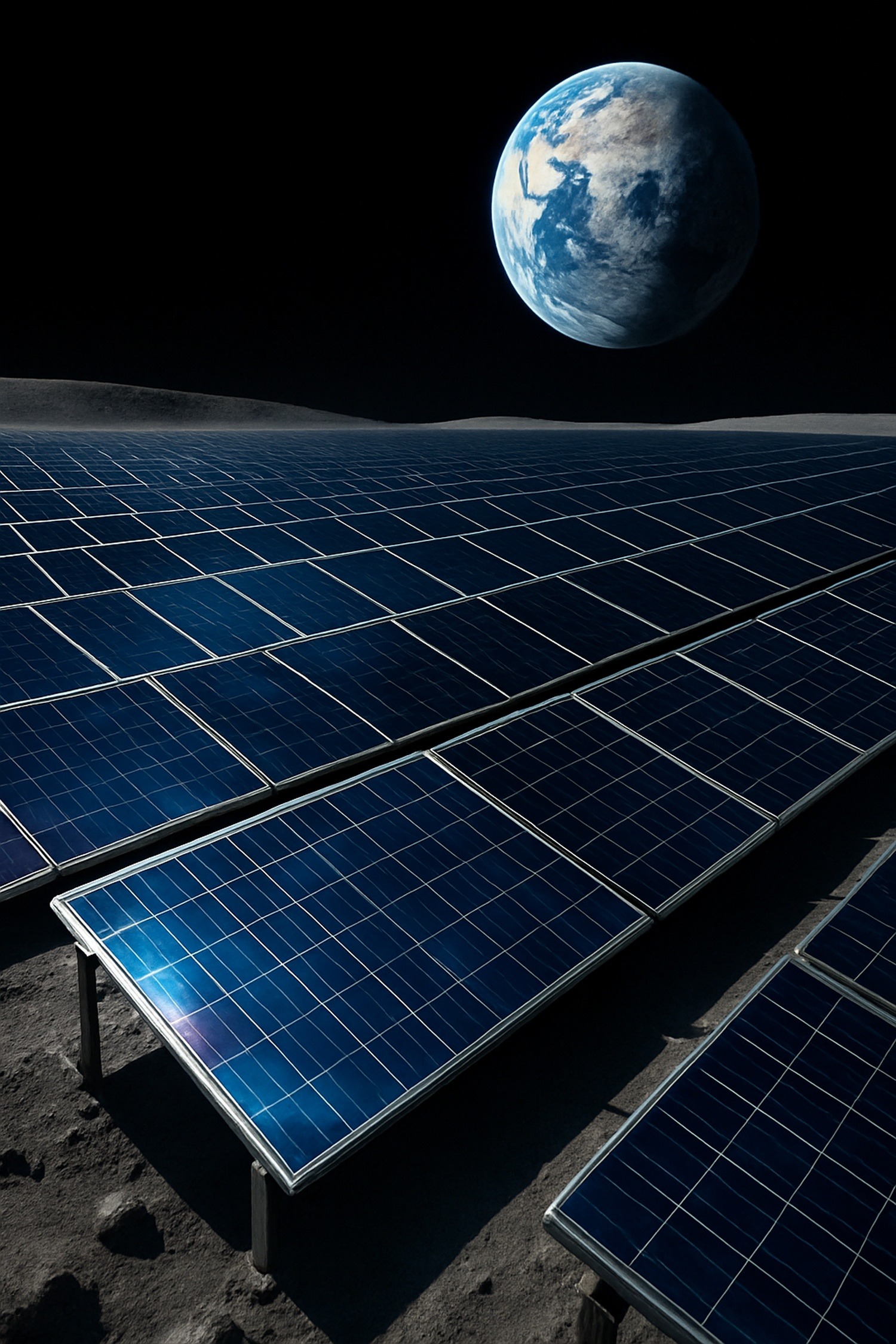
What if humanity’s solution to climate energy demand is already being designed — not on Earth, but 384,400 kilometers away on the Moon’s surface? Shimizu Corporation drew up those plans in 2013. The Luna Ring solar power Moon concept proposes an 11,000-kilometer band of photovoltaic panels circling the lunar equator, beaming clean energy back through space via microwave and laser transmission. The engineering blueprint exists. The question is whether we’ll ever move from paper to construction.
In 2013, Tokyo-based Shimizu Corporation released a formal concept document for the Luna Ring — a continuous solar collection belt wrapping the Moon’s entire equatorial circumference. The proposal called for microwave and laser transmission of collected power to ground-based receiving stations on Earth. More than a decade later, no shovel has touched lunar regolith. But the physics still checks out, the energy math still holds, and the planet’s hunger for clean power has only grown more desperate.
Why hasn’t this idea moved? That’s the question worth asking.
Key Facts
- Tokyo-based Shimizu Corporation published the Luna Ring concept in 2013, proposing an 11,000-kilometer solar belt around the Moon’s equator.
- The proposed belt would be 400 kilometers wide, with energy beamed to Earth via 5.8 GHz microwaves and infrared lasers across the 384,400-kilometer Earth-Moon distance.
- The Luna Ring was designed to meet roughly 18 terawatts of estimated current global energy consumption, per the International Energy Agency.
- In 1975, NASA’s William Brown demonstrated microwave power transmission at the Goldstone facility, achieving enough efficiency to power a small aircraft.
- In 2023, Caltech’s SSPD-1 satellite beamed solar energy wirelessly from orbit to an Earth-based receiver for the first time, validating a core Luna Ring assumption.
In short: Luna Ring solar power is Shimizu Corporation’s 2013 concept for an 11,000-kilometer belt of solar panels circling the Moon’s equator, beaming up to 18 terawatts back to Earth via microwave and laser. The physics holds, and Caltech’s 2023 orbital transmission test validated it, but robotic lunar construction remains decades away.
The Luna Ring: What Shimizu Actually Proposed
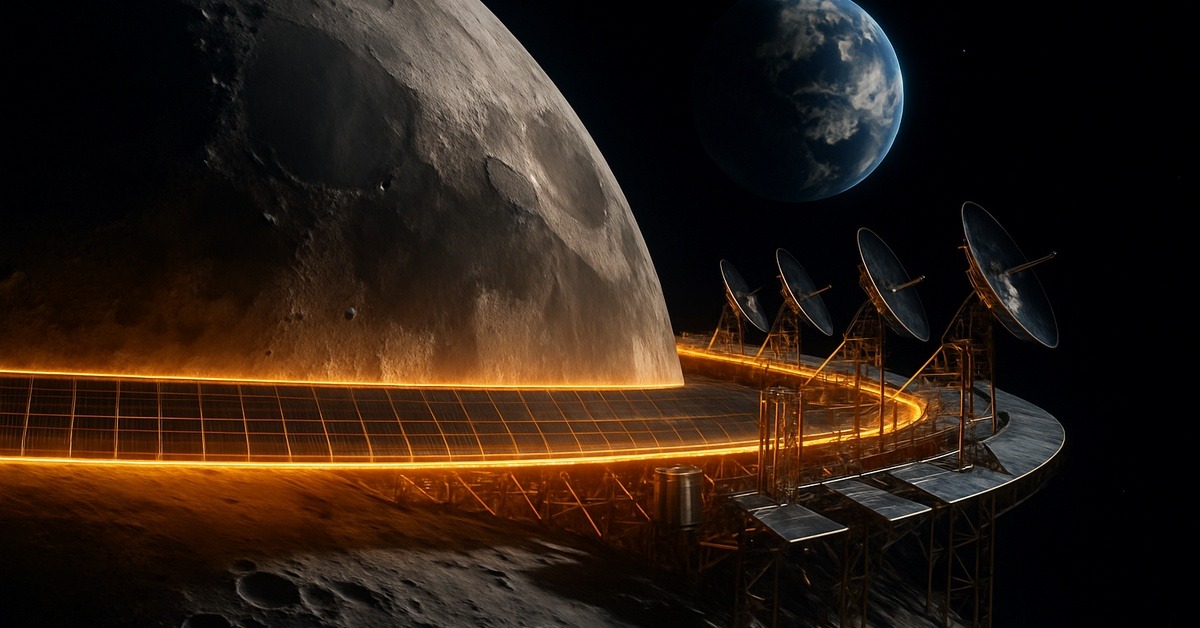
Shimizu Corporation, one of Japan’s largest and oldest construction conglomerates — founded in 1804 and still active across architecture, civil engineering, and now space infrastructure — published the Luna Ring concept in 2013 as part of its broader Smart Community environmental vision. The core design called for a continuous belt of photovoltaic solar cells and solar-thermal generators stretching 400 kilometers wide and 11,000 kilometers long, circling the Moon’s equator in an unbroken ring.
The lunar equatorial region was chosen deliberately: it receives near-constant solar illumination, free from Earth’s atmospheric interference, cloud cover, or seasonal tilt. Energy collection efficiency on the Moon’s surface can run dramatically higher than terrestrial solar installations — some estimates suggest two to three times the yield per square meter under comparable panel conditions. And here’s the thing: that efficiency advantage compounds across every single hour of operation, while Earth-based systems lose time to night, weather, and seasonal variation.
The energy wouldn’t stay on the Moon. That’s the part that sounds like fantasy — and the part that’s actually been demonstrated on smaller scales. Shimizu’s design converts collected solar energy into high-frequency microwaves and infrared laser beams, then transmits them across space to large receiving antennae and converter stations on Earth. Wireless power transmission via microwave has been tested since the 1970s.
NASA’s William Brown famously demonstrated microwave energy transfer in 1975 at the Goldstone facility in California, achieving transmission efficiencies high enough to power a small aircraft. The Luna Ring would simply be doing it at a scale that makes Brown’s experiment look like a candle next to a lighthouse.
Construction was always the audacious part. Shimizu proposed using lunar soil — regolith — as the primary raw material, processed on-site by robotic systems transported from Earth in phases. No single rocket launch. No preassembled panels shipped wholesale from Tokyo. The Moon would build itself, guided by machines.
It’s a beautiful idea. It’s also an idea that requires robotics, materials science, and in-situ resource utilization to advance considerably before the first panel goes in the ground.
Beaming Power Across Space: The Transmission Question
Wireless energy transmission over vast distances feels like the kind of concept that belongs in a Jules Verne novel, but the underlying physics is well-established. Energy transmission isn’t so different, conceptually, from the way humans have already converted motion into electricity on Earth. At London’s Victoria Station, for instance, engineers once installed kinetic tiles beneath commuter footfall — harvesting the mechanical energy of 80 million annual footsteps — demonstrating that unconventional energy collection and conversion at scale is a problem of engineering, not imagination. You can read more about that experiment in this piece on how footstep electricity works at Victoria Station.
The Luna Ring’s transmission challenge is orders of magnitude greater, but the philosophical leap is the same: capture energy where it’s abundant, convert it, move it where it’s needed. (Researchers actually call this the “power beaming problem,” which understates the elegance of what they’re trying to solve.)
Caltech’s 2023 SSPD-1 satellite experiment successfully beamed solar energy from orbit to Earth for the first time — a milestone that quietly validated one of the Luna Ring’s central assumptions. Ground-based rectenna arrays — rectifying antennae that convert microwave energy back into direct current — would need to cover substantial land area, but wouldn’t necessarily require exclusive use of that land. Early-stage research at institutions including the Japan Aerospace Exploration Agency (JAXA) and Caltech’s Space Solar Power Project has demonstrated transmission efficiencies improving year over year. The current favored transmission method in Shimizu’s Luna Ring design uses microwaves in the 5.8 GHz range, a frequency that passes through Earth’s atmosphere with minimal absorption.
Laser transmission offers a narrower, more targeted alternative. Infrared lasers can concentrate energy delivery to a smaller receiving footprint. The tradeoff is atmospheric interference — clouds and weather absorb laser energy in ways they don’t significantly affect microwaves. Shimizu’s proposal accounts for both methods, treating them as complementary rather than competing systems. Multiple transmission modes means redundancy. Redundancy means resilience.
In an energy system meant to power a civilization, resilience isn’t optional.
Why the Moon Outperforms Earth for Solar Collection
Earth is a frustrating place to harvest sunlight. The atmosphere scatters and absorbs roughly 30 percent of incoming solar radiation before it reaches a panel. Weather interrupts collection. Night interrupts it further. Seasonal axial tilt means that high-latitude installations spend months at reduced efficiency. Deserts near the equator come closest to ideal conditions, but even the Sahara has sandstorms, humidity gradients, and the inconvenient fact of nighttime.
The Moon has none of these problems. According to research compiled by the Smithsonian Magazine’s science coverage of space-based solar, the energy density available in space — and on the Moon’s surface — exceeds terrestrial collection potential by a factor that makes the comparison almost unfair. The Luna Ring solar power Moon concept exists precisely because of this gap.
Because the belt wraps the entire equatorial circumference, some portion of it is always facing the Sun regardless of the Moon’s rotation. The Moon’s equatorial region receives sunlight for approximately 14.75 Earth days continuously, followed by an equal period of darkness — a lunar day-night cycle that the Luna Ring’s geometry is specifically designed to circumvent. The system doesn’t sleep.
Earth’s energy consumption — currently estimated at around 18 terawatts annually by the International Energy Agency — could theoretically be met and exceeded by a fully operational Luna Ring, depending on transmission efficiency losses over the Earth-Moon distance of roughly 384,400 kilometers.
That number — 18 terawatts — deserves a moment of stillness.
It represents every factory, every data center, every electric vehicle charging overnight, every hospital, every city at full illumination. The Luna Ring, at full buildout, could hypothetically deliver that entire figure from a single source, with zero combustion, zero carbon, and no fuel chain to disrupt. Watching a global energy crisis potentially solved by a system that doesn’t yet exist on a world we’ve barely touched — you realize how thin the line is between the present and the transformed future we’re still deciding whether to build.
Luna Ring Solar Power Moon: The Engineering Obstacles
The concept is coherent. The obstacles are not small. Shimizu’s proposal envisions a phased robotic build-out using lunar regolith as a feedstock material — specifically, the silica and metals present in lunar soil that could theoretically be refined into solar panel components and structural materials. But the robotic systems required to mine, refine, and assemble at this scale don’t exist yet.
The European Space Agency’s PROSPECT program and NASA’s Artemis infrastructure both include early-stage in-situ resource utilization (ISRU) research. As of 2024, no human mission has extracted and processed lunar materials for functional hardware. The most immediate construction logistics challenge is measured in decades, not years.
Maintenance is the second major challenge — one that Shimizu’s concept documents acknowledge without fully resolving. A solar belt exposed to the lunar surface environment faces micrometeorite impacts, radiation degradation, and temperature swings between -173°C and 127°C across the lunar day-night cycle. Panel degradation on Earth — already a concern for terrestrial solar installations — would occur faster and more unpredictably on the Moon. Shimizu proposed robotic repair systems that themselves require development. Micrometeorite bombardment at operational scale has never been tested on the lunar surface, leaving lifespan projections for Luna Ring infrastructure genuinely uncertain. There’s a circularity to the problem: the Luna Ring needs robots to build it, robots to maintain it, and a supply chain robust enough to replace components faster than the lunar environment destroys them.
Political and regulatory frameworks don’t yet exist for a project of this nature. The 1967 Outer Space Treaty prohibits national appropriation of the Moon, which raises questions about corporate construction of permanent infrastructure on its surface. International coordination at a scale not seen since the International Space Station program would be required before a single panel could be installed. JAXA has indicated interest in space solar power as a long-term energy strategy. But interest and investment are different languages.
What Comes Next — and What’s Already Moving
The Luna Ring remains a proposal, but the field it inhabits has accelerated considerably since 2013. Space-based solar power — the broader category that includes both orbital collection platforms and lunar surface systems — has attracted serious governmental and private investment in the past five years.
What’s different now from 2013? The United Kingdom’s Space Energy Initiative published a detailed roadmap in 2021 calling for a 2039 demonstration mission. The European Space Agency launched SOLARIS, a formal feasibility study, in 2022. The Chinese National Space Administration has publicly discussed orbital solar power development on timelines stretching to 2050. None of these programs is the Luna Ring specifically — but all of them are validating the transmission technologies and construction frameworks that would underpin it.
The scaffolding of a lunar energy future is being assembled, piece by piece, in labs and policy documents that most people will never read.
Caltech’s Space Solar Power Project delivered its landmark result in 2023 when the SSPD-1 satellite successfully transmitted solar energy wirelessly from orbit to a ground receiver — the first time this had been demonstrated in space. The power delivered was modest. The principle was not. If wireless power transmission works from low Earth orbit, the physics scales. Distance introduces losses, but the Moon’s lack of atmospheric interference partly compensates for the additional range. The Luna Ring solar power Moon concept depends on exactly this chain of reasoning: demonstrate the components, prove the transmission, then ask how large the collection surface could realistically grow.
Hiroshi Matsumoto, a Japanese physicist whose foundational work on microwave power transmission at Kyoto University in the 1990s helped lay the theoretical groundwork for space-based solar proposals, once described the challenge as a question of will, not physics. The physics was solved. The will fluctuates with oil prices and political cycles. What’s different now is that climate pressure doesn’t fluctuate. It accumulates. And that changes the calculation.
How It Unfolded
- 1968: American aerospace engineer Peter Glaser first proposed the concept of space-based solar power collection and wireless transmission to Earth, establishing the theoretical framework all subsequent proposals draw from.
- 1975: NASA’s William Brown demonstrated functional microwave power transmission at the Goldstone Deep Space Communications Complex in California, achieving sufficient efficiency to power a small aircraft — the first physical proof-of-concept for wireless energy delivery.
- 2013: Shimizu Corporation publicly released the Luna Ring concept, proposing an 11,000-kilometer solar belt along the Moon’s equator using robotic construction from lunar regolith, with microwave and laser transmission to Earth.
- 2023: Caltech’s Space Solar Power Project successfully beamed solar energy from orbit to an Earth-based receiver for the first time, validating a core transmission assumption of the Luna Ring and similar space solar proposals.
By the Numbers
- 11,000 km — the proposed circumferential length of the Luna Ring along the Moon’s equatorial belt (Shimizu Corporation, 2013)
- 18 terawatts — estimated current global energy consumption, the approximate target the Luna Ring was designed to meet at full operational capacity (International Energy Agency, 2023)
- 384,400 km — average Earth-Moon distance across which microwave and laser transmission would need to travel
- 2–3× — estimated improvement in solar energy collection efficiency on the Moon’s surface compared to equivalent terrestrial installations, due to the absence of atmosphere and weather
- 1804 — the founding year of Shimizu Corporation, the Japanese firm behind the Luna Ring proposal, underscoring that the company’s ambitions have always scaled with the era’s biggest engineering challenges
Field Notes
- In 2023, Caltech’s SSPD-1 experiment transmitted power wirelessly from orbit using a device called MAPLE — Microwave Array for Power-transfer Low-orbit Experiment. The amount of energy delivered was small enough to power a few LEDs. The significance was enormous: it was the first orbital demonstration of directed microwave energy delivery to a ground target.
- The Moon’s equatorial regolith contains ilmenite, a titanium-iron oxide mineral that some researchers believe could be processed into conductive components for solar infrastructure — meaning the Luna Ring might partly build itself from Moon dirt rather than imported materials.
- The Luna Ring’s proposed width of 400 kilometers is wider than the entire country of Japan from its western coastline to its Pacific shore — a comparison that gives Shimizu’s home country a strangely personal stake in the scale of the vision.
- Researchers still can’t fully resolve the question of long-term panel degradation under continuous micrometeorite bombardment on the lunar surface. No long-duration solar hardware has ever been tested in the actual lunar environment at operational scale, leaving the lifespan projections of a Luna Ring installation genuinely uncertain.
Frequently Asked Questions
Q: What exactly is the Luna Ring solar power Moon concept?
The Luna Ring is a formal engineering proposal by Japan’s Shimizu Corporation, first published in 2013, for a continuous belt of solar panels and thermal generators spanning 11,000 kilometers along the Moon’s equator. The system would collect solar energy with no atmospheric interference and transmit it to Earth via microwave and laser beams aimed at ground-based receiving stations. It’s designed to theoretically meet the entirety of Earth’s current energy demand from a single extraterrestrial installation.
Q: How would the energy actually get from the Moon to Earth?
The transmission relies on two technologies: high-frequency microwave beams and infrared lasers. Microwaves in the 5.8 GHz range pass through Earth’s atmosphere with minimal loss, while lasers offer higher precision at a smaller receiving footprint. Ground stations equipped with rectifying antennae — or rectennas — convert the received microwave energy back into usable direct current electricity. This isn’t theoretical: microwave power transmission was successfully demonstrated by NASA as far back as 1975, and Caltech’s 2023 SSPD-1 satellite extended that proof-of-concept to orbit.
Q: Isn’t the Luna Ring just science fiction — has it ever been taken seriously?
The misconception is understandable, but the Luna Ring is a documented engineering proposal, not a narrative concept. Shimizu Corporation published detailed schematics, phased construction timelines, and robotic deployment strategies. Independently, JAXA, the European Space Agency, and the UK’s Space Energy Initiative have all launched formal feasibility studies into space-based solar power using similar transmission principles. The Luna Ring’s specific form may never be built exactly as drawn, but the engineering logic behind it is being validated incrementally by real satellite experiments and government-backed research programs.
Editor’s Take — Dr. James Carter
What strikes me about the Luna Ring isn’t the ambition — it’s the timing problem. This proposal arrived a decade before the transmission technologies needed to validate it. Now those technologies are catching up fast. Caltech’s 2023 experiment didn’t make headlines the way it should have. It should have. When you can beam power from space to a ground receiver for the first time in history, the distance between a laboratory result and a lunar energy belt starts to feel less like fantasy and more like a funding gap waiting to be closed.
The Luna Ring solar power Moon concept asks a question that outlasts any single government or corporation: what would humanity do with a limitless, clean energy source positioned just far enough away to require real courage to reach? The technology is assembling itself piece by piece — in Caltech labs, in ESA feasibility reports, in JAXA transmission experiments. What isn’t assembling at the same pace is the collective will to treat the Moon as infrastructure rather than symbol. Somewhere on the lunar equator, the sunlight falls on empty regolith and simply bounces back into space. It’s been doing that for four and a half billion years. How much longer do we leave it there?
Illustrations are AI-generated. Article fact-checked and human-edited. Our editorial standards.