Bronze Age Dagger Found in Poland Still Bears Blade Marks
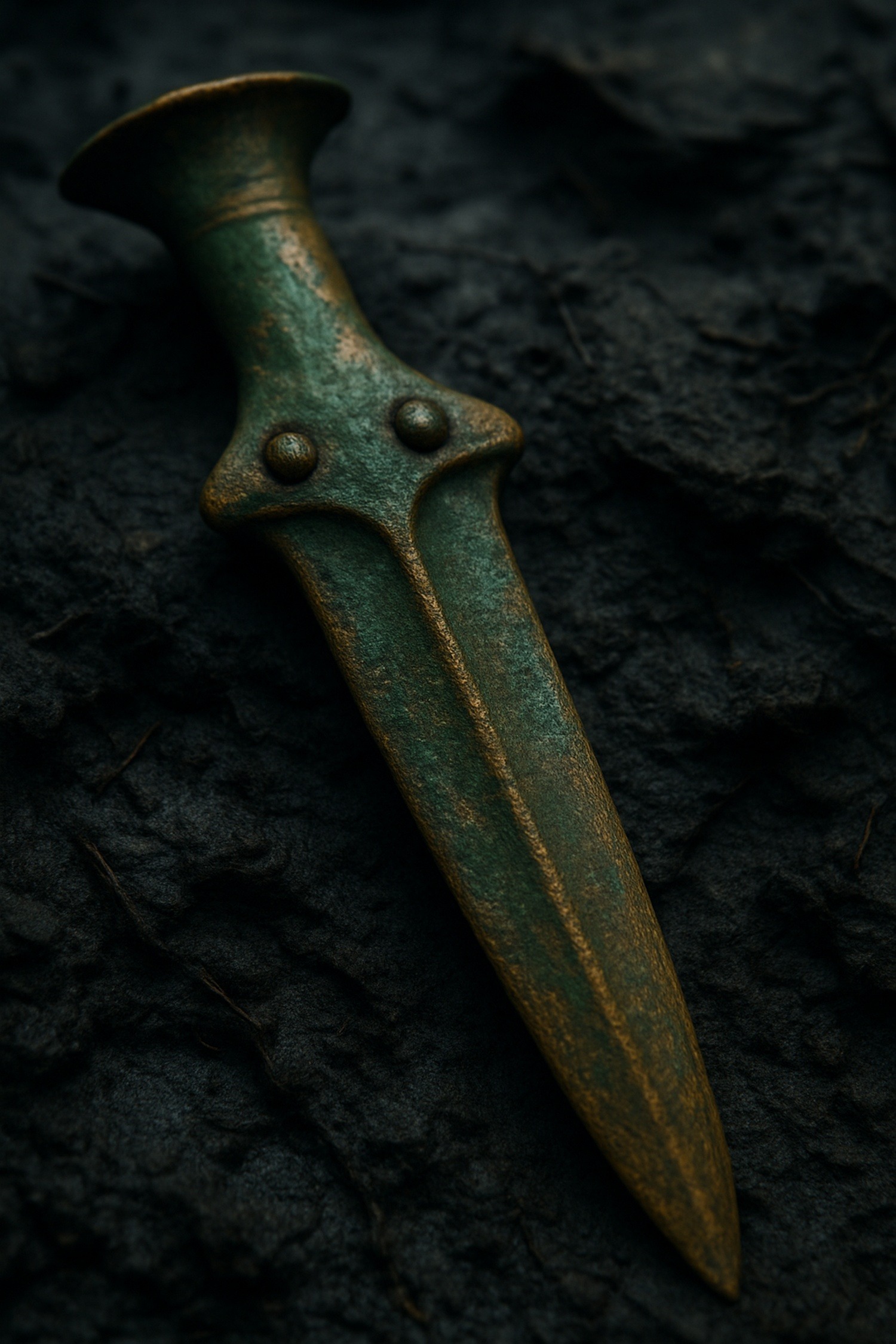
Someone held this Bronze Age dagger. They used it — cut something with it, wore it down with their own hands — and then, with deliberate care, they placed it in the ground and walked away. Nearly 3,000 years later, a cliff face in northern Poland crumbled into the Baltic, and the earth gave back what it had kept sealed in dense glacial clay since roughly 900 BCE. The weapon emerged intact. The secrets it carried did not.
The dagger surfaced from a crumbling stretch of coastline near Wolin, its hilt and blade still structurally present, its surface wrapped in the same dense clay that had sealed it from oxygen and moisture for three millennia. Archaeologists from the Polish Academy of Sciences moved quickly to document the find before the tides could finish what the cliffs had started.
What they found under magnification stopped the lab cold: microscopic blade marks. Repeated. Deliberate. This weapon had a working life before someone decided it was done.
Key Facts
- A Bronze Age dagger dating to roughly 900 BCE emerged from a crumbling cliff face near Wolin on Poland’s Baltic coast and was documented by archaeologists from the Polish Academy of Sciences.
- Coastal erosion confirmed by the Polish Academy of Sciences in 2023 retreats certain sections of the Pomeranian coast by 0.5 to 1.5 meters per year, with storm events removing far more in a single night.
- The dagger was preserved by dense glacial clay laid down during the last ice age, which cut off oxygen and groundwater and slowed corrosion of the bronze alloy.
- Microscopic wear analysis revealed a pattern consistent with repeated fine cutting rather than combat or butchery, suggesting the weapon had a working life before its burial.
- Researchers at the University of Warsaw’s Institute of Archaeology noted that the dagger was deliberately oriented when placed in the clay, with no damage consistent with being dropped, fitting Lusatian culture patterns of intentional deposition near water and cliffs.
In short: A Bronze Age dagger from around 900 BCE emerged from an eroding Baltic cliff near Wolin, Poland, preserved intact by dense glacial clay. Microscopic analysis of blade wear shows repeated fine cutting, and Polish Academy of Sciences and University of Warsaw researchers documented the deliberate orientation of its deposition.
The Cliffs Are Still Erasing Evidence — And Occasionally Releasing It
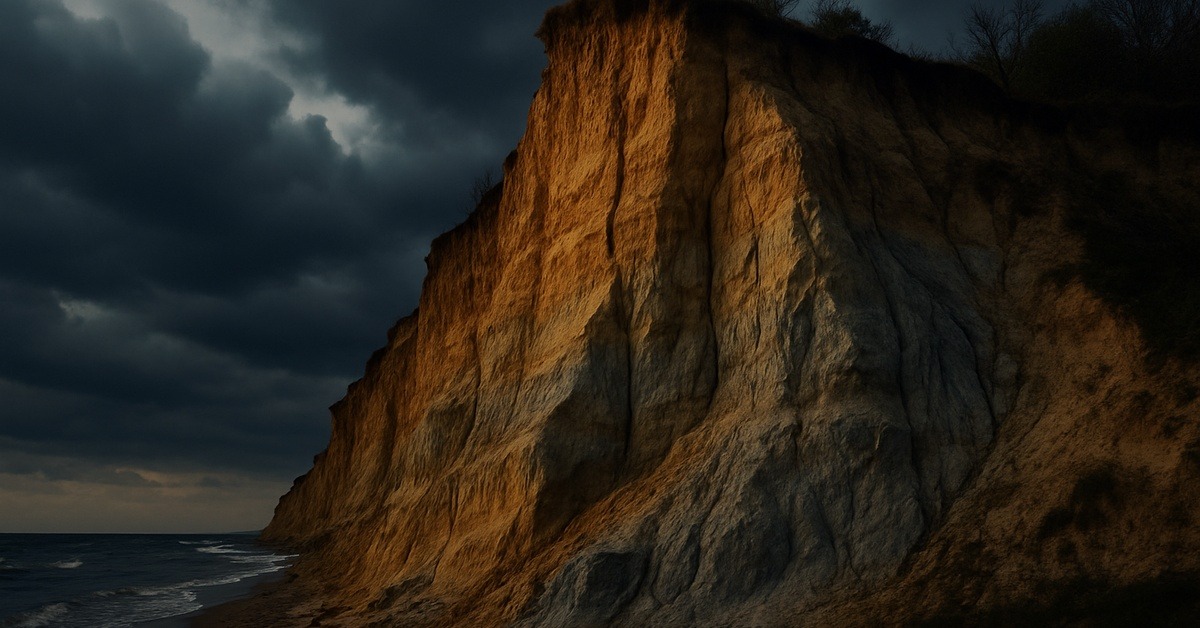
Poland’s Baltic coastline is not a gentle place. These cliffs — stretching across the Pomeranian coast near sites like Wolin and Kołobrzeg — erode at a rate that terrifies conservation teams and thrills archaeologists in equal measure. In 2023, researchers from the Polish Academy of Sciences confirmed that coastal erosion along this stretch had accelerated measurably over the preceding decade, partly driven by storm frequency and wave energy changes in the Baltic Sea. Certain sections now retreat by between 0.5 and 1.5 meters per year under current conditions, with storm events capable of removing far more in a single night.
What that erosion destroys in one sense, it occasionally releases in another.
The Bronze Age dagger that tumbled from the cliff face was cocooned in glacial clay — a deposit laid down during the last ice age — that had functioned, accidentally, as a near-perfect preservation medium. Cut off from free-flowing oxygen and groundwater, the bronze alloy corroded at a fraction of the rate it would have in open soil. What metallurgists received was not a relic eaten to abstraction. It was a weapon still carrying the geometry of its original form. That geometry matters enormously.
What the Metal Itself Reveals
Bronze Age smiths working along the southern Baltic around 900 BCE weren’t producing crude tools. They were operating inside sophisticated regional networks, sourcing tin and copper from separate, often distant deposits, and combining them with a precision that required both knowledge and infrastructure. The alloy composition of this particular dagger — still being analyzed as of the time of writing — could tell researchers exactly where those raw materials originated.
Lead isotope ratios in ancient bronze act like fingerprints. They point back to specific ore deposits, sometimes hundreds of kilometers from the deposition site. A dagger found in Poland might carry Bohemian copper, Scandinavian tin, or material traded up from the Adriatic corridor. But here’s something most people miss about Baltic Bronze Age metallurgy: it wasn’t provincial. By 900 BCE, southern Baltic communities were embedded in exchange networks that connected them to craftspeople and traders across a huge swath of Europe. (Researchers actually call this the “interconnected Late Bronze Age” — and the southern Baltic was dead center in it, not on the margins.) This wasn’t the edge of the ancient world. It was a crossroads.
The Blade Marks That Changed Everything
Objects recovered from Bronze Age deposits are frequently categorized as ceremonial — placed in the earth as votive offerings, status symbols, or ritual gifts to gods that left no written names behind. That categorization is sometimes accurate. But it has also become a default assumption, a way of handling objects whose function we don’t immediately recognize.
This dagger resisted that easy filing. The microscopic wear analysis showed something else entirely: a pattern consistent with repeated fine cutting rather than combat or butchery. Think controlled strokes, not hacking. The kind of wear you’d expect on a tool used for leatherwork, food preparation, or craft activity over months or years — not a weapon pulled once and then consecrated. Someone had worked with this thing.
Why does this combination matter? Because it collapses the distinction that archaeologists usually maintain — the line between the functional and the sacred. Polish researchers working on the find in collaboration with colleagues at the University of Warsaw’s Institute of Archaeology noted in their preliminary documentation that the deposition itself — the manner in which the dagger was placed in the clay — suggested deliberate intent rather than loss or abandonment. The blade was oriented in a specific direction. The hilt showed no damage consistent with being dropped or thrown. Someone put this object into the ground carefully. They may have placed it with the same hands that used it.
Bronze Age Poland sits within the Lusatian culture’s geographic range during this period, a cultural complex known for elaborate burial practices and significant metalwork. Deliberate weapon deposits near water, cliffs, and liminal landscape features appear repeatedly in the Lusatian archaeological record — suggesting that this dagger may be one data point in a much larger pattern of intentional deposition along the Baltic edge. And if that’s true, then the act of burying a used tool wasn’t marginal to Bronze Age life. It was central to it.
Continental Supply Chains in 900 BCE
To understand why a Bronze Age dagger found in coastal Poland carries implications far beyond a single artifact, you need to understand what bronze itself required. Copper and tin rarely occur together naturally in significant quantities. Making bronze demanded either that a society controlled both sources — uncommon — or that it traded for one or both components across considerable distances.
By the Late Bronze Age, around 1200 to 800 BCE, Europe had developed a continental-scale trading architecture that moved metals, amber, glass beads, and finished goods across thousands of kilometers. As Smithsonian Magazine has documented in its coverage of European Bronze Age archaeology, this period represents one of the most interconnected pre-industrial economies the continent would see until the Roman era. The southern Baltic was not peripheral to that system.
Polish amber — found in extraordinary concentrations along this coastline — was one of the most prized luxury materials in the ancient Mediterranean world. Baltic amber has been recovered from Egyptian New Kingdom tombs. It sat in Mycenaean palaces. In exchange for that amber, metal, finished goods, and ideas flowed north.
The Bronze Age dagger Poland’s coastline has now surrendered may have been made by a smith whose copper came from the Alps and whose tin arrived via Bohemian trade routes. The craftsperson who forged it may never have seen either deposit in their lifetime. What they did know was how to work the alloy — how to judge its temperature by color, how to hammer it to the right hardness without making it brittle, how to grind an edge that would hold. These were not simple skills. They were tradeable, teachable, and deeply valued. A smith with that knowledge held real social power in any Late Bronze Age community. The cliff didn’t just preserve metal. It preserved an entire economic moment — and the person who understood how to make it work.
What’s Still Hidden in the Cliffs
Poland’s Baltic coast is losing ground. Not metaphorically — literally. A 2021 assessment by the Institute of Meteorology and Water Management in Warsaw documented what climate and storm patterns have been doing to the Pomeranian bluffs. For heritage professionals, this is an emergency unfolding in slow motion. Every meter of cliff that falls into the sea potentially carries with it material that has survived undisturbed since the Bronze Age, the Iron Age, or the medieval period — material that, once it hits the surf, is chemically destroyed within months.
The window between a cliff collapse and the arrival of a trained archaeologist can be measured in tides rather than weeks. That’s not a system that works. Emergency survey programs have been mobilized in response. The National Heritage Board of Poland, working with regional universities and the Baltic Coastal Survey Initiative, has been using drone-mounted LiDAR and ground-penetrating radar to map subsurface anomalies in the most vulnerable cliff sections.
The goal isn’t full excavation — that’s not feasible at this scale. Triage is what matters: identify where the highest-density deposits are likely to be, so that when a section does give way, someone is positioned to recover what falls. It’s reactive archaeology operating at the edge of the possible.
But the dagger wasn’t found by a scheduled excavation. It was found because someone was walking the beach after a storm and recognized what they were looking at. Local knowledge, curiosity, and a willingness to report rather than pocket — that’s what saved this object. Watching a species of knowledge disappear at the speed these cliffs are eroding, you stop calling it slow.
How It Unfolded
- c. 900 BCE — A Late Bronze Age craftsperson deposits a used dagger in the Baltic coastal clay of what is now northern Poland, during the height of the Lusatian culture’s geographic reach.
- c. 1200–800 BCE — Europe’s Late Bronze Age trade networks reach maximum connectivity, linking Baltic amber routes to Mediterranean markets and enabling the alloy compositions now being analyzed in finds like this dagger.
- 2021 — The Institute of Meteorology and Water Management in Warsaw formally documents accelerating erosion rates along the Pomeranian coastline, flagging the archaeological emergency at the cliff face.
- 2023–2024 — The Bronze Age dagger is recovered from eroded cliff material along Poland’s Baltic coast; preliminary metallurgical and use-wear analysis begins at affiliated institutions including the University of Warsaw’s Institute of Archaeology.
By the Numbers
- ~900 BCE — estimated deposition date of the dagger, placing it in the Late Bronze Age Lusatian cultural horizon of northern Poland.
- 0.5 to 1.5 meters per year — average annual coastline retreat rate on vulnerable stretches of the Pomeranian Baltic coast (Institute of Meteorology and Water Management, Warsaw, 2021).
- 3,000+ kilometers — approximate distance Baltic amber traveled along documented Late Bronze Age trade routes to reach Mediterranean markets, including Egypt and Mycenae.
- 2–3 months — estimated maximum survival window for unprotected bronze artifacts once they enter the Baltic surf zone, due to salt water corrosion rates.
- 200+ — number of deliberate Late Bronze Age metalwork deposits currently documented within the Lusatian culture’s geographic range across central and northern Europe.
Field Notes
- The dagger’s blade marks fall into a pattern archaeologists describe as “fine repetitive cutting” — consistent with craft use rather than combat or animal processing. A 2019 use-wear study by researchers at Adam Mickiewicz University in Poznań identified similar micro-patterns on Bronze Age blades from western Poland, suggesting this type of tool saw mixed domestic and ceremonial use across the region before deposition.
- Baltic amber contains succinic acid in concentrations of up to 8%, a compound that actually slows bacterial degradation of organic material buried nearby — which may partly explain why wooden hilt components and organic residues sometimes survive in Baltic coastal deposits when they would not elsewhere.
- The Lusatian culture, active across what is now Poland, eastern Germany, and parts of the Czech Republic between roughly 1300 and 500 BCE, is one of the most extensively documented Bronze Age cultural complexes in central Europe — yet its belief systems and the specific logic of its votive deposits remain genuinely contested among specialists.
- Researchers still can’t determine with certainty whether this dagger was deposited as part of an active ritual, hidden for safekeeping during conflict, or placed as a grave good from a burial that the cliff subsequently destroyed. The orientation and condition narrow the possibilities but don’t close them. That ambiguity may never fully resolve.
Frequently Asked Questions
Q: How significant is a Bronze Age dagger found in Poland compared to similar discoveries across Europe?
The Bronze Age dagger found in Poland is significant not just for its preservation state but for the data it carries. Most Bronze Age metalwork recovered from eroding coastal sites arrives damaged beyond use-wear analysis. This dagger retained enough surface detail for microscopic study, making it unusually informative. The Polish Academy of Sciences has noted fewer than a dozen comparable coastal recoveries with intact use-wear evidence from the entire Baltic region in the past two decades.
Q: What do the blade marks actually tell researchers about how this dagger was used?
Use-wear analysis reads microscopic scratches, polish patterns, and edge rounding under high magnification. Different activities leave different signatures. Cutting soft materials like leather or plant fiber creates one pattern; cutting bone or hard materials creates another. The marks on this blade suggest repeated fine cutting over an extended period — not a single event. That pattern indicates regular use before deposition, meaning the dagger had a functional life before it became an object significant enough to bury deliberately. The two roles — tool and offering — weren’t mutually exclusive in Bronze Age culture.
Q: Does the discovery prove that Bronze Age communities in Poland were connected to Mediterranean trade networks?
It doesn’t prove it alone, but it fits a pattern that’s already well-documented. The assumption that Bronze Age Poland was culturally isolated from Mediterranean civilization has been overturned repeatedly by the archaeological record. Baltic amber found in Egyptian and Mycenaean contexts — chemically fingerprinted back to specific Baltic deposits — established that connection decades ago. What this dagger’s alloy analysis may add is a more precise picture of which specific trade corridors the metalworking materials traveled to reach this part of the Baltic coast by 900 BCE.
Editor’s Take — Sarah Blake
What gets me about this find isn’t the age or the preservation — it’s the use-wear. We’ve spent so long filing Bronze Age metalwork under “ceremonial” that we’ve half-convinced ourselves these people didn’t just live in their objects, work with them, wear them down. Someone used this dagger for something mundane. Cutting. Crafting. Then they buried it with care. That gap — between the workaday and the sacred — is the most human thing in this entire story. And the cliff held it for us for three thousand years.
Baltic coastlines are not patient archivists. They take and give back on their own schedule, indifferent to what’s been waiting inside the clay since the Bronze Age. Every storm that carves another meter from the Pomeranian bluffs potentially destroys something irreplaceable — or releases it. The Polish coast is estimated to hold hundreds of undocumented deposits from cultures that left no written records, only objects. What we know about Bronze Age life along this edge of Europe depends almost entirely on what the land decides to surrender next. How many more stories are still in there, waiting for the right tide?
Illustrations are AI-generated. Article fact-checked and human-edited.