Ancient Mysteries of Egypt: 8 Puzzles Modern Science Still Can’t Solve
The ancient mysteries of Egypt have a way of outliving every generation that tries to solve them. We have walked on the Moon, sequenced the human genome, and scanned the inside of a pyramid with cosmic rays — yet we still cannot say with certainty how a 13-acre limestone mountain was built in the desert, what killed a teenage king, or where one of the most powerful queens in history was buried. These are not the lazy “lost civilisation” puzzles of cable television. They are stubborn, evidence-driven gaps in the historical record, and modern archaeology is only now beginning to close some of them.
Key Facts
- The Great Pyramid of Giza, built around 2560 BC for the pharaoh Khufu, contains roughly 2.3 million limestone and granite blocks and stood 146.6 metres tall — a record height it held for nearly 3,800 years.
- In March 2023, the international ScanPyramids project used cosmic-ray muon detectors to confirm a previously unknown 9-metre-long corridor behind the pyramid’s north face, the first major internal discovery since the 19th century.
- Queen Nefertiti’s tomb and mummy have never been definitively identified, despite her being one of the most depicted royal women of the 14th century BC.
- A 2020 isotope study of baboon mummies from Egyptian temples pinpointed the legendary Land of Punt to the region around modern Eritrea and Djibouti, but no archaeological site has yet been confirmed there.
- Of Egypt’s 31 known dynasties spanning roughly 3,100 years, fewer than half the royal tombs from the New Kingdom (1550–1070 BC) have ever been located intact.
In short: Egypt’s enduring mysteries are not Hollywood riddles but real archaeological gaps — missing tombs, unexplained voids, contested dates, and disappearing rulers. New technologies are finally cracking some of them, while opening fresh ones we never thought to ask.
Key Facts
- The Great Pyramid of Giza, built around 2560 BC for the pharaoh Khufu, contains roughly 2.3 million blocks, stood 146.6 metres tall, and held the record height for nearly 3,800 years.
- In March 2023, the ScanPyramids project used cosmic-ray muon detectors to confirm a previously unknown 9-metre-long corridor behind the pyramid’s north face.
- Queen Nefertiti’s tomb and mummy have never been definitively identified, despite her being one of the most depicted royal women of the 14th century BC.
- A 2020 isotope study of baboon mummies pinpointed the legendary Land of Punt to the region around modern Eritrea and Djibouti, though no archaeological site has yet been confirmed there.
- In 2013, archaeologists at Wadi al-Jarf uncovered the diary of Merer, a mid-level inspector under Khufu, the first contemporary documentary evidence of pyramid logistics.
In short: Egypt’s enduring mysteries are not Hollywood riddles but real archaeological gaps such as missing tombs, unexplained internal voids, contested dates, and disappearing rulers. New technologies like cosmic-ray muon imaging and isotope analysis are finally cracking some of them while opening fresh questions. The honest framing is not lost knowledge but lost data, with most of Egypt’s past still buried.
Why Egypt Still Hides So Much After 200 Years of Digging
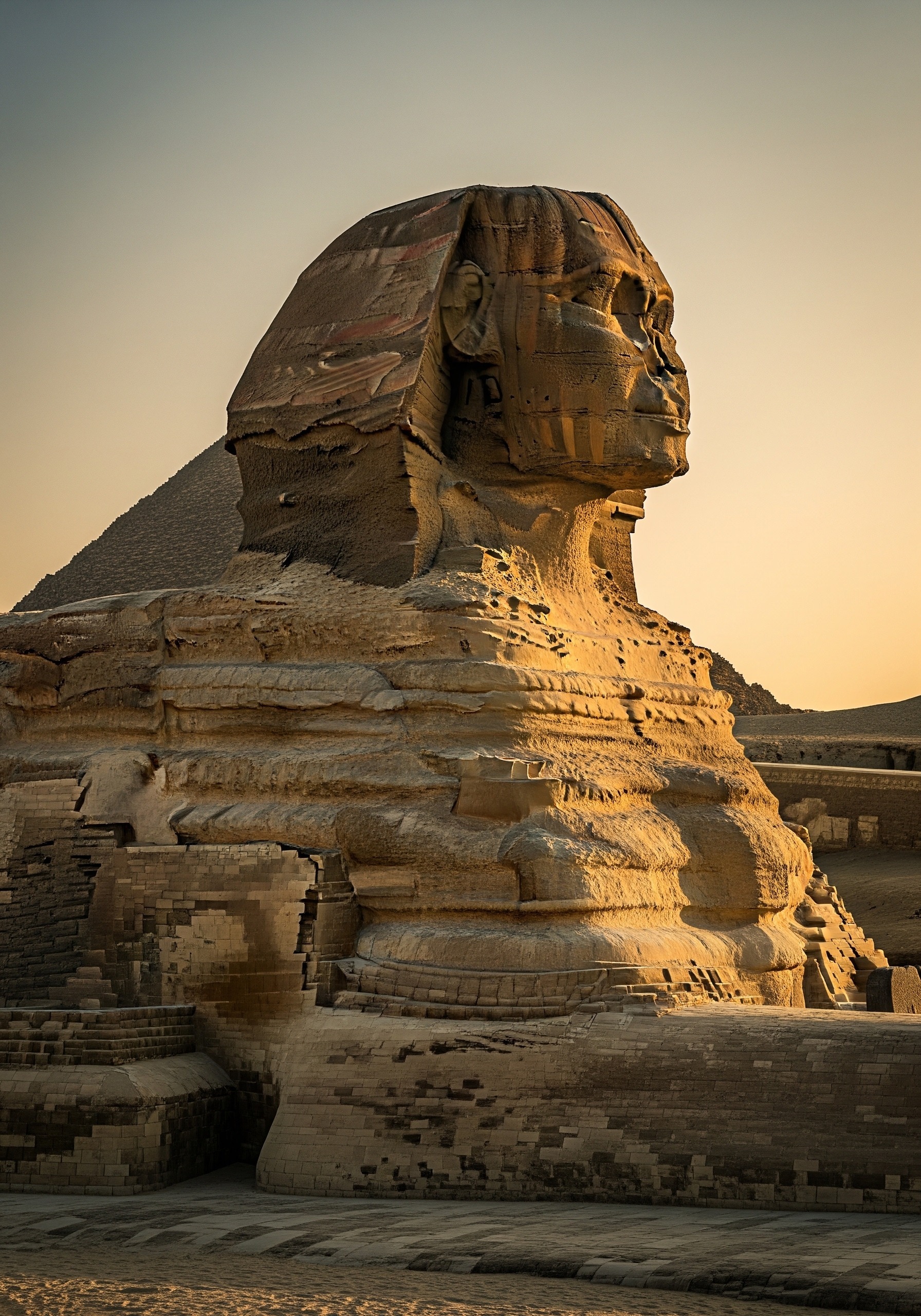
Egyptology as a scientific discipline began in 1822, when Jean-François Champollion decoded the Rosetta Stone. Two centuries later, the British Museum, the Louvre, the Egyptian Museum in Cairo, and the new Grand Egyptian Museum in Giza hold roughly 200,000 catalogued objects between them — and most archaeologists working in the field will tell you that figure represents perhaps a tenth of what is still buried.
The reasons are structural. The Nile delta is one of the most densely populated agricultural regions on Earth, so many ancient sites lie beneath modern villages and cannot be excavated. The Western Desert sands have swallowed entire cities; ground-penetrating radar surveys at Tanis, Avaris, and Hawara have repeatedly shown subsurface architecture far larger than what has been dug up. And the New Kingdom royal cemeteries, particularly the Valley of the Kings, were systematically looted in antiquity — meaning the evidence trail for many pharaohs is fragmented across museums, smugglers’ chains, and untouched ground.
That is the honest framing for the ancient mysteries of Egypt: not “lost knowledge” but lost data. The puzzles below are the ones where the data gap is widest, the stakes highest, and the recent science most surprising.
How the Great Pyramid Was Really Built
The single most popular question in Egyptology — how did a Bronze Age society quarry, transport, and stack 2.3 million blocks averaging 2.5 tonnes each, in roughly 20 to 27 years — does not have a single accepted answer. It has several converging ones.
The quarrying is the least mysterious part. The local Tura limestone for the casing and the Aswan granite for the King’s Chamber came from documented quarries, and copper saws, dolerite pounders, and wedge-and-lever techniques are well attested. The breakthrough came in 2013, when archaeologists working at Wadi al-Jarf on the Red Sea coast uncovered the diary of Merer, a mid-level inspector under Khufu. Written on papyrus in hieratic script, it records his crew moving Tura limestone by boat along a now-vanished Nile branch directly to the construction site — the first contemporary documentary evidence of pyramid logistics.
The internal architecture, by contrast, has just become stranger. The ScanPyramids project, a collaboration between Cairo University and France’s HIP Institute, has used cosmic-ray muon imaging — the same physics technique used to inspect nuclear reactors — to detect cavities through 100 metres of solid stone. In 2017 they announced a “Big Void” roughly 30 metres long above the Grand Gallery. In March 2023, peer-reviewed papers in Nature Communications confirmed a separate 9-metre corridor behind the north face, exactly where masonry irregularities had been noted in the 1980s. Neither space connects to any known passage. Egyptologists are still arguing whether they are structural relieving chambers, abandoned construction shafts, or something else entirely.
{IMAGE_2}
The Sphinx: An Age We Cannot Agree On
The mainstream archaeological consensus places the Great Sphinx in the reign of Khafre, around 2500 BC, based on its proximity to his pyramid complex and stylistic comparisons with his diorite portrait statues. But the Sphinx’s age is one of the few mysteries in ancient Egypt where a serious scientific dissent exists.
In the early 1990s, Boston University geologist Robert Schoch examined the vertical weathering channels in the limestone enclosure surrounding the statue’s body and argued they are diagnostic of prolonged rainfall — not the wind-blown sand that has dominated the Giza plateau for the last 5,000 years. The implication, Schoch wrote, was that the Sphinx’s core body must have been carved during the wetter African Humid Period, ending around 3000–5000 BC at the earliest. Egyptologists including Mark Lehner and Zahi Hawass rejected the conclusion, pointing to known Old Kingdom drainage patterns and the absence of any pre-dynastic occupation layer at the site.
Three decades on, the geological evidence has not been overturned, but neither has a single Old Kingdom artifact ever been found in the Sphinx temple enclosure. The standoff is a useful reminder that “consensus” in archaeology is not the same as “proven”, and that a single radiocarbon-datable hearth, if anyone ever digs deep enough to find one, could rewrite a textbook.
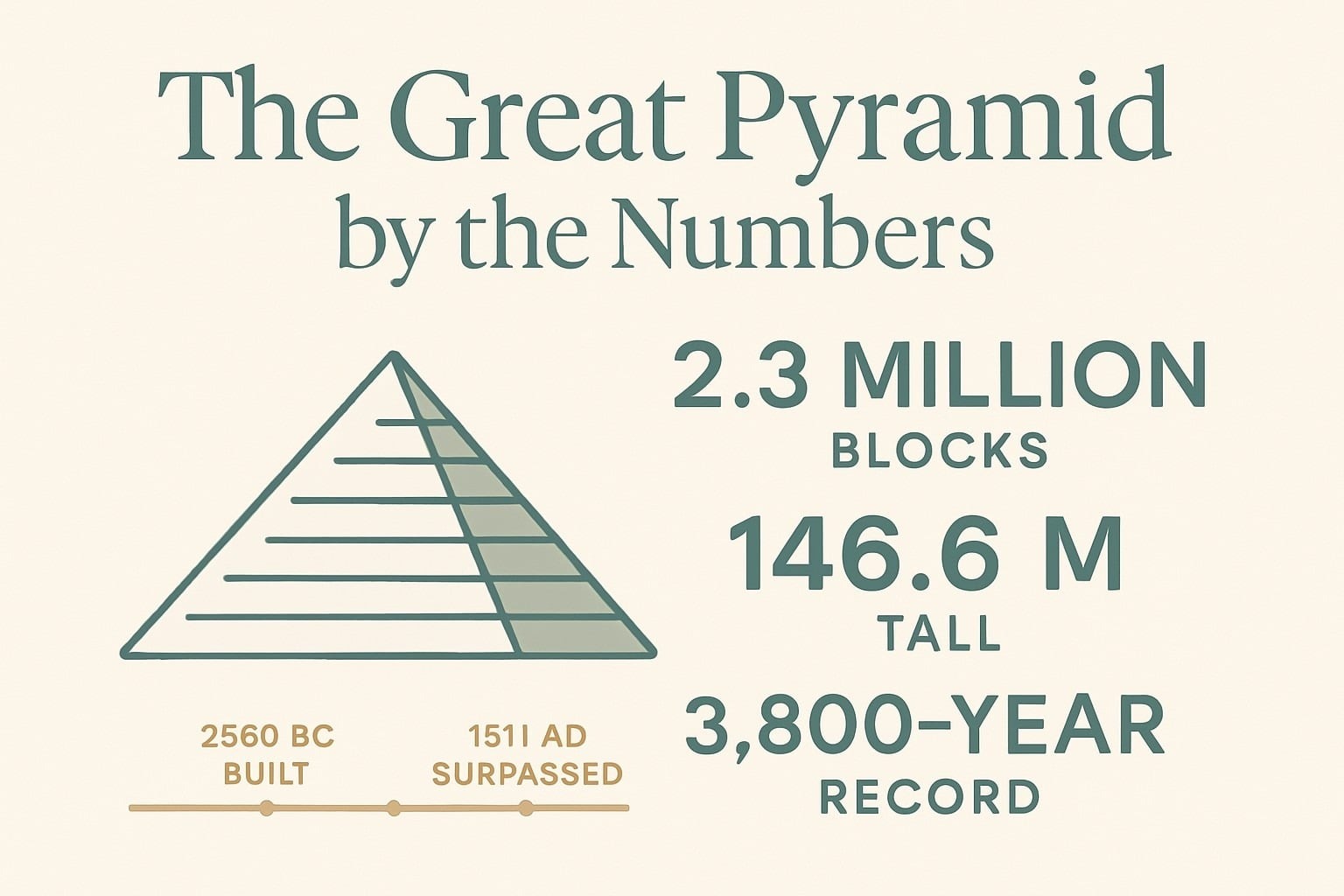
The Great Pyramid by the Numbers
- 2.3 million stone blocks, averaging 2.5 tonnes each (heaviest granite blocks in the King’s Chamber weigh up to 80 tonnes).
- 146.6 m original height; 138.8 m today after the loss of the polished Tura limestone casing.
- ~20–27 years total construction time, based on Khufu’s reign length and recent logistical modelling.
- 3,800 years as the tallest human-made structure on Earth — surpassed only by Lincoln Cathedral in AD 1311.
- 30 m and 9 m — the lengths of two newly confirmed internal voids found by cosmic-ray muography in 2017 and 2023.
The Vanishing of Queen Nefertiti
Nefertiti — wife of the heretic pharaoh Akhenaten, possibly co-regent in her own right, and the face of arguably the most famous painted limestone bust in the world — disappears from the historical record around 1336 BC. There is no recorded burial, no confirmed mummy, no funerary equipment bearing her cartouche. For one of ancient Egypt’s most documented royal women, the silence is bizarre.
The leading hypothesis, advanced by Egyptologist Aidan Dodson and others, is that Nefertiti briefly ruled as the obscure pharaoh Neferneferuaten or even as Smenkhkare, bridging her husband’s reign and Tutankhamun’s. In 2015, British archaeologist Nicholas Reeves caused an international stir by arguing that thermal anomalies behind the north wall of Tutankhamun’s tomb (KV62) might indicate a hidden chamber containing Nefertiti’s burial. Three rounds of ground-penetrating radar between 2015 and 2018 produced conflicting results; the final, most rigorous scan published in 2018 found no evidence of voids. The mystery has cooled, but it has not closed.
A separate, quieter line of evidence concerns the so-called “Younger Lady” mummy (KV35YL), found in 1898 and re-examined by Zahi Hawass’s DNA team in 2010. Her genetics match a sister-wife of Akhenaten and the biological mother of Tutankhamun. Some scholars argue she is Nefertiti; others insist Nefertiti was not Tutankhamun’s mother. The bones are real; the name is still missing.
The Lost Labyrinth of Hawara
Of all the egypt unsolved mysteries, the Labyrinth of Hawara is the one most likely to be solved in our lifetime — if anyone is allowed to dig. The Greek historian Herodotus visited it around 450 BC and called it more astonishing than the pyramids: 3,000 rooms on two levels, half underground, with twelve roofed courts, all built of single blocks of stone. Strabo and Pliny the Elder repeated and embellished the description.
The labyrinth was the mortuary temple of Pharaoh Amenemhat III (reigned c. 1860–1814 BC), attached to his ruined pyramid at Hawara in the Fayum. In 2008, a Belgian–Egyptian expedition using electrical resistivity tomography mapped a stone structure roughly 304 by 244 metres beneath the surface sand south of the pyramid — broadly consistent with the ancient descriptions. The Egyptian Supreme Council of Antiquities subsequently restricted further publication, citing site security; no full excavation has followed. The largest mortuary complex ever described in the ancient world is, as of this writing, sitting under perhaps two metres of sand awaiting funding and political will.
What Really Killed Tutankhamun
Tutankhamun died around 1323 BC, aged roughly 18 or 19. His mummy is one of the most studied human remains in history, and yet the cause of death is still contested. The 1968 X-ray survey suggested a blow to the head; the 2005 CT scan ruled that out but identified a poorly healed left femur fracture, possibly from a fall. The 2010 DNA study found malaria parasites in his blood and evidence of Köhler disease in his foot. A 2014 “virtual autopsy” floated a chariot accident as the primary trauma.
The honest synthesis is that Tutankhamun was a sickly young man, inbred (his parents were full siblings), walking with a cane, suffering from malaria, with a recent leg injury — and any one of these, or several in combination, could have killed him. The mystery is not “what killed him” so much as “which of several plausible things killed him first”. It is a humbling lesson in the limits of forensic certainty across 3,300 years.
The Land of Punt and Other Vanished Places
For more than a thousand years, Egyptian pharaohs sent expeditions to a kingdom called Punt, returning with gold, ebony, leopard skins, incense, and live baboons. Queen Hatshepsut’s reliefs at Deir el-Bahari, around 1470 BC, depict Punt’s people, houses on stilts, and giraffes in extraordinary detail. And yet no archaeologist has ever stood in Punt and known they were there.
The most recent breakthrough came in 2020, when a team led by Nathaniel Dominy at Dartmouth analysed the strontium and oxygen isotope ratios in two mummified baboons from Egyptian temple offerings. The signatures matched the highlands of modern Eritrea and northern Ethiopia, narrowing centuries of speculation to a roughly 800-kilometre arc on the Horn of Africa. It is the first hard scientific localisation of Punt. The next step — actually finding a Puntite settlement, with their own ceramics and inscriptions — remains for future archaeologists.
Punt is not alone. The tomb of Imhotep, the architect of the Step Pyramid and one of only a handful of non-royal Egyptians ever deified, has never been found at Saqqara. The tomb of Cleopatra VII and Mark Antony, mentioned by Plutarch as a shared royal burial near a temple of Isis, has never been located — though excavations at Taposiris Magna west of Alexandria, led by Kathleen Martinez since 2005, continue to turn up suggestive evidence.
The Secrets of Ancient Egypt Worth Watching Next
Three quietly important things are happening in the field right now. First, the Grand Egyptian Museum, which fully opened in 2024, has consolidated more than 100,000 artifacts under one roof for the first time, allowing comparative study at a scale previously impossible. Second, ScanPyramids is extending its muon-imaging programme to the Pyramid of Khafre and the Bent Pyramid at Dahshur; results are expected before 2030. Third, ongoing excavations at Saqqara since 2018 have uncovered hundreds of sealed Late Period coffins, a workshop for mummification with named priests on its labels, and a 3,400-year-old “lost golden city” near Luxor announced by Hawass in 2021.
None of these will “solve” Egypt the way a detective novel resolves. They will, instead, slowly fill in the data gaps that make the secrets of ancient Egypt feel like secrets. As the Egyptologist Salima Ikram has put it, “Egypt does not give up its dead easily — but it gives them up.” For an authoritative overview of current excavations, the British Museum’s Egypt galleries, the Metropolitan Museum’s Department of Egyptian Art, and the open-access 2023 Nature Communications paper on the newly confirmed Khufu corridor are the best starting points.
Frequently Asked Questions
Q: What is the biggest unsolved mystery of ancient Egypt?
A: There is no single biggest mystery, but the two that matter most academically are the internal architecture of the Great Pyramid (still being mapped by cosmic-ray muography) and the location of Nefertiti’s burial. Both are within reach of current technology and may be resolved within a generation.
Q: Have any ancient Egyptian mysteries been solved recently?
A: Yes. The 2013 discovery of the diary of Merer at Wadi al-Jarf clarified pyramid logistics; the 2020 isotope study of mummified baboons localised the Land of Punt to the Horn of Africa; and the 2023 confirmation of a 9-metre internal corridor at the Great Pyramid was the first major internal pyramid discovery in over a century.
Q: Why was Nefertiti’s tomb never found?
A: The most likely explanations are that she was reburied under a different name during the religious counter-reform after Akhenaten’s death, that her tomb lies in an unexcavated area of Amarna or the Valley of the Kings, or that her remains are already in a museum collection under a different label — most controversially, as the “Younger Lady” mummy from tomb KV35.
Q: Did aliens build the pyramids?
A: No. The construction techniques are well attested in contemporary papyri (the Merer diary), tool marks on the blocks, abandoned ramps, workers’ graffiti, and the workers’ village at Giza with its bakeries and infirmary. The mystery is not who built the pyramids — it is the precise sequence and engineering tricks that achieved such accuracy, and that is a question for civil engineering, not extraterrestrials.
Egypt’s puzzles endure not because the ancients were inscrutable, but because we have only ever asked a fraction of the right questions of the evidence we already have. Each new technique — muon imaging, isotope geochemistry, ancient DNA, satellite radar — opens a fresh window onto a civilisation that still has more to say. The next decade will almost certainly add chapters to this list, and quietly remove a few. That, more than any single revelation, is the real reward of paying attention.
Illustrations are AI-generated. Article fact-checked and human-edited. Our editorial standards.