Ancient Egyptian Technology That Was Centuries Ahead
The story of ancient Egyptian technology is the story of a civilization that, again and again, solved problems a thousand years before anyone else thought to ask the question. Standing at the foot of the Great Pyramid, it is easy to be dazzled by sheer scale and miss the deeper point: the people who built it were operating, in many domains, with mechanical, medical, and mathematical know-how that the rest of the world would not catch up to until the Greeks, the Romans, or in some cases the Renaissance.
Key Facts
- The Great Pyramid of Giza was built around 2560 BC from roughly 2.3 million limestone blocks weighing 2.5 to 15 tons each, and remained the tallest human-made structure on Earth for about 3,800 years.
- The Edwin Smith Papyrus, a surgical handbook describing 48 trauma cases in clinical, magic-free language, dates in copy form to around 1600 BC and is believed to preserve material from as early as 3000 BC.
- Egyptian papyrus, manufactured industrially from around 3000 BC, remained the world’s dominant writing medium for roughly 3,500 years — longer than paper has existed in Europe.
- Egyptian shipwrights were sailing against the wind on the Nile by about 2400 BC; a working stern-mounted steering oar gave them maneuverability European fleets only matched in the late Middle Ages.
- The Egyptian civil calendar of 365 days, divided into 12 months of 30 days plus 5 epagomenal days, is the direct ancestor of the Julian and modern Gregorian calendars used worldwide today.
In short: Ancient Egyptian technology was not a scatter of clever tricks; it was a coherent, industrial-scale system for managing a river, building in stone, recording knowledge, and treating the human body. Many of its inventions — from paper to surgery, from the 365-day year to the keel-and-sail ship — were not merely “first.” They were better than anything that followed for centuries.
Key Facts
- The Great Pyramid of Giza was built around 2560 BC from roughly 2.3 million limestone blocks weighing 2.5 to 15 tons each, and remained the tallest human-made structure for about 3,800 years.
- The Edwin Smith Papyrus, a surgical handbook describing 48 trauma cases in clinical, magic-free language, dates in copy form to around 1600 BC and preserves material from as early as 3000 BC.
- Egyptian papyrus, manufactured industrially from around 3000 BC, remained the dominant writing medium of the Mediterranean world until parchment overtook it around 400 AD.
- Egyptian shipwrights were sailing against the wind on the Nile by about 2400 BC, using a stern-mounted steering oar European fleets only matched in the late Middle Ages.
- The Step Pyramid of Djoser was designed around 2650 BC by the vizier Imhotep, who stacked six stone mastabas to invent monumental cut-stone architecture.
In short: Ancient Egyptian technology was a coherent, industrial-scale system for managing a river, building in stone, recording knowledge, and treating the human body. Many of its inventions, from papyrus and surgery to the 365-day calendar and the keel-and-sail ship, were not merely first but better than anything that followed for centuries. The reliable flooding of the Nile gave Egyptian engineers and scribes the rare luxury of time to specialize.
Ancient Egyptian Technology and Inventions: Why So Far Ahead?
To appreciate ancient Egyptian technology, you have to picture the world around it. In 3000 BC, most of humanity still lived in mud-brick villages with stone tools. In the Nile Valley, by contrast, a centralized state was already running royal granaries, taxing harvests with standardized measures, sailing cedarwood ships to Lebanon, and writing the world’s first administrative diaries on a manufactured paper called papyrus.
The reason was not magic. It was the river. The Nile flooded with such reliable, predictable regularity that Egyptian society could plan years ahead — and that gave its engineers, surveyors and scribes something rare in the ancient world: time to specialize. A scribe could spend a lifetime mastering hieroglyphs. A priest-astronomer could spend decades watching the heliacal rising of Sirius. A “kher-heb” temple architect could refine the geometry of stone vaults across generations. That long focus is what produced the leap.
Building in Stone: The Engineering of the Impossible
The most visible monument to ancient Egyptian engineering is the Giza plateau, but the real breakthrough came earlier and quieter: the Step Pyramid of Djoser, designed around 2650 BC by the vizier Imhotep. Before Imhotep, royal tombs were low rectangular mudbrick mounds. He stacked six progressively smaller stone mastabas on top of one another and, in a single project, invented the technology of monumental cut-stone architecture.
That technology then iterated in public. Pharaoh Sneferu’s engineers tried — and famously failed — at Meidum, where the outer casing slumped away in antiquity, and at Dahshur, where the “Bent Pyramid” abruptly changes angle halfway up because the architects realized in mid-build that 54° was unstable. Sneferu’s third attempt, the Red Pyramid, finally worked at 43°. His son Khufu then scaled the same recipe to a 146.5-meter colossus we now call the Great Pyramid of Giza. The lesson is profound: Egyptian engineering had a feedback loop. They learned from failure, and they wrote it in stone.
The toolkit was deceptively simple — copper chisels, dolerite pounders, wooden sleds, lever arms, and ramps — but the execution was extraordinary. The Great Pyramid’s base is level to within about 2.1 cm across 230 meters, and its sides are aligned to true north with an error of just a few minutes of arc. That is laser-grade accuracy, achieved with star-sighting tools called merkhets and the patient mathematics of right triangles centuries before Pythagoras wrote his name on the theorem.
{IMAGE_2}
Papyrus, Ink, and the World’s First Information Revolution
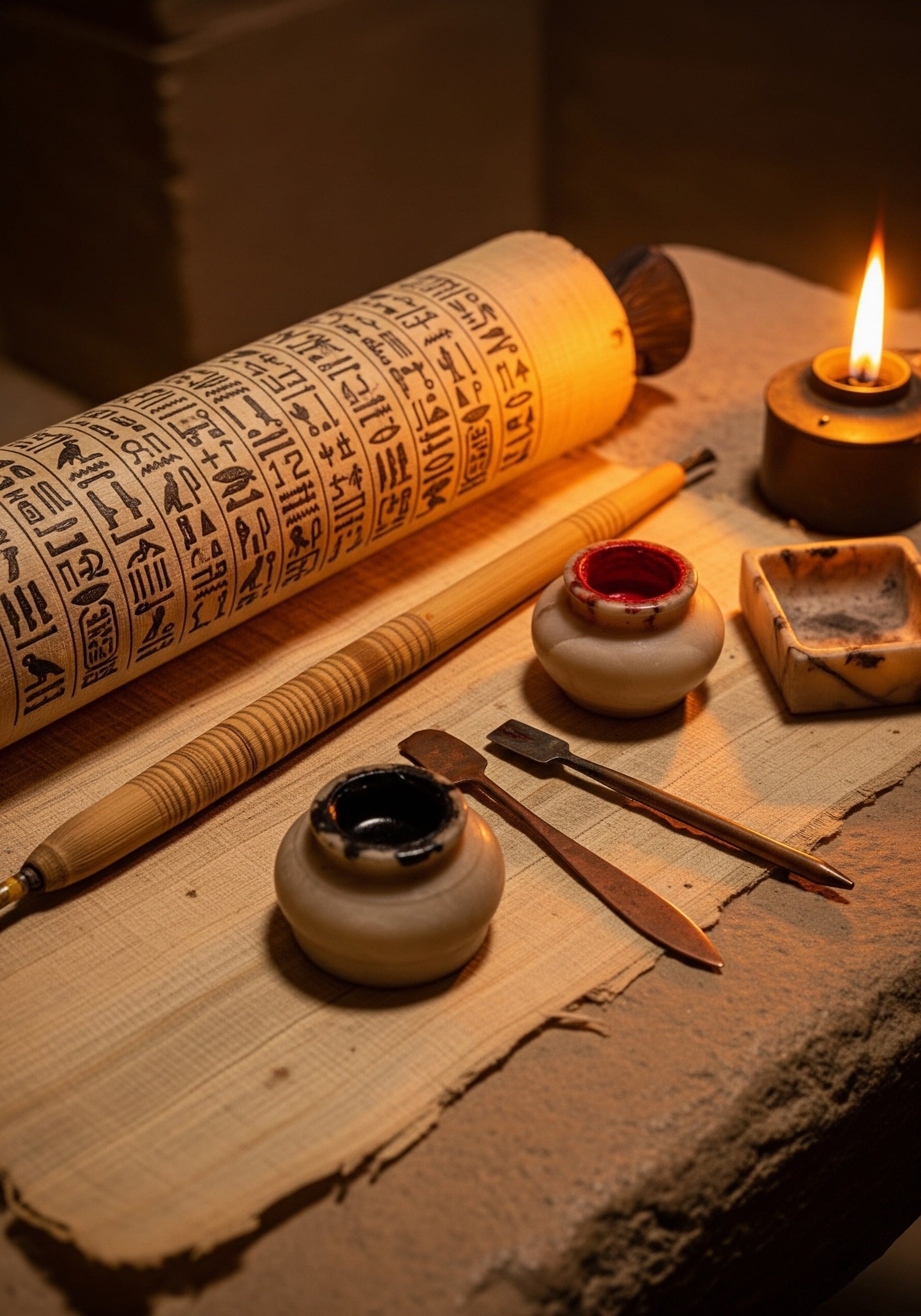
Long before the printing press, ancient Egypt staged its own information revolution. Around 3000 BC, Egyptian artisans worked out how to slice the pith of Cyperus papyrus into thin strips, lay them in two perpendicular layers, soak and press them, and burnish the dried sheet smooth with a stone or shell. The result was the world’s first mass-produced writing surface — lighter than clay tablets, cheaper than parchment, and capable of being rolled into scrolls many meters long.
It is almost impossible to overstate what this enabled. The world’s oldest surviving administrative document, the Diary of Merer, is a logbook on papyrus from the reign of Khufu (c. 2560 BC) detailing the daily work of a crew of 200 men hauling Tura limestone to Giza for the Great Pyramid. From medical handbooks and tax registers to love poems and dream interpretations, Egyptian scribes used carbon-and-gum ink — a recipe so chemically stable that 4,000-year-old texts are still legible.
Papyrus remained the dominant writing medium of the Mediterranean world from roughly 3000 BC until parchment overtook it around 400 AD — a working lifespan of about 3,400 years. For context, paper as we know it has been used in Europe for only about 900.
Medicine That Anticipated Modern Science by 3,000 Years
The clearest evidence that ancient technology of Egypt was not merely empirical but properly scientific lies in two extraordinary medical scrolls. The Edwin Smith Papyrus, copied around 1600 BC from an original that may date to roughly 3000 BC, is the oldest surviving surgical treatise on Earth. It walks through 48 trauma cases — from depressed skull fractures to dislocated jaws to spinal injuries — in a strict format of examination, diagnosis, prognosis, and treatment. It distinguishes “an ailment which I will treat” from “an ailment with which I will contend” and “an ailment not to be treated.” That triage logic is the spine of modern emergency medicine.
The roughly contemporaneous Ebers Papyrus (c. 1550 BC) runs to about 110 pages and catalogues hundreds of remedies — including the first known description of a heart-circulation system and what some scholars argue is the first written reference to cancer. Egyptian surgeons used bronze scalpels, forceps, dental drills and probes; the dentist Hesyre, “Chief of Toothers,” held formal title under King Djoser around 2660 BC, making him the first named dentist in history. They even fitted a wooden-and-leather prosthetic big toe on a noblewoman around 1000 BC — a functional device, worn in life, that biomechanics labs have since shown actually worked.
Mastering Time: The Calendar, the Clock, and the Sky
Watching the river forced Egypt to watch the sky. By roughly 2700 BC, Egyptian astronomer-priests had noticed that the heliacal rising of the star Sirius — its first dawn appearance after weeks below the horizon — coincided almost exactly with the start of the annual Nile flood. They built a calendar on it: 12 months of 30 days plus 5 added “epagomenal” days, for a total of 365. That structure passed to the Romans (via Julius Caesar’s Egyptian astronomer Sosigenes) and forms the backbone of the calendar on every phone screen today.
They were equally inventive about the day. Egyptian shadow clocks — T-shaped sundials oriented east at sunrise and flipped west at noon — divided daylight into ten hours plus two twilight hours. For the night, they built water clocks. The oldest surviving example, from the tomb of the courtier Amenemhet under Amenhotep III (c. 1417–1379 BC), is a finely tapered alabaster bowl with a small bottom hole: water drips out at a measurable rate, and graduated scales on the inside let priests read off the hour even in pitch darkness. That single object is the technological ancestor of every clock that followed for the next 2,700 years.
Egyptian Inventions That Tamed the Nile
The genius of ancient Egypt innovation in agriculture was that it scaled. Individual farmers used the shaduf — a counterweighted lever bucket capable of lifting roughly 2,500 liters of water per day from the Nile into a higher field. The state ran the bigger system: a network of canals, dikes and reservoirs that the modern world still uses as a template. Pharaoh Senusret III (c. 1878–1839 BC) and later Amenemhat III turned the natural depression of the Faiyum into a colossal regulated reservoir, releasing stored Nile water in low years and capturing excess in floods. It was, in effect, a Bronze-Age dam project at the scale of a small modern hydraulic district.
On the river itself, Egyptian shipwrights pioneered the wooden plank hull lashed with rope, the rectangular linen sail, and the stern-mounted steering oar that would eventually evolve into the rudder. By around 2400 BC, Egyptian boats could tack against the prevailing north wind — the very capability that made the Nile a two-way highway and let cedar ships reach Byblos in Lebanon for timber and Punt (probably the Horn of Africa) for incense, ebony, and gold.
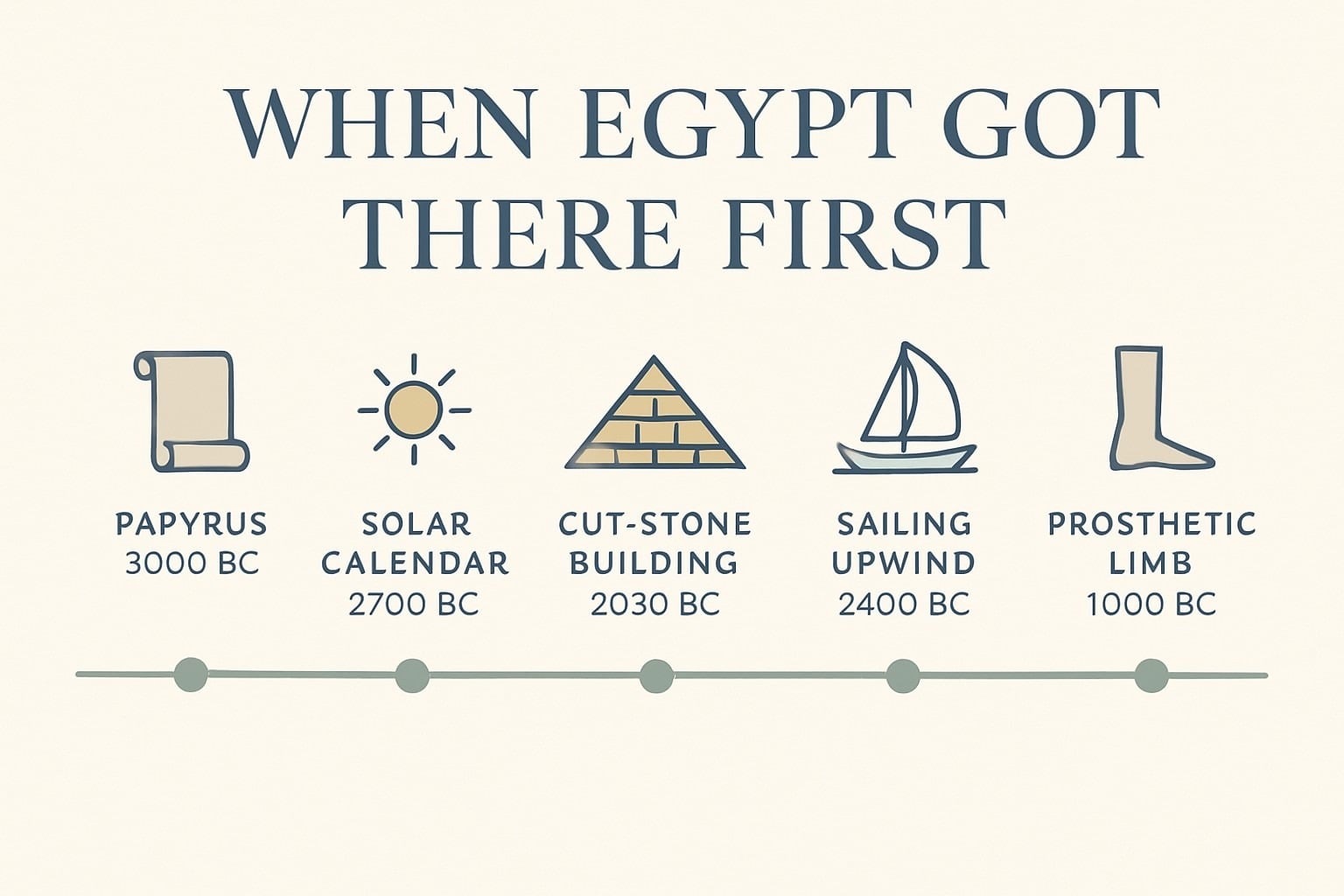
When Egypt Got There First
How Egyptian inventions compared to the rest of the ancient world
- Papyrus paper: Egypt c. 3000 BC — China’s first true paper c. 100 AD (≈ 3,100-year lead)
- Sail against the wind: Egypt c. 2400 BC — Greek triremes c. 500 BC (≈ 1,900-year lead)
- 365-day solar calendar: Egypt c. 2700 BC — Roman Julian reform 45 BC (≈ 2,600-year lead)
- Surgical handbook with prognosis logic: Egypt c. 1600 BC copy of older original — Hippocratic corpus c. 400 BC (≈ 1,200-year lead)
- Cut-stone monumental architecture: Egypt c. 2650 BC — Mycenaean Greece c. 1300 BC (≈ 1,350-year lead)
- Functional prosthetic limb (the Cairo toe): Egypt c. 1000 BC — next confirmed example c. 300 BC, Roman (≈ 700-year lead)
The Everyday Tech: Glass, Bronze, Cosmetics, Locks
Walk through any major museum’s Egyptian wing and you will find the smaller half of the story — the household and craft technologies that quietly seeded the modern toolkit. Egyptian inventions in this register include:
Bronze metallurgy: arsenical copper alloys in the Old Kingdom, true tin bronze by the New Kingdom, allowing harder chisels, sharper razors, and more durable hinges. Faience and glassmaking: by about 1500 BC, Egyptian workshops were producing the world’s first cast glass vessels, blue-green and opaque, centuries before the Romans invented blown glass. Cosmetics and personal care: kohl eyeliner (a lead-antimony compound that recent research suggests had genuine antibacterial properties for the eyes), perfumed creams in alabaster jars, toothpaste made of mint, rock salt, dried iris flowers, and pepper — a recipe Austrian dentists tested and found surprisingly effective.
Egyptians also gave us the pin-tumbler lock — a wooden door bolt with falling pins disengaged by a notched wooden key, the direct mechanical ancestor of every brass key in every modern pocket. They were among the first to use the corbeled arch, the inclined plane on industrial scale, the potter’s wheel (in use by Dynasty 4, c. 2500 BC), and ox-drawn plows that doubled grain yields.
Where the Technology Hit Its Limits
An honest account of ancient Egyptian technology has to admit what it could not do — because the limits are as instructive as the breakthroughs. Egyptian mathematics was extraordinarily good at practical problems (areas of fields, rations for workmen, the slope of a pyramid face) but never made the conceptual leap to abstract proof; that step was left to the Greeks. Egyptian medicine could set fractures and stitch wounds beautifully, but the same Ebers Papyrus that anticipates cardiology also prescribes incantations for crocodile bites. And Egyptian engineering, for all its precision, was deeply conservative — it preferred to repeat a proven design for a thousand years rather than experiment. That conservatism is why the wheel, known in Egypt by the Old Kingdom, was barely used for transport until war chariots arrived from the Levant around 1650 BC.
This is the texture missing from most internet lists: Egyptian technology was not a flat catalogue of “firsts.” It was a real human enterprise — brilliant in some domains, blocked in others, and entirely unafraid of failure when the next dynasty’s monument required it.
Frequently Asked Questions
Q: What was the most important ancient Egyptian invention?
A: Papyrus is the strongest single candidate. By creating a cheap, durable, mass-produced writing surface around 3000 BC, the Egyptians made it possible to record administration, science, medicine, and literature at a scale no clay-tablet civilization could match. Every surviving Egyptian medical, mathematical, and literary text is a downstream consequence of that one material.
Q: Did ancient Egyptians really invent the 365-day year?
A: Yes. The Egyptian civil calendar of 12 months of 30 days plus 5 epagomenal days — totaling 365 — was in use by roughly 2700 BC. Julius Caesar’s reform of 45 BC was based directly on it, advised by the Alexandrian astronomer Sosigenes, and the modern Gregorian calendar is a refinement of that Julian system.
Q: How accurate was ancient Egyptian medicine?
A: Surprisingly accurate within its surgical and observational domain. The Edwin Smith Papyrus describes the brain, the meninges, and the heart’s connection to a network of vessels in clinically recognizable terms, and prescribes treatments — splints, sutures, honey wound dressings — that modern medicine has validated. It also coexisted with magical remedies; rationality and ritual ran side by side.
Q: How did ancient Egyptians build the pyramids without modern machinery?
A: With copper chisels, dolerite hammerstones, wooden sleds dragged on wet sand (which cuts friction by roughly 50%, as a 2014 University of Amsterdam study showed), levers, internal and external ramps, and a workforce of skilled paid laborers — not slaves — organized in rotating crews of about 20,000. The geometry was set out with knotted ropes, plumb lines, and star-sighting tools called merkhets.
Four and a half thousand years after the last casing stone was set on the Great Pyramid, the technology of ancient Egypt still has the power to startle. Not because it was mystical — it was not — but because it was so deeply, patiently practical. Paper, surgery, the calendar on your wall, the keel under every modern hull, the lock on your front door: each of them carries Egyptian DNA. The Nile civilization’s real gift was not any single invention. It was the habit of looking at a hard problem, writing it down, and coming back the next generation with a better answer.
Illustrations are AI-generated. Article fact-checked and human-edited. Our editorial standards.