Ancient Greek Technology: 10 Inventions Still Used Today
Ancient Greek technology was not a museum of curiosities — it was the prototype workshop of the modern world, and a startling amount of it is still humming inside the buildings, machines, and medical kits we use every day. From the bronze gears of the Antikythera Mechanism to the spiral water-lifter at your local sewage plant, the practical and theoretical engineering of Hellenistic Greece set down rails that civilization is still riding.
Key Facts
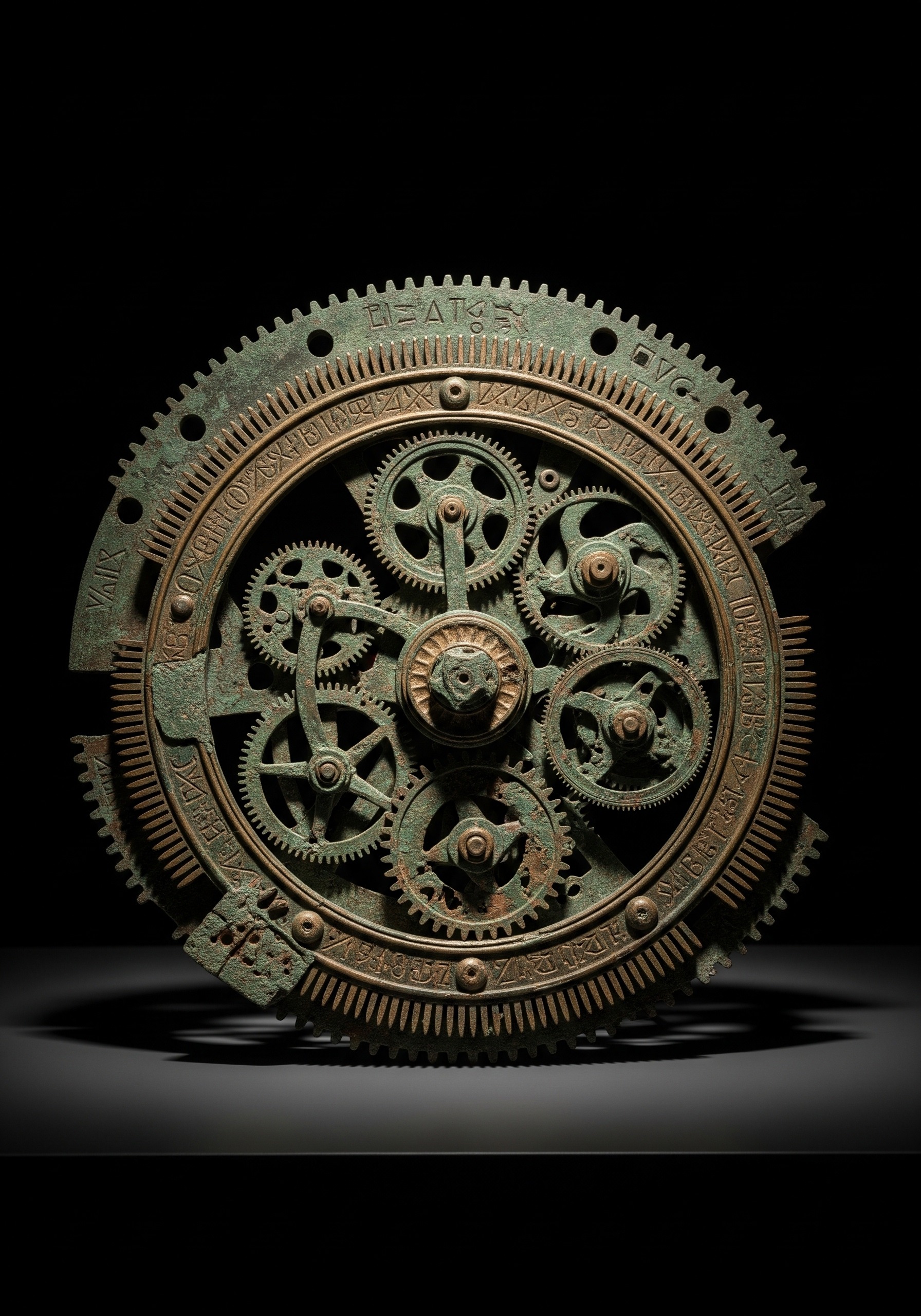
- The Antikythera Mechanism (c. 150–100 BCE) is the oldest known geared analog computer; CT scans of its 82 surviving fragments have revealed at least 30 precision bronze gears.
- The Archimedes screw, devised in 3rd-century-BCE Syracuse, still lifts wastewater in thousands of modern treatment plants and now generates electricity in low-head “Archimedean” hydro turbines.
- Hero of Alexandria’s aeolipile (1st century CE) was the first recorded steam-powered device — roughly 1,700 years before James Watt’s improved industrial steam engine of 1769.
- The hydraulis, a water-powered keyboard organ built by Ctesibius around 270 BCE, is the direct ancestor of every modern pipe organ — and, by extension, of the piano and electronic keyboard.
- Surgical instruments described in the Hippocratic Corpus — scalpels, bone forceps, vaginal specula, trephination drills — are nearly identical in form and function to instruments used in hospitals today.
In short: Ancient Greek technology gave us the first computer, the first steam device, the first programmable machines, the surgical kit, the keyboard instrument, and the structural columns that hold up half of the world’s civic buildings. The Greeks built the toolkit; we are mostly refining it.
Key Facts
- The Antikythera Mechanism, dated to about 150 to 100 BCE, is the oldest known geared analog computer, and CT scans of its 82 surviving fragments have revealed at least 30 precision bronze gears.
- The Archimedes screw, devised in 3rd-century-BCE Syracuse, still lifts wastewater in thousands of modern treatment plants and now generates electricity in low-head Archimedean hydro turbines.
- Hero of Alexandria’s aeolipile, from the 1st century CE, was the first recorded steam-powered device, roughly 1,700 years before James Watt’s improved industrial steam engine of 1769.
- The hydraulis, a water-powered keyboard organ built by Ctesibius around 270 BCE, is the direct ancestor of every modern pipe organ.
- A 2021 reconstruction published in Nature by Tony Freeth’s team at University College London modelled the Antikythera Mechanism’s display of all five naked-eye planets on a front dial of nested concentric rings.
In short: Ancient Greek technology was the prototype workshop of the modern world, giving us the first computer, the first steam device, surgical instruments, the keyboard organ, and structural columns still in use today. The Greek difference was the marriage of theoretical reasoning and craft skill, producing a roughly four-century burst of invention centred on Athens, Syracuse, Rhodes, and Alexandria. Many of these devices, such as the Archimedes screw, have never actually stopped being used.
The Greek Approach: Why Ancient Greek Technology Still Matters

What separated the Greeks from earlier civilizations was not raw ingenuity — Egyptians built pyramids, Babylonians tracked planets, the Chinese cast iron centuries earlier. The Greek difference was the marriage of theoria (theoretical reasoning) and techne (craft skill). When Archimedes worked out the law of buoyancy, he applied it the next morning to a ship’s hull. When Euclid formalized geometry, surveyors and shipwrights had a working language for shape and proportion within a generation.
The result was a roughly four-century burst, from the 6th century BCE to the 1st century CE, centred on Athens, Syracuse, Rhodes and especially Hellenistic Alexandria, in which dozens of foundational machines and concepts were invented, written down and — crucially — transmitted to Rome, the Islamic world and medieval Europe. The continuity is the point. Many of these devices have never actually stopped being used.
The Antikythera Mechanism: A 2,000-Year-Old Computer
In 1901, sponge divers off the island of Antikythera pulled a corroded lump of bronze out of a Roman-era shipwreck. It looked unimportant. It turned out to be the most sophisticated mechanism known from the ancient world by more than a thousand years, and today its main fragment sits in the National Archaeological Museum of Athens as the single most studied object in the history of technology.
Built around 150–100 BCE, almost certainly in the orbit of the astronomer Hipparchus on Rhodes, the device was a hand-cranked analog computer. Turning the handle advanced bronze gear-trains that simultaneously displayed the position of the Sun and Moon, predicted lunar and solar eclipses decades in advance, tracked the four-year cycle of the Olympic Games, and — according to a 2021 reconstruction published in Nature by Tony Freeth’s team at University College London — modelled the motion of all five planets visible to the naked eye on a front dial of nested concentric rings.
Its differential gear, which compensated for the Moon’s elliptical orbit, would not reappear in a European mechanism until the 14th century. The Antikythera Mechanism is hard, unarguable evidence that the Greeks had built a programmable, geared computational machine — and that we lost the thread for a thousand years. (For a deep dive into how the gear-trains actually worked, see our companion piece on the Antikythera Mechanism decoded.)
Archimedes and the Birth of Practical Physics
If the Antikythera Mechanism is the symbolic apex of Greek engineering, Archimedes of Syracuse (c. 287–212 BCE) is its working hands. Almost every ancient Greek invention still used today either comes from his workshop or runs on a principle he was the first to state mathematically.
The Archimedes screw — a helical blade rotating inside a tilted cylinder — was first applied to bail bilge water from one of King Hiero II’s giant ships. Twenty-three centuries later, a near-identical device lifts raw sewage at the inlet of nearly every major wastewater treatment plant on Earth, because it is mechanically simple, almost impossible to clog and astonishingly gentle on whatever it is pumping (which is why aquaculture farms use it to move live fish). Run it backwards under flowing water and it becomes an Archimedean turbine, now installed in hundreds of low-head hydroelectric stations across Europe; the same device that drained Hellenistic ships now powers villages.
His law of the lever (“give me a place to stand and I will move the Earth”) underwrites every wrench, crowbar, see-saw and excavator boom in existence. His principle of buoyancy — discovered in the bath, allegedly — is still the equation naval architects use to decide whether your container ship will float. And the compound block-and-tackle pulley, which he is said to have used to single-handedly drag a fully loaded warship onto a beach, remains the lifting method of choice for sailboat rigging, theatre flies and mountain rescue worldwide.
{IMAGE_2}
Greek Water Engineering Still in Your Bathroom and Your Concert Hall
Hellenistic engineers were obsessed with water — controlling it, measuring it, making music with it. Their inventions sound exotic until you realize you live with their direct descendants.
The clepsydra (water clock) was refined by Ctesibius of Alexandria around 270 BCE into the most accurate timepiece in the world; it remained unbeaten until the European pendulum clock of the 17th century. The same Ctesibius then routed his pressurized water through a clever set of valves and a chest of tuned bronze pipes and invented the hydraulis, the world’s first keyboard instrument. It is the literal, direct ancestor of every cathedral pipe organ and, by extension, of the piano, the synthesizer and the laptop keyboard in front of you.
The Greeks did not invent the aqueduct, but they perfected the inverted siphon, a U-shaped pipe that uses pressure to carry water up and over hills without active pumping. Modern municipal water systems still use it under any river, valley or freeway they need to cross. And the simple force pump — two pistons, a chamber, two non-return valves — that Ctesibius drew in Alexandria is, in essence, the same machine inside a fire engine, a bicycle pump and the lift cylinder of a hydraulic excavator.
Steam, Automata and the First Robotics: Hero of Alexandria
If one ancient Greek inventor should make a modern engineer uncomfortable, it is Hero (or Heron) of Alexandria, working in the 1st century CE. His surviving treatises read like a science-fair catalog from a civilization that was about three lucky breaks away from an Industrial Revolution.
His aeolipile was a hollow bronze sphere mounted on a pivot, fed with steam from a kettle below; the steam escaped through two bent nozzles and spun the sphere — the first reaction turbine and the first steam-powered device in history. He treated it as a toy. Sixteen centuries later, Thomas Newcomen and James Watt would turn the same principle into the engine that built the modern world.
Hero also built coin-operated vending machines that dispensed holy water in temples, automatic self-opening doors for sanctuaries (a sacrificial fire on the altar warmed air in a hidden chamber, which expanded and pulled ropes through a counterweight), a wind-powered organ, and a programmable cart driven by a falling weight and steered by a system of pegs in a rotating drum — a binary, sequential program written in wood and string. The pegs are functionally indistinguishable from a music-box cylinder or, more uncomfortably, from the punched-card programs that ran the Jacquard looms of 1801 and the computers of 1945.
Ancient Greek Technology Still Used Today: A Quick Reference
The table below summarizes the inventions covered in this article and traces each one directly to the device or system you can find in a 21st-century city.
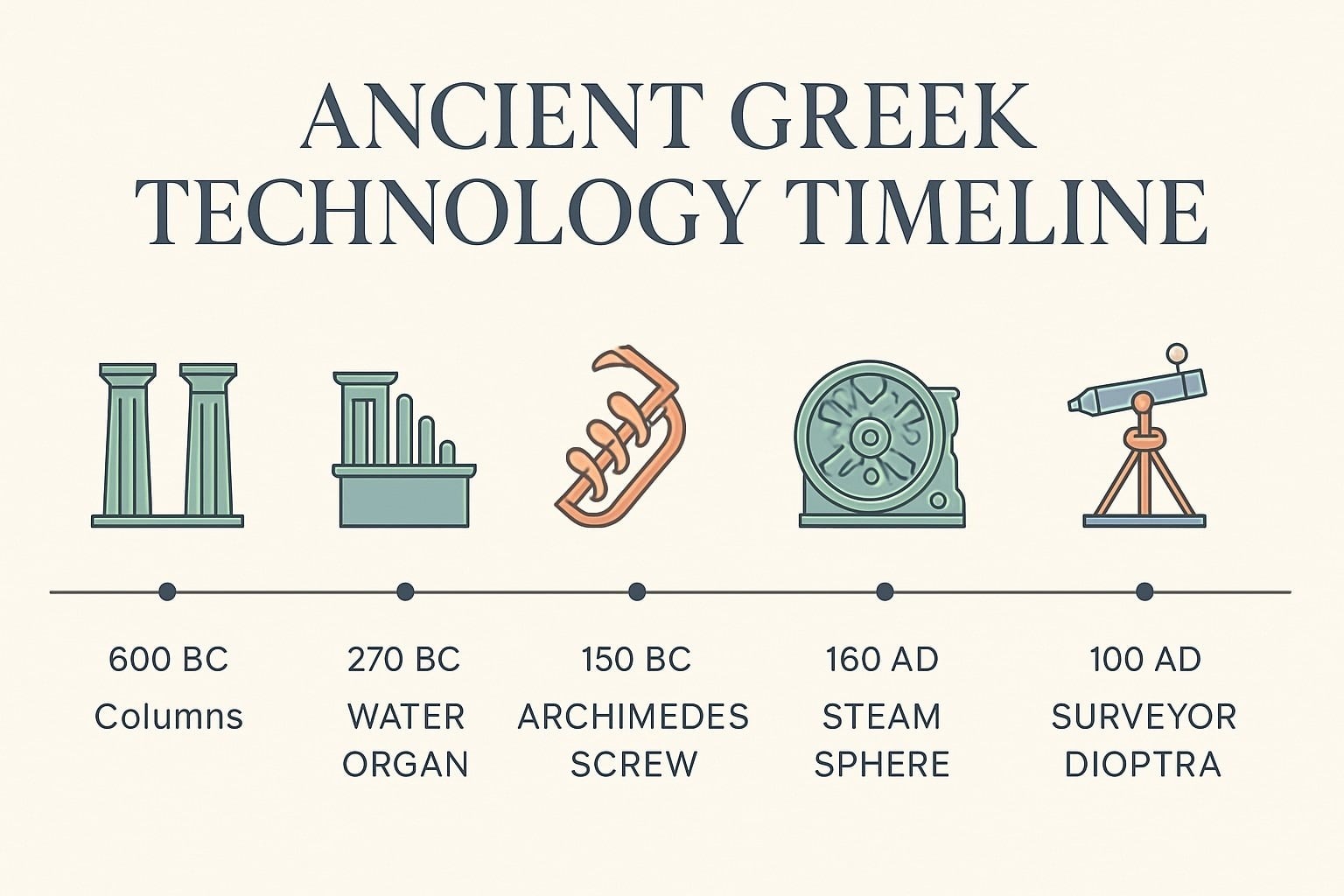
| Greek invention | Inventor / date | Modern descendant |
|---|---|---|
| Antikythera Mechanism | School of Hipparchus, c. 150–100 BCE | Analog computers; geared planetariums |
| Archimedes screw | Archimedes, c. 250 BCE | Sewage pumps; Archimedean hydro turbines |
| Block-and-tackle pulley | Archimedes, c. 250 BCE | Cranes, sailboat rigging, rescue gear |
| Hydraulis (water organ) | Ctesibius, c. 270 BCE | Pipe organ; piano; electronic keyboard |
| Force pump | Ctesibius, c. 270 BCE | Fire-engine pump; bicycle pump; hydraulics |
| Aeolipile (steam reaction turbine) | Hero of Alexandria, c. 60 CE | Steam turbines; jet-propulsion principle |
| Programmable peg-drum cart | Hero of Alexandria, c. 60 CE | Music-box cylinders; sequential machine control |
| Surveyor’s dioptra | Hero of Alexandria, 1st c. CE | Theodolite; total station |
| Doric / Ionic / Corinthian column | 7th–5th c. BCE | Civic, banking and government architecture worldwide |
| Hippocratic surgical kit | 5th c. BCE onward | Modern scalpel, forceps, speculum, trephine |
Medical Instruments That Survived Two Millennia
Walk into any operating theatre and most of the steel on the tray would be recognizable to a Greek physician of the 5th century BCE. The Hippocratic Corpus and the later treatises of Galen describe — and surviving Greco-Roman finds confirm — a kit of scalpels, probes, bone chisels, dental forceps, cataract needles, arrow extractors, vaginal specula, rectal specula and trephination drills whose shapes have changed only at the millimetre.
The reason for this continuity is humbling: human anatomy has not changed, and the Greeks were the first physicians on record to design tools by studying it directly rather than guessing. Their commitment to observation also produced the first systematic clinical case histories, the first ethical code for doctors, and the term iatros — the root of every medical word from “psychiatry” to “pediatrics.”
By the numbers: the Greek tech footprint today
- ~30 bronze gears reconstructed inside the Antikythera Mechanism, including a 223-tooth wheel that tracked the Saros eclipse cycle.
- 1,000+ years — the gap between the Antikythera Mechanism and the next comparable European geared device (the astronomical clock of Richard of Wallingford, c. 1330 CE).
- ~1,700 years between Hero’s steam aeolipile (c. 60 CE) and James Watt’s improved steam engine (patented 1769).
- 23 centuries of continuous use, in some form, for the Archimedes screw — bilge pump → irrigation → modern sewage works → hydroelectric turbine.
- 3 classical column orders (Doric, Ionic, Corinthian) still on the façades of the U.S. Supreme Court, the British Museum, the Brandenburg Gate and tens of thousands of banks, libraries and courthouses worldwide.
What the Greeks Got Wrong — and Why It Doesn’t Matter
It is fair, and important, to be honest: the Greeks also got plenty wrong. Aristotle thought heavier objects fell faster than lighter ones (they don’t). Several physicians believed the womb wandered around the body. The geocentric cosmos of Ptolemy delayed European astronomy for fifteen centuries. The aeolipile remained a toy because, with slave labour available, no Hellenistic city had an economic reason to harness steam for industry. The fact that Greek engineering still spread later through Rome — see our piece on how the Romans scaled it — owed a lot to luck.
But the framework the Greeks built — that the world is law-bound, that natural phenomena can be modelled with mathematics, that experiments should be written down and replicated, that craftsmen and theoreticians should talk to each other — is the reason science exists at all. Every later breakthrough, from Newton to NASA, is a footnote on a Greek argument.
Frequently Asked Questions
Q: What was the most advanced piece of ancient Greek technology?
A: By unanimous expert consensus, the Antikythera Mechanism (c. 150–100 BCE), an astronomical computer of roughly 30 precision bronze gears whose differential mechanism and concentric dials would not be matched in Europe for more than a thousand years. The 2021 study by Tony Freeth’s team at University College London reconstructed its complete cosmos display, including the motions of all five visible planets.
Q: Did the ancient Greeks have a steam engine?
A: Yes, in principle. Hero of Alexandria’s aeolipile (c. 60 CE) was a working reaction turbine driven by steam — the world’s first steam device. It was used as a temple curiosity rather than for industrial work, but the underlying physics was correct, and a modern steam turbine generates electricity by the same fundamental reaction.
Q: Which ancient Greek inventions are still used today exactly as the Greeks designed them?
A: The Archimedes screw (in sewage plants and hydro turbines), the block-and-tackle pulley (in cranes and rigging), the inverted siphon (in modern water mains), the classical column orders (in civic architecture) and most of the Hippocratic surgical instruments are in use today in forms a 3rd-century-BCE Greek would recognize at a glance.
Q: Why did Greek technology stop advancing?
A: It did not “stop”; it was transmitted. The centre of innovation shifted from Hellenistic Alexandria to Rome (which scaled Greek engineering into roads, aqueducts and concrete), then to the Islamic Golden Age (which preserved, translated and extended Greek mathematics and medicine), and finally back to Renaissance Europe — where Galileo, Newton and Watt were explicitly reading translations of Archimedes and Hero.
The deeper you look, the harder it gets to call ancient Greek technology “ancient.” It is woven into the water pipes under your street, the chord on the church organ, the scalpel in the surgeon’s hand and the math behind the rocket leaving the launch pad. The Greeks did not just build clever machines — they built the habit of mind that keeps building them.
Illustrations are AI-generated. Article fact-checked and human-edited. Our editorial standards.