Ancient Mysteries Science Can’t Explain (2026 Update)
The shortlist of ancient mysteries science can’t explain keeps getting shorter — and stranger. Carbon dating, lidar, isotope sourcing, CT scanning and now machine vision have quietly solved problems that taunted scholars for centuries, yet a hard core of riddles refuses to crack. The remaining puzzles are not the ones television loves; they are the ones where every new dataset deepens the strangeness instead of dissolving it.
Key Facts
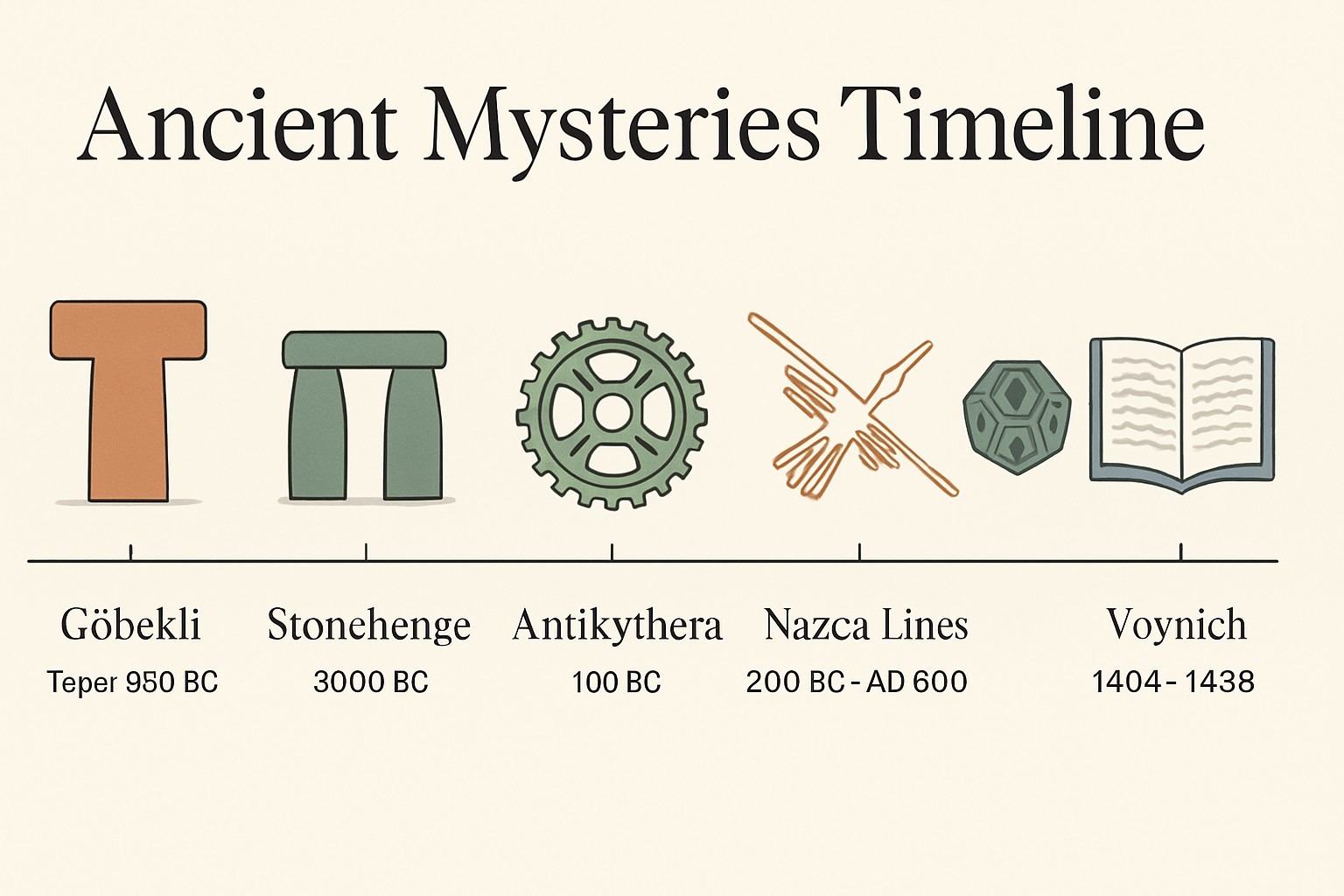
- The Antikythera Mechanism, recovered from a Roman-era shipwreck off the Greek island of Antikythera in 1901, is roughly 2,100 years old and contains at least 30 hand-cut bronze gears — a level of geared computation not matched in Europe again until the 14th-century cathedral clocks.
- Stonehenge’s six-tonne central Altar Stone was traced in a 2024 Nature paper not to Wales (the long-assumed source of the bluestones) but to north-east Scotland, more than 700 kilometres away.
- Göbekli Tepe in southeastern Turkey was built around 9,500 BC — about 6,000 years before Stonehenge and before pottery, writing, or large-scale agriculture existed.
- The Voynich Manuscript, radiocarbon-dated to 1404–1438, has resisted every cryptographer who has tried it, including the WWII codebreakers at Bletchley Park and the US National Security Agency.
- In 2024, AI-assisted aerial surveys announced 303 newly identified Nazca figures in Peru — nearly doubling the known total in less than six months and adding to lines that span up to 1,200 square kilometres of desert.
In short: The genuine ancient mysteries science can’t explain are not the ones that fail for lack of evidence — they are the ones where the evidence we keep adding makes the artefact harder, not easier, to fit into the rest of history. This article walks through the strongest of them, what we now know, what we still don’t, and how to tell a real unsolved puzzle from a TV-friendly myth.
Key Facts
- The Antikythera Mechanism, recovered from a Roman-era shipwreck off Antikythera in 1901, is roughly 2,100 years old and contains at least 30 hand-cut bronze gears.
- Stonehenge’s six-tonne central Altar Stone was traced in a 2024 Nature paper not to Wales but to north-east Scotland, more than 700 kilometres away.
- Göbekli Tepe in southeastern Turkey was built around 9,500 BC, about 6,000 years before Stonehenge and before pottery, writing, or large-scale agriculture existed.
- The Voynich Manuscript, radiocarbon-dated to 1404 to 1438, has resisted every cryptographer who has tried it, including the WWII codebreakers at Bletchley Park and the US National Security Agency.
- In 2024, AI-assisted aerial surveys announced 303 newly identified Nazca figures in Peru, nearly doubling the known total in less than six months.
In short: The genuine ancient mysteries science cannot explain are not the ones that fail for lack of evidence, but the ones where every new dataset deepens the strangeness instead of dissolving it. Modern tools like carbon dating, lidar, isotope sourcing, and machine vision have quietly solved many old puzzles while making a hard core of riddles even stranger. The article distinguishes real unsolved puzzles from TV-friendly myths.
Why some ancient mysteries science can’t explain — yet
Most “lost civilization” content treats every unsolved puzzle as equal. It is not. An ancient mystery becomes genuinely hard for a specific, identifiable reason: the object is unique (no comparable artefacts to anchor it), the context is destroyed (looters, war, modern building work), the technology that produced it left no descendants, or the language that explains it died with its last reader. When archaeologists call something “unexplained,” they usually mean one of these four barriers is in play.
That matters because it tells you, in advance, which mysteries are likely to be solved by the next CT scanner and which never will be. The Antikythera Mechanism, for example, was a “unique object” mystery until 2021, when computer reconstruction by University College London’s Antikythera Research Team finally reproduced its planetary gearing in working form. The Voynich Manuscript, by contrast, is a “dead language plus unique object” problem — a far worse pair — and after a century of attempts no decipherment has survived peer review.
The Antikythera Mechanism: the 2,100-year-old computer we mostly understand now
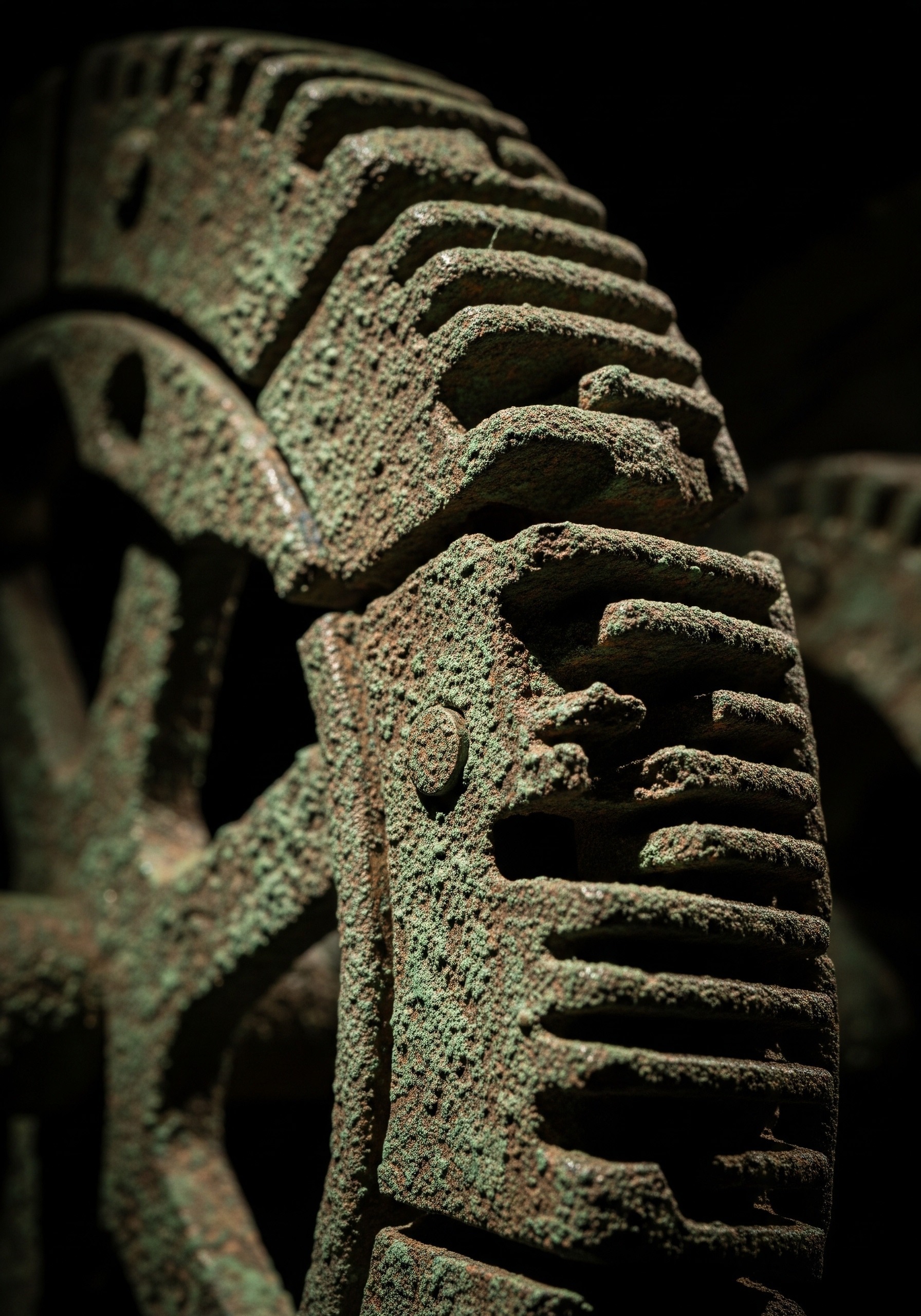
Sponge divers off the islet of Antikythera in 1901 hauled up a shoebox-sized lump of corroded bronze. Inside, X-rays in the 1970s and high-resolution CT scans in 2005 revealed an intricate gear train that displayed the positions of the Sun, the Moon and the five planets known to antiquity, predicted lunar and solar eclipses, and tracked the four-year cycle of the Panhellenic games — including the Olympics. Mechanically, it has been called the world’s first analogue computer.
{IMAGE_2}
The strangeness is not the device itself any more — it is the silence around it. Nothing comparable survives from the next 1,400 years. Either Greek engineers built exactly one such object (vanishingly unlikely) or an entire branch of Hellenistic precision engineering existed and left no other physical trace. That is what science genuinely cannot yet explain: not the mechanism, but the empty centuries on either side of it.
Stonehenge: a 2024 paper that proved we still don’t know its builders
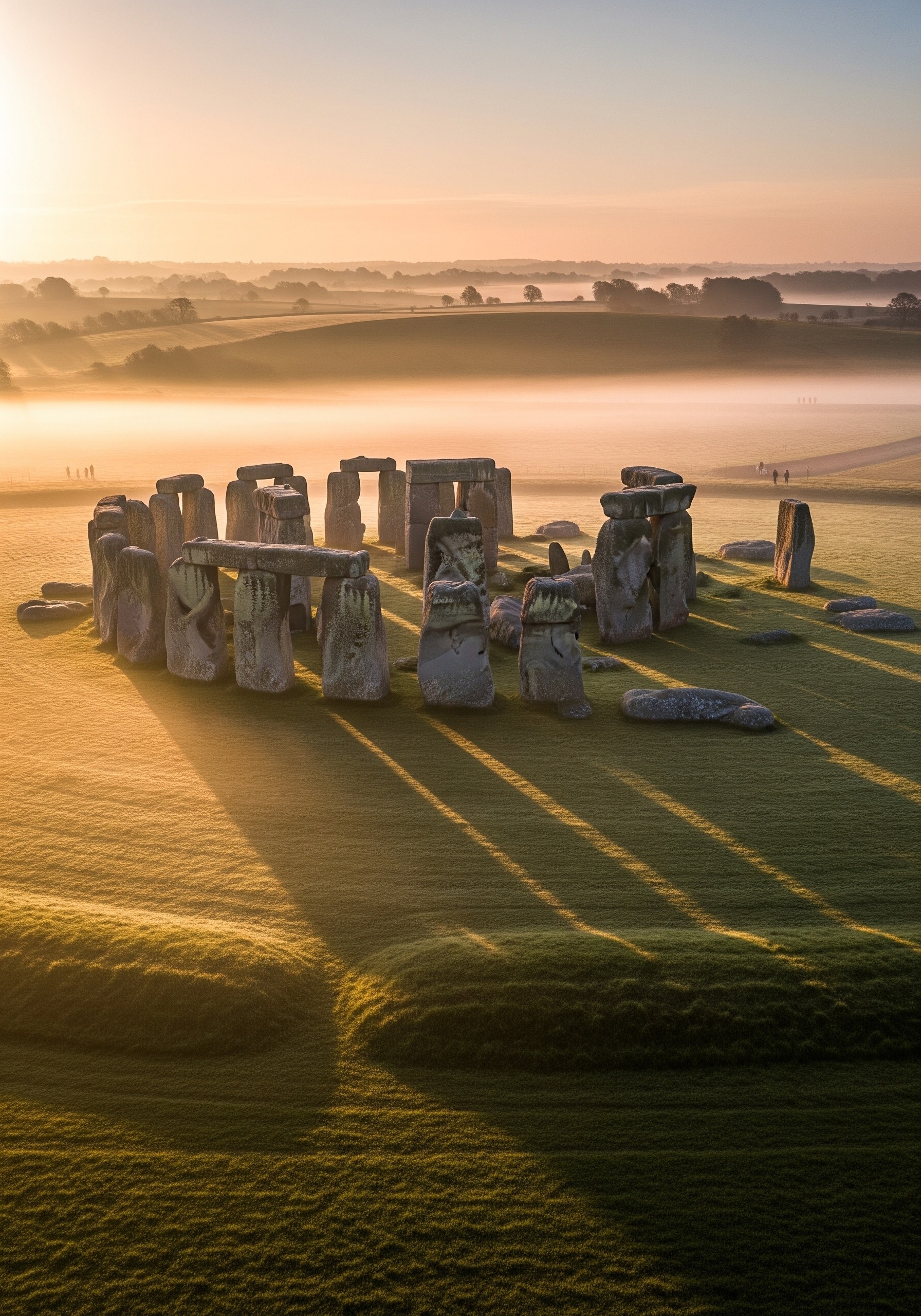
Stonehenge is the most-studied prehistoric site on Earth, and yet 2024 delivered the kind of result that makes archaeologists rewrite chapters. A team led by Anthony Clarke at Curtin University used the chemical fingerprint of zircon, apatite and rutile grains in the monument’s six-tonne Altar Stone and matched them to bedrock not in Wales — the source of the famous bluestones, dragged some 225 kilometres — but in the Orcadian Basin of north-east Scotland, more than 700 kilometres away. The result was published in Nature and is, at the time of writing, the most-cited Stonehenge paper of the decade.
That single sentence rewrites everything we thought we knew about how Neolithic Britain organised itself. Hauling a six-tonne sandstone slab from Aberdeenshire to Salisbury Plain in 2,600 BC implies a network of cooperation across most of the British mainland, centuries before metal, writing or wheeled vehicles. We still cannot say why they did it. The henge’s purpose — temple, calendar, ancestral monument, audio amplifier, all of the above — remains the genuine open question, and the new sourcing only deepens it.
The Nazca Lines: AI just doubled the puzzle
For nearly a century, the Nazca geoglyphs of southern Peru — the hummingbird, the spider, the monkey, the 200-metre “astronaut” — have been the textbook example of an unexplained ancient creation. Visible only from altitude, etched into the desert floor between roughly 200 BC and AD 600 by removing the dark surface gravel to expose paler clay beneath, the figures total well over a thousand by traditional count.
In September 2024, a team at Yamagata University reported that a deep-learning model trained to recognise faint geoglyph signatures in aerial imagery had identified 303 previously unknown figurative designs in six months — a workload that would have taken human surveyors nearly a century at their previous pace. The new figures, smaller and often depicting humans or domesticated animals beside trails, suggest that many Nazca lines were not built to be seen from the sky at all, but to be walked past. That quietly demolishes the “ancient astronaut” framing and substitutes a more interesting puzzle: a culture that spent half a millennium drawing for an audience of pedestrians and possibly gods, then stopped.
Göbekli Tepe: a temple older than agriculture
If you have to pick one site that genuinely upended the 20th-century model of human prehistory, it is Göbekli Tepe in southeastern Turkey. Excavated since 1995 and added to the UNESCO World Heritage list in 2018, it consists of monumental T-shaped limestone pillars, some five metres tall and weighing up to 10 tonnes, arranged in circles and decorated with reliefs of foxes, vultures, scorpions and snakes. Radiocarbon evidence places the oldest layers around 9,500 BC.
That date is the problem. Standard prehistoric narrative says: first agriculture, then settlements, then monumental religious architecture. Göbekli Tepe reverses the order. The temple was raised by hunter-gatherers, before domesticated wheat, before pottery, before writing. The orthodox view that “civilisation” required farming as its precondition is, at minimum, incomplete. We still have no agreed answer to how a foraging population organised the labour to quarry, transport and erect these pillars, nor why, after a few centuries of use, the entire complex was deliberately buried under tonnes of fill. As of 2024, less than 10% of the site has been excavated.
The Voynich Manuscript and Linear A: the languages we cannot read
Two of the strongest entries on any honest list of unexplained ancient mysteries are not objects but texts. The Voynich Manuscript, a 240-page illustrated codex held at Yale’s Beinecke Library, is written in a unique script of some 25–30 characters and illustrated with plants that match no known species, naked women bathing in green liquid, and astronomical roundels. Radiocarbon dating places its vellum firmly in the early 15th century, ruling out a modern hoax. Every serious decipherment claim — Anglo-Saxon shorthand, proto-Romance, encrypted Hebrew, Nahuatl — has failed peer-review reproduction. Statistical analyses show the text has the entropy of a real language, not gibberish, which is what makes it maddening.
Linear A, used by the Minoan civilisation of Crete between roughly 1800 and 1450 BC, is a different kind of impossible. Its sister script, Linear B, was cracked by architect Michael Ventris in 1952 and revealed an archaic form of Greek. Linear A uses many of the same signs, but the underlying language is not Greek, not Phoenician, not Hittite — it is a Bronze-Age Mediterranean tongue with no surviving descendants, and roughly 1,400 inscriptions provide too small a corpus for a decisive decipherment. Without a bilingual “Rosetta Stone” for Minoan, it may stay unreadable forever.
Roman dodecahedrons and the problem of the lonely artefact
Since the 18th century, roughly 130 small bronze dodecahedrons — hollow 12-sided objects with circular holes of varying diameter on each face and knobs at every vertex — have been pulled from late-Roman sites across the empire’s north-western frontier, from Britain to Hungary. In 2023, an exceptionally well-preserved example was excavated near Norton Disney in Lincolnshire. Not a single Roman text mentions them. No two have identical hole sizes. None show wear patterns from rolling. They appear in officers’ grave goods and in junk hoards alike.
Theories proposed include candle holders, surveyor’s range-finders, knitting tools for woollen gloves, dice for an unknown game, military standards, religious objects and goldsmiths’ calibration gauges. Every theory fails at least one piece of evidence. The dodecahedron is the textbook “lonely artefact”: dozens of physical specimens, zero contextual writing, and no descendant tradition. It is exactly the configuration of evidence that, for now, science cannot solve.
How to tell a real ancient mystery from a popular myth
Pop culture has flooded the genre. The Bermuda Triangle, the Bosnian “pyramids,” ancient-astronaut readings of Egyptian reliefs, the lost continent of Mu — all share a common pattern: the mystery exists only if you ignore the mainstream evidence, and the proposed solution requires either unknown civilisations or extraterrestrials. A genuine ancient mystery science can’t explain has the opposite signature: every mainstream technique has been applied, the data are public, the artefact is real, and the experts disagree about which conservative explanation fits best.
The honest scorecard is short. Antikythera (mechanism understood; cultural context not). Stonehenge (function unknown; sourcing partially solved 2024). Göbekli Tepe (real, dated, only partly excavated). Voynich and Linear A (untranslated). The dodecahedrons (genuinely uninterpreted). Beyond these, most “ancient mysteries science can’t explain” listicles dissolve under one hour of reading the primary literature. Skepticism is not the enemy of wonder — it is the only way to find out which wonders are real.
Frequently Asked Questions
Q: What is the oldest unexplained ancient site in the world?
A: Göbekli Tepe in Turkey, with construction dated to around 9,500 BC, is currently the oldest monumental site whose builders and purpose remain unexplained. Earlier human structures exist (such as Theopetra Cave in Greece), but none combine monumental scale with deliberate symbolic decoration in the same way.
Q: Has the Voynich Manuscript ever been decoded?
A: No. Despite hundreds of attempts — including by the WWII Bletchley Park team and modern machine-learning models — no decipherment has passed peer review. The text shows the statistical signature of a real language, not random noise, which is why mainstream cryptographers still consider it an open problem rather than a hoax.
Q: Were the Nazca Lines made by aliens?
A: No. The lines were made by the Nazca culture between roughly 200 BC and AD 600 by scraping away the dark desert surface to reveal pale clay underneath — a technique experimentally reproduced by archaeologists. The 2024 AI-assisted survey found that many figures were designed to be walked past at ground level, not viewed from the air.
Q: Why can’t we figure out what Stonehenge was for?
A: Because the people who built it left no writing, and the monument was modified over more than 1,500 years (roughly 3,000–1,500 BC) by different communities for different reasons. Astronomy, ancestor worship, healing and political assembly all leave traces at the site. The 2024 discovery that its Altar Stone came from Scotland — over 700 km away — added a brand-new question about who organised the project.
The shortlist of genuine ancient mysteries science can’t explain is short for a reason: every decade, sharper instruments and patient excavation take another puzzle off it. What remains is the irreducible residue — the singular artefact, the dead language, the temple raised before farming — that humbles the assumption that we have already understood our species. The honest answer is that we haven’t, not yet, and that the next CT scan or trained model may quietly retire one of the entries on this page.
Illustrations are AI-generated. Article fact-checked and human-edited.