9 Ancient Mysteries Still Unsolved in 2026 (Honest Status)
The shortlist of ancient mysteries still unsolved in 2026 is shorter than the internet pretends — but the puzzles that remain are some of the strangest objects, scripts and stone circles ever pulled from the dirt. They are not “lost cities” or pulp-novel curses. They are real artefacts in real museums, dated by real laboratories, that simply refuse to give up their secrets.
Key Facts
- Göbekli Tepe in southeastern Turkey was built between roughly 9500 and 8000 BCE — about 6,000 years before Stonehenge — and only an estimated 10% of the site has been excavated.
- The Antikythera Mechanism, recovered from a Greek shipwreck in 1901, contains at least 30 surviving bronze gears and dates to roughly 150–100 BCE.
- The Voynich Manuscript was radiocarbon-dated by the University of Arizona in 2009 to 1404–1438 CE and contains roughly 38,000 words in an alphabet no one has ever read.
- Linear A, the script of Bronze Age Crete used between 1800 and 1450 BCE, has resisted decipherment despite its sibling script Linear B being cracked in 1952.
- About 300 perfect stone spheres were found in Costa Rica’s Diquís Delta in 1940, the largest weighing roughly 16 tonnes and ground to within a few centimetres of true spherical geometry.
In short: A handful of genuine, well-documented puzzles from antiquity remain genuinely unsolved — not for lack of effort, but because the evidence we need (a bilingual inscription, a workshop, a second example) has not survived. This article walks through the nine biggest, what we actually know, and how close 2026 science is to cracking each one.
Key Facts
- Göbekli Tepe in southeastern Turkey was built between roughly 9500 and 8000 BCE, about 6,000 years before Stonehenge, and only an estimated 10 percent of the site has been excavated.
- The Antikythera Mechanism, recovered from a Greek shipwreck in 1901, contains at least 30 surviving bronze gears and dates to roughly 150 to 100 BCE.
- The Voynich Manuscript was radiocarbon-dated by the University of Arizona in 2009 to 1404 to 1438 CE and contains roughly 38,000 words in an alphabet no one has ever read.
- Linear A, the script of Bronze Age Crete used between 1800 and 1450 BCE, has resisted decipherment despite its sibling script Linear B being cracked in 1952.
- About 300 perfect stone spheres were found in Costa Rica’s Diquís Delta in 1940, the largest weighing roughly 16 tonnes and ground to within a few centimetres of true spherical geometry.
In short: A handful of genuine, well-documented puzzles from antiquity remain unsolved, not for lack of effort, but because the evidence needed, such as a bilingual inscription, a workshop, or a second example, has not survived. The article walks through the nine biggest, what is actually known, and how close 2026 science is to cracking each one. Each puzzle resists solution because of the Rosetta problem, context loss, or preservation bias.
Why these ancient mysteries still unsolved after centuries of work
Most archaeological “mysteries” you read about on click-farm sites are not mysteries at all — they were solved decades ago, just unfashionably. What remains on the real shortlist resists solution for one of three concrete reasons.
The first is the Rosetta problem. To decipher an unknown script, scholars almost always need a bilingual text — the same passage written in a known language alongside the unknown one. Linear A and the Voynich Manuscript have no such anchor, so brute-force statistical attacks fail. The second reason is context loss: artefacts ripped from their stratigraphy in the 19th and early 20th centuries (the Costa Rica spheres, many Nazca geoglyphs) lost the surrounding pottery, bones and burnt seeds that would have dated and explained them. The third reason is preservation bias: organic evidence — wooden frameworks, painted plaster, written records on perishable media — simply rotted away in humid climates, leaving only the indestructible stone behind.
Keep these three filters in mind. Every entry below is unsolved for at least one of them.
Göbekli Tepe — the temple that rewrites prehistory
On a windswept ridge in southeastern Turkey, German archaeologist Klaus Schmidt recognised in October 1994 the significance of a mound that had been catalogued and ignored since 1963. What he eventually exposed broke a foundational assumption of archaeology: that monumental religious architecture required agriculture and settled life to precede it.
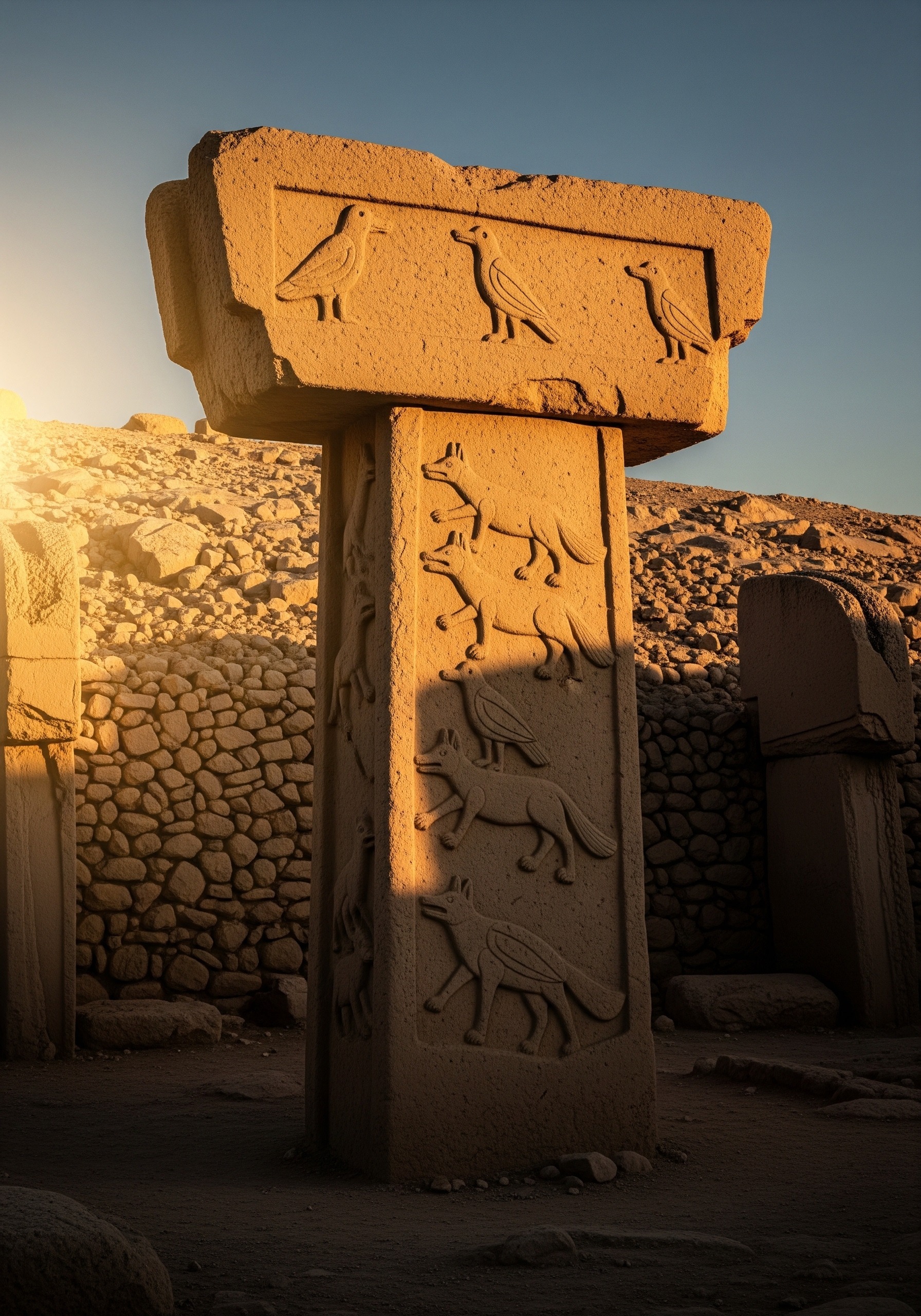
Göbekli Tepe’s T-shaped limestone pillars, some standing more than five metres tall and carved with foxes, vultures, scorpions and human-like figures, were raised by pre-pottery Neolithic hunter-gatherers around 9600 BCE. Geophysical surveys indicate roughly 200 pillars distributed across at least 20 enclosures, only four of which have been fully excavated. The mystery is not who built it — we know it was the foragers of the Urfa region — but why, and what for, and how a society without grain storage, without pottery, without writing, organised the labour to quarry, transport and erect these megaliths a full six millennia before the pyramids.
{IMAGE_2}
The Antikythera Mechanism — a Greek computer that should not exist
Hauled from a Roman-era shipwreck off the Greek island of Antikythera in 1901, the encrusted bronze lump sat in the National Archaeological Museum in Athens for decades before anyone realised what they had. X-ray tomography from the 1970s onward revealed at least 30 interlocking gears packed into a wooden case roughly the size of a hardback book. The mechanism, dated to between 150 and 100 BCE, modelled the motion of the Sun and Moon, predicted solar and lunar eclipses via the Saros cycle, tracked the four-year cycle of the Panhellenic games, and — according to the 2021 reconstruction by Tony Freeth’s team at University College London — almost certainly also displayed the positions of all five planets known to antiquity.
The puzzle that remains is brutal in its simplicity: no other object of comparable mechanical complexity survives from anywhere in the ancient world for roughly the next 1,000 years. Either the Greeks were astonishingly more advanced than the rest of the surviving evidence suggests, or this was the last of a tradition we have otherwise lost. A 2025 paper even argued that manufacturing tolerances may have prevented the device from functioning smoothly — meaning it could have been a teaching model rather than a working calculator. The debate is wide open.
The Voynich Manuscript — 240 pages no one can read
Held today at Yale’s Beinecke Rare Book and Manuscript Library as MS 408, the Voynich Manuscript is a 240-page illustrated codex written in a looping, unique alphabet that has resisted every cryptographic and linguistic attack thrown at it since rare-book dealer Wilfrid Voynich acquired it in 1912. The vellum itself was carbon-dated in 2009 to between 1404 and 1438 CE — so whatever it is, it is not a Victorian forgery.
Its illustrations show plants that match nothing in any herbal, women bathing in green pools connected by tubes, and astronomical-looking diagrams. Statistical analysis indicates the text has the entropy and word-distribution patterns of a real natural language rather than gibberish, yet no one has produced a verified translation. Stephen Bax’s 2014 attempt to identify a handful of plant names is still the most cautious, most respected effort — and it stalled at fewer than a dozen words.
The Numbers Behind the Nine
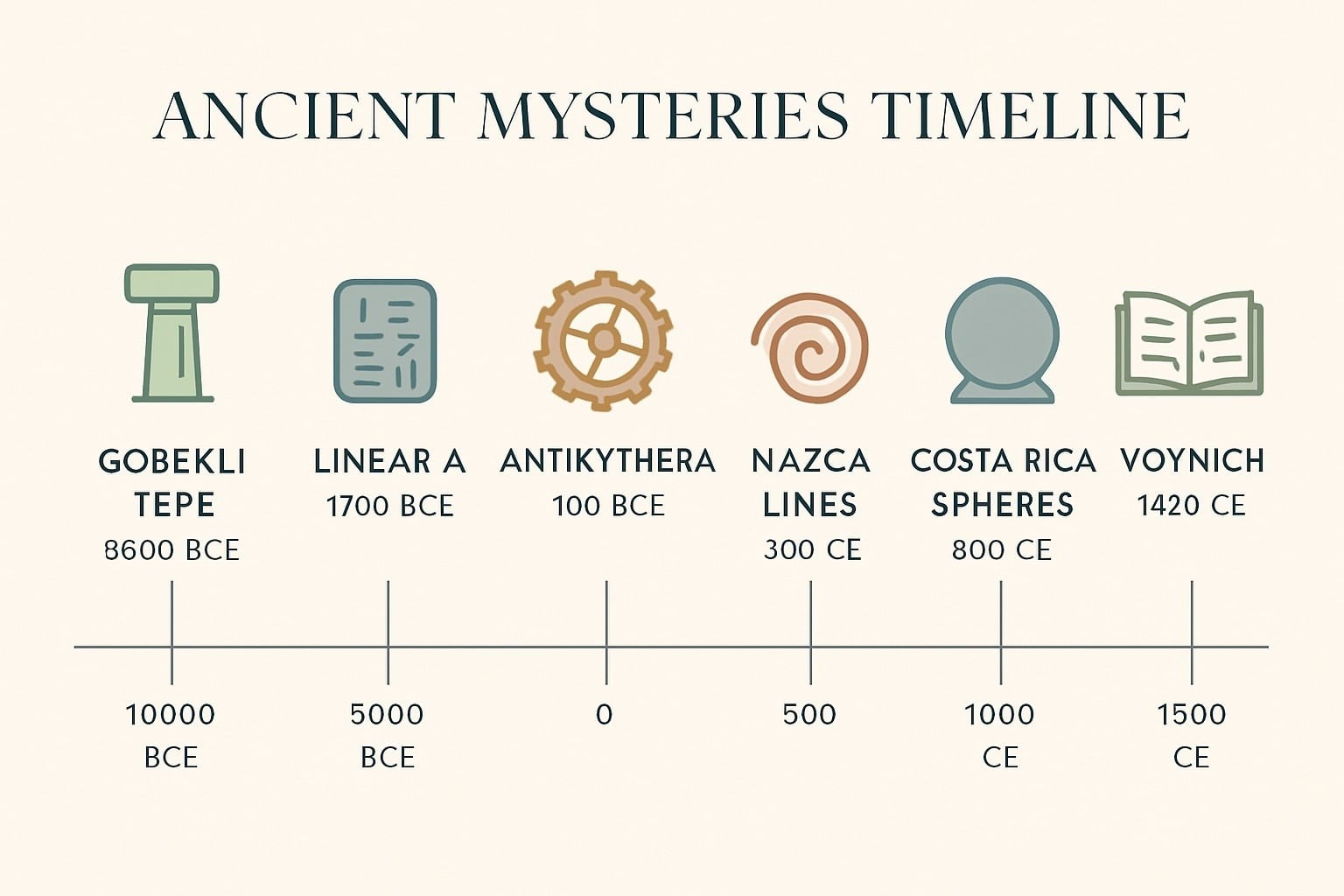
- Göbekli Tepe: c. 9600 BCE · ~200 T-pillars · ~10% excavated
- Antikythera Mechanism: c. 100 BCE · 30+ gears · 1,000-year technological lead
- Voynich Manuscript: 1404–1438 CE vellum · ~38,000 words · ~9,000 unique terms
- Linear A: 1800–1450 BCE · ~1,400 surviving inscriptions · 0 deciphered words
- Nazca Lines: 200 BCE – 600 CE · 450 km² · 1,000+ designs
- Costa Rica Spheres: ~600–1500 CE · ~300 spheres · 16-tonne maximum
Linear A and the silence of the Minoans
When the British architect Michael Ventris cracked Linear B in 1952, proving it was an archaic form of Greek used for Mycenaean palace accounts, scholars assumed its older sibling Linear A would fall within a decade. Seventy years later, it has not. Linear A was used by the Minoans of Crete between roughly 1800 and 1450 BCE, surviving on around 1,400 clay tablets, libation tables and pottery shards. The signs look similar to Linear B, but when scholars apply Linear B’s sound values, the resulting “words” match no known language — Greek, Anatolian, Semitic, Egyptian or otherwise.
Linear A is the canonical Rosetta problem: there is simply no surviving bilingual text. Until one is excavated — or until artificial intelligence finds a pattern human eyes have missed — the Minoans, the most artistically dazzling civilisation of the Bronze Age Aegean, remain mute.
The Nazca Lines — geometry at the scale of a country
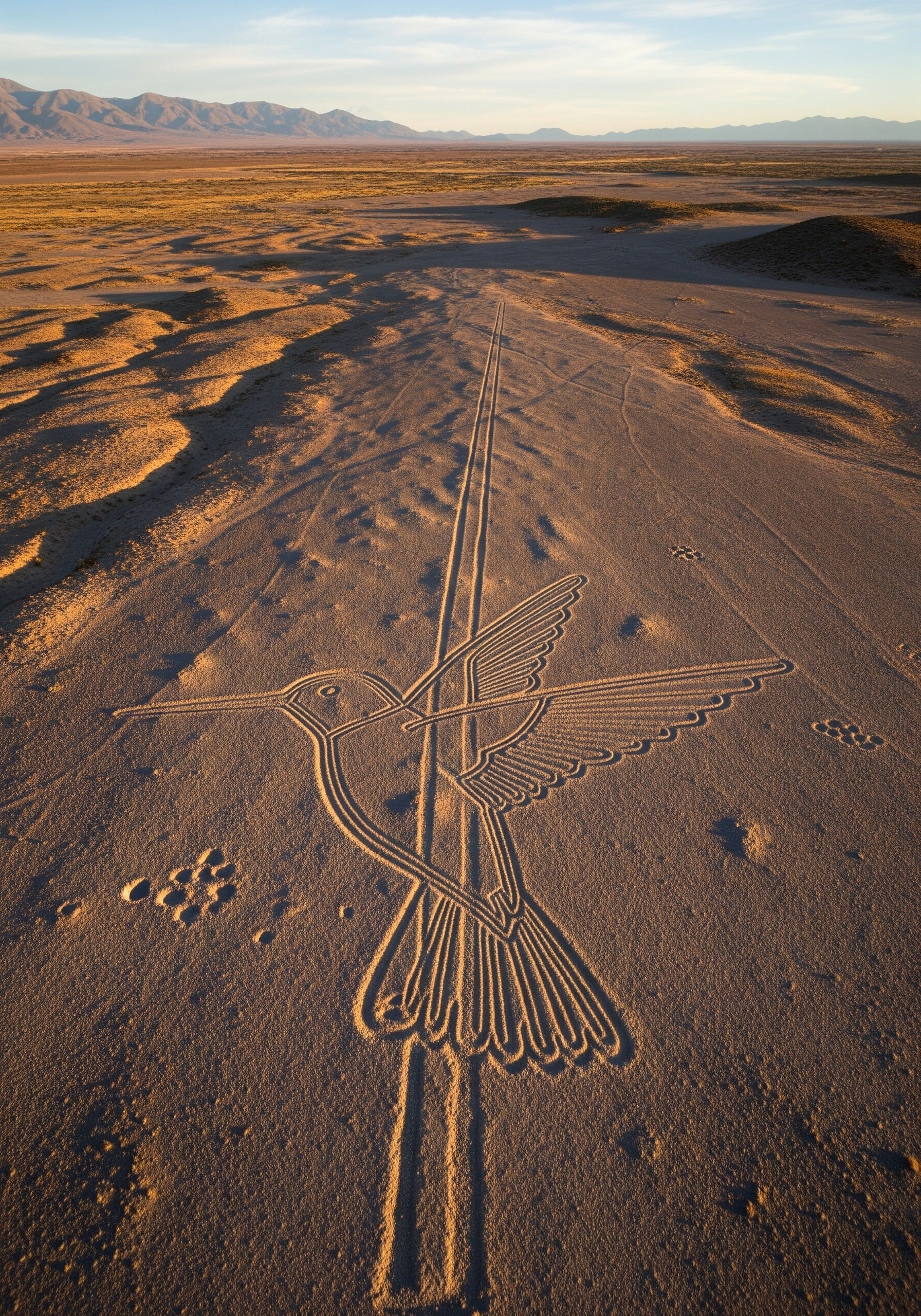
Etched into the desert pavement between roughly 200 BCE and 600 CE, the Nazca geoglyphs of southern Peru cover about 450 square kilometres and include over a thousand designs — straight lines stretching up to 30 miles, geometric trapezoids, and the famous biomorphs (monkey, hummingbird, spider, killer whale). They are invisible from ground level and reveal themselves only from the air. That fact alone seeded a century of fringe theory.
The mainstream consensus is that the lines were ceremonial pathways, likely connected to water-cult rituals — Nazca was an arid civilisation perpetually at the edge of drought. But the consensus is thinner than it looks. Why these specific shapes? Why this scale? Why so many redrawings? Yamagata University’s drone-and-AI survey programme has added more than 300 newly identified geoglyphs since 2019, suggesting we still do not know how many there really are. For more on Andean iconography, see our piece on the Paracas mystery.
Costa Rica’s stone spheres — perfect geometry, no records
In 1940 the United Fruit Company began clearing jungle in the Diquís Delta of southern Costa Rica and uncovered, scattered across river terraces, a population of perfect stone spheres. Roughly 300 are known. They range from grapefruit-sized to 2.5 metres in diameter, weighing up to 16 tonnes, and the largest are ground to within a few centimetres of geometric perfection. They were made by the pre-Columbian Diquís culture between roughly 600 and 1500 CE — the dating itself is firm — but their purpose is not. Many were moved by 20th-century landowners as garden ornaments, destroying their original alignments and contexts. UNESCO inscribed four surviving sites in 2014 precisely to protect what little context remains.
Roman dodecahedrons and the age of the Sphinx
Two smaller puzzles round out the canonical list. The first: roughly 120 hollow bronze dodecahedrons, each with twelve pentagonal faces studded with knobs at the vertices and a circular hole of varying size on each face, found scattered across the northwestern Roman provinces — Britain, Gaul, Germania — and dated to the 2nd to 4th centuries CE. Not one Roman text mentions them. Theories run from surveying tools to knitting jigs to candleholders to religious objects. None is conclusive.
The second is the Great Sphinx of Giza itself — not whether it exists (obviously it does) but whose face it bears and exactly when it was carved. The orthodox view places its construction in the reign of Khafre around 2500 BCE, but the unusual weathering pattern on the limestone enclosure walls has fuelled a still-unresolved geological debate about whether parts of the monument could be older than the dynastic Egyptians who later co-opted it. For more on Egypt’s foundational debates, see our coverage of the pyramid-building question.
How close are we, really? A 2026 status check
Reporting on these mysteries usually stops at “no one knows.” That is misleading. Some are inches from a breakthrough; others remain genuinely intractable. The table below is our honest reading of where the evidence stands.
| Mystery | Approx. age | Location | Closer in 2026? |
|---|---|---|---|
| Göbekli Tepe | c. 9600 BCE | Şanlıurfa, Turkey | Yes — neighbouring Karahan Tepe is reshaping the picture |
| Antikythera Mechanism | c. 100 BCE | Aegean Sea (Greece) | Yes — 2021 UCL reconstruction is widely accepted |
| Voynich Manuscript | 1404–1438 CE | Yale Beinecke Library | No — every recent “solution” has been refuted |
| Linear A | 1800–1450 BCE | Crete (Minoan) | Maybe — AI pattern analysis is the best hope |
| Nazca Lines | 200 BCE – 600 CE | Southern Peru | Partly — drones keep finding new ones |
| Costa Rica spheres | c. 600–1500 CE | Diquís Delta | No — most context was destroyed in the 1940s |
| Roman dodecahedrons | 2nd–4th c. CE | NW Roman provinces | No — no contemporary text mentions them |
| Great Sphinx age | c. 2500 BCE (disputed) | Giza, Egypt | Slowly — geological dating still controversial |
A useful umbrella resource for anyone going deeper is the Smithsonian Magazine archaeology archive, which tracks new finds in close to real time. You may also enjoy our companion piece on the Bronze Age collapse, which sets several of these puzzles in their wider historical frame.
Frequently Asked Questions
Q: What is the oldest unsolved ancient mystery?
A: By a wide margin, Göbekli Tepe in southeastern Turkey, with construction beginning around 9600 BCE — more than six thousand years before Stonehenge or the Egyptian pyramids. We know who built it (Pre-Pottery Neolithic foragers) but still do not know why hunter-gatherers organised that much labour for monumental architecture they apparently did not live in.
Q: Has the Voynich Manuscript been deciphered?
A: No. Despite headline-grabbing announcements roughly every two years, no proposed translation of the Voynich Manuscript has survived peer-review or been independently reproduced. The text behaves statistically like a real natural language, but without a bilingual reference text or a definitively identified subject illustration, no decipherment has been verified.
Q: Why can’t we read Linear A if we can read Linear B?
A: Linear B was cracked because it turned out to encode an early form of Greek, a language already well known to scholars. Linear A encodes an unknown language — almost certainly “Minoan” — for which we have no other source. Applying Linear B’s phonetic values to Linear A signs produces non-words. Without a bilingual inscription, decipherment is currently impossible.
Q: Are any of these ancient mysteries close to being solved in 2026?
A: Yes — two in particular. The Antikythera Mechanism is now well understood functionally thanks to the 2021 UCL reconstruction; remaining questions concern manufacturing and provenance rather than purpose. Göbekli Tepe is being progressively contextualised as nearby sister sites (Karahan Tepe, Sayburç) are excavated, slowly revealing a whole forgotten Neolithic culture rather than a single anomalous temple.
Real archaeology is slower, less theatrical and far more rigorous than the documentary genre suggests — but it is also genuinely closing in on some of these puzzles. The list of ancient mysteries still unsolved in 2050 will almost certainly be shorter than the one you have just read. Which makes the present moment, with the questions still open and the evidence still arriving, an unusually good time to pay attention.
Illustrations are AI-generated. Article fact-checked and human-edited.