Ancient Mysteries That Have Been Solved: 8 Real Verdicts
For most of recorded history, the most famous ancient mysteries that have been solved in the last two decades looked permanently unsolvable: a corroded Greek calculator from a Roman-era shipwreck, a Caribbean-blue concrete that outlived empires, twelve-ton stone giants standing alone on a treeless Pacific island. They surrendered not to better guesses but to better instruments — X-ray tomography, ancient DNA, satellite radar, dendrochronology. The headline isn’t only that the puzzles cracked. It’s why they cracked all at once.
Key Facts
- The Antikythera Mechanism, the world’s first analog computer, is calibrated to begin on 12 May 205 BC — confirmed by aligning its eclipse dial with Babylonian records.
- A January 2023 MIT study (Masic et al., Science Advances) identified lime clasts plus “hot-mixing” as the reason 2,000-year-old Roman concrete still heals its own cracks.
- In 2012, archaeologists Carl Lipo and Terry Hunt walked a 4.35-tonne moai replica with just 18 people, three ropes, and a rocking gait — covering 100 metres in under an hour.
- A 2022 Nature paper sequenced Yersinia pestis DNA from 1338-dated tombstones beside Lake Issyk Kul, Kyrgyzstan — locating the Black Death’s birthplace.
- A 993 AD solar storm fingerprint in tree rings at L’Anse aux Meadows fixed the Vikings’ arrival in the Americas to AD 1021, exactly 471 years before Columbus.
In short: The famous ancient mysteries that have been solved in recent years weren’t cracked by armchair theorising — they fell to a wave of new science (ancient DNA, micro-CT, satellite remote sensing, cosmic-ray dating) that finally caught up to the questions our ancestors left behind. The pages below take the eight strongest cases and tell each one with the dates, names and mechanisms intact.
Key Facts
- The Antikythera Mechanism, the world’s first analog computer, is calibrated to begin on 12 May 205 BC, confirmed by aligning its eclipse dial with Babylonian records.
- A January 2023 MIT study (Masic et al., Science Advances) identified lime clasts plus “hot-mixing” as the reason 2,000-year-old Roman concrete still heals its own cracks.
- In 2012, archaeologists Carl Lipo and Terry Hunt walked a 4.35-tonne moai replica with just 18 people, three ropes, and a rocking gait, covering 100 metres in under an hour.
- A 2022 Nature paper sequenced Yersinia pestis DNA from 1338-dated tombstones beside Lake Issyk Kul, Kyrgyzstan, locating the Black Death’s birthplace.
- A 993 AD solar storm fingerprint in tree rings at L’Anse aux Meadows fixed the Vikings’ arrival in the Americas to AD 1021, exactly 471 years before Columbus.
In short: A wave of new scientific instruments, including ancient DNA, micro-CT scanning, satellite remote sensing, and cosmic-ray dating, cracked a cluster of long-standing ancient mysteries between roughly 2005 and 2020. The article presents eight of the strongest cases as genuinely closed, peer-reviewed verdicts rather than fresh speculation. Each is told with the dates, names, and mechanisms intact, ordered by how completely the original riddle has been answered.
Why ancient mysteries that have been solved tend to fall in clusters
Every generation gets the ancient mysteries it can afford to solve. The Victorians could measure pyramids; they couldn’t sequence a 700-year-old tooth. Today’s archaeologists barely dig at all in the old sense. Their power tools are micro-computed-tomography scanners, ground-penetrating radar (GPR), LiDAR drone surveys, isotope mass spectrometers and ancient-DNA labs that can pull a single bacterial genome out of dental calculus. That toolkit matured between roughly 2005 and 2020, which is why so many “unsolvable” puzzles cracked in the same window.
What follows are eight of the strongest cases. Each one is genuinely closed — not just newly speculated — with peer-reviewed citations behind the verdict. We’ve put them in the order of how completely the original riddle has been answered.
1. The Antikythera Mechanism: a Greek computer that predicted eclipses
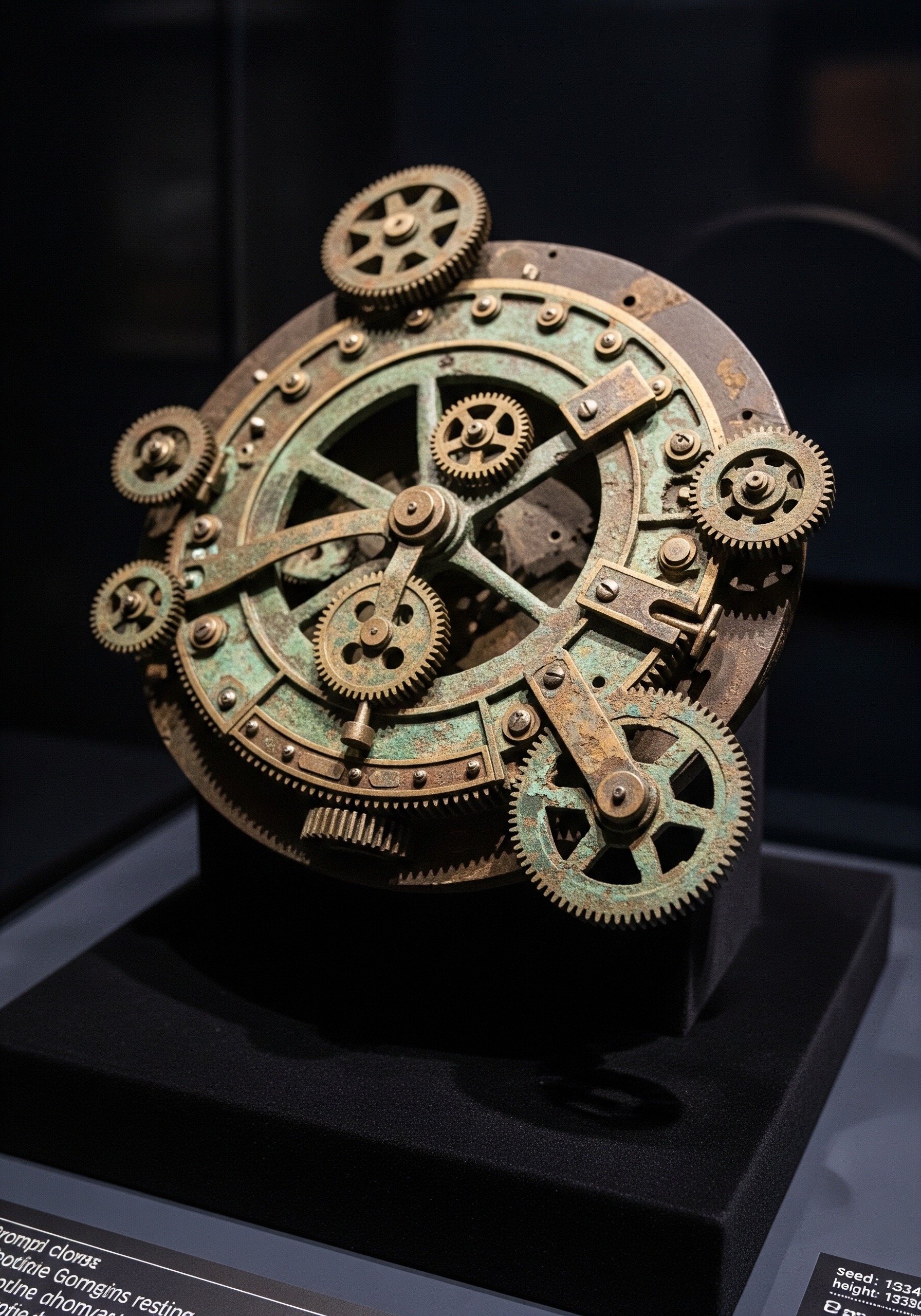
Sponge divers off the islet of Antikythera hauled a corroded bronze lump out of a Roman-era shipwreck in 1901. For sixty years nobody could read it. Then, in the 2000s, a team led by Tony Freeth (UCL) and Mike Edmunds (Cardiff) used a custom-built 8-tonne micro-CT scanner from X-Tek Systems to look inside the fused gear-train. They found at least 30 hand-cut bronze gears modelling the synodic month, the metonic 19-year cycle, the saros eclipse cycle, and the irregular orbit of the Moon — a piece of Hellenistic engineering that wouldn’t be matched until 14th-century European clockmakers.
The kicker came when astrophysicist James Evans aligned the saros dial against Babylonian eclipse records: the device’s “year zero” is 12 May 205 BC, the date of a real solar eclipse. A 2021 UCL paper led by Freeth then completed the front-face cosmology, showing the mechanism modelled the five planets known to the ancients. Verdict: this is a fully resolved mystery. The world had analog computers more than 1,000 years before the Renaissance, and one of them survived.
{IMAGE_2}
2. Why Roman concrete still stands while ours crumbles
Visit the dome of the Pantheon (built AD 126) or a Roman harbour mole at Caesarea Maritima and you are looking at concrete that has shrugged off two millennia of seawater, freeze-thaw and earthquake. Modern Portland-cement concrete typically begins to spall within 50 to 100 years. Why?
For decades engineers credited the volcanic ash (pozzolana) the Romans mixed in. That was partly right and crucially incomplete. In January 2023, an MIT–Harvard team led by Admir Masic published in Science Advances the missing piece: the small white “lime clasts” embedded in Roman concrete — long dismissed as sloppy mixing — are in fact the secret. Roman builders used hot mixing, adding water to dry quicklime so the reaction itself heated the batch. That left chemically reactive lime pockets throughout the cured concrete. When micro-cracks form and water seeps in, those pockets dissolve and recrystallise as calcium carbonate, sealing the crack like organic scar tissue. Masic’s team made replica concrete with and without hot-mixed lime clasts: only the Roman-style batch self-healed. The recipe is now being adapted for 3D-printed concrete trial pours.
3. How the moai of Easter Island “walked”
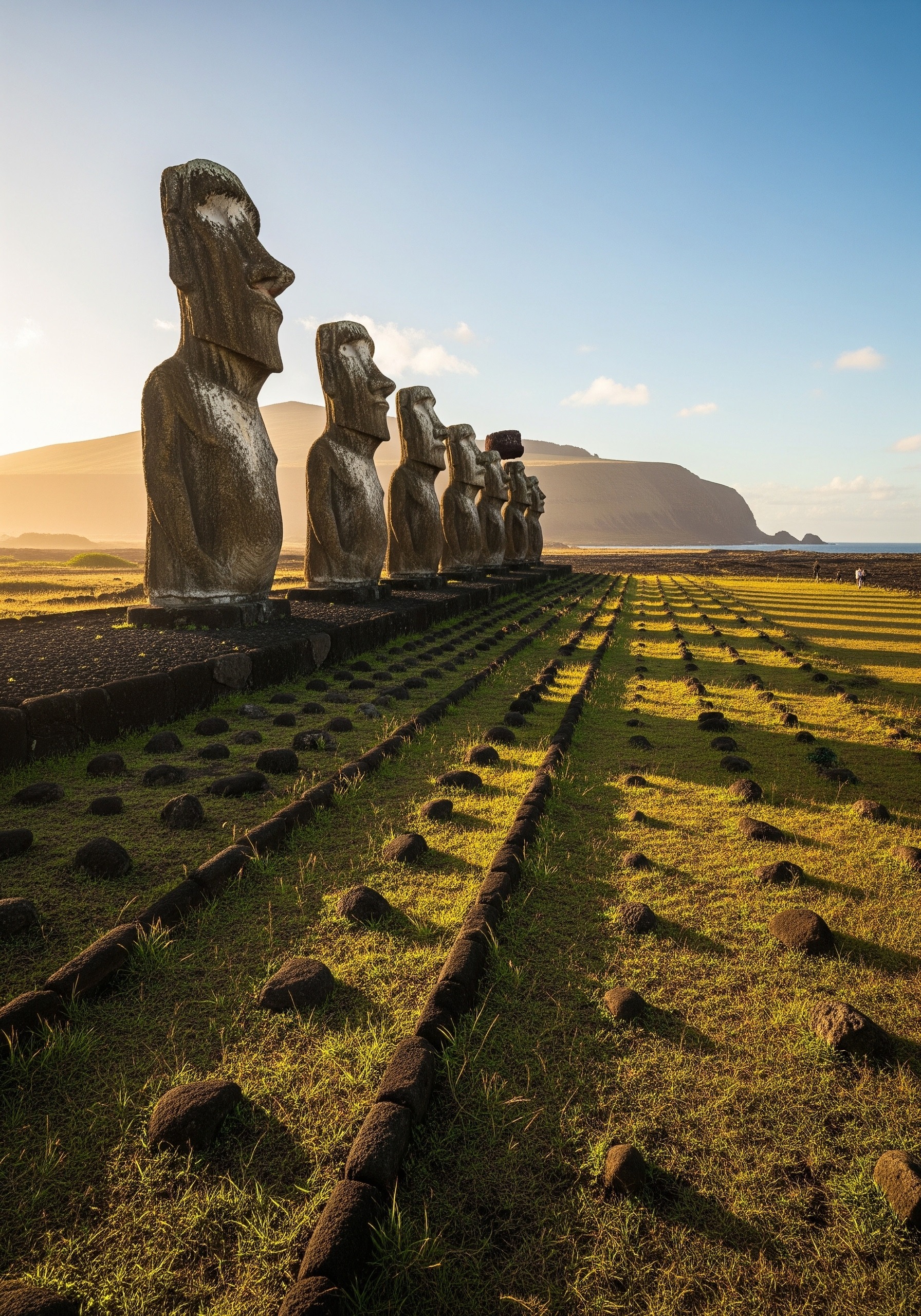
The Rapanui have always said it plainly: the moai walked from the quarry to their ahu platforms. Western archaeology rolled its eyes for a century and reached for log rollers, sledges and depopulation hypotheses. Then Carl Lipo (Binghamton) and Terry Hunt (Arizona) noticed something subtle on the road moai (the ones abandoned in transit): a forward lean of about 17° and a wide D-shaped base — exactly the geometry you’d want for rocking.
In 2012 they cast a 4.35-tonne concrete moai matching those proportions and, with 18 people working three hemp ropes, walked it 100 metres in under an hour. A 2025 follow-up by Lipo’s group used Easter Island’s actual road network in 3D, showing the roads themselves are concave — precisely the surface a rocking, walking statue wants. Verdict: a centuries-old “mystery” was simply oral history we refused to listen to. The technical part has now been replicated on camera.
4. The Black Death’s true birthplace
For almost 700 years historians argued over where the second plague pandemic — the one that erased a third of Europe between 1346 and 1353 — actually started. China? Mongolia? The lower Volga? In June 2022 a Max Planck team (Maria Spyrou, Johannes Krause and Phil Slavin) put the question to bed in Nature. They had ancient teeth from a small Nestorian cemetery at Kara-Djigach, in the Chu Valley near Lake Issyk Kul, in modern Kyrgyzstan. The tombstones were dated and inscribed: an unusual spike of burials in 1338 and 1339, eight years before the plague reached Caffa on the Black Sea.
DNA pulled from three of those teeth was Yersinia pestis — and not just any strain. It sat at the root of the family tree from which every Black Death lineage radiated. Modern marmots in the surrounding Tian Shan still carry its closest living descendant. So the pandemic that reshaped medieval Europe began as a local outbreak in a mountain valley most Europeans of the time had never heard of.
5. When Vikings actually stepped onto American soil — to the year
That Norse explorers reached Newfoundland before Columbus has been textbook since 1960, when Helge and Anne Stine Ingstad excavated turf longhouses at L’Anse aux Meadows. The harder question was always when. Sagas suggested “around 1000,” but sagas aren’t dates. In October 2021 a team led by Margot Kuitems and Michael Dee (University of Groningen) published in Nature a piece of dating wizardry: in AD 993 the Sun unleashed a massive cosmic-ray storm that left a spike of carbon-14 inside every tree alive that year — a global, single-year time-stamp. Three pieces of wood at L’Anse aux Meadows showed the spike, and each had exactly 28 more growth rings after it before being cut with a metal axe. The cut year: AD 1021. Vikings stood in the Americas 471 years before Columbus, and we now know it to the calendar year.
6. The lost city of Helike, found beneath a lagoon
One winter night in 373 BC, the classical Greek city of Helike on the Gulf of Corinth was destroyed by an earthquake and a tsunami so completely that travellers two centuries later still rowed over its drowned columns. Then it disappeared from the map. The Greek archaeologist Dora Katsonopoulou launched the Helike Project in 1988 with seismologist Steven Soter (American Museum of Natural History). Using bore-hole sediment cores and magnetometer surveys, they finally pinpointed the city in 2001 — not under the sea but beneath an inland lagoon and the alluvial fan of the Selinous River, exactly where Hellenistic geology predicted a tsunami-deposited city ought to lie. Excavations since have uncovered Bronze Age and Classical layers, including a paved Roman road that runs straight into the destruction horizon.
7. Why the stones of Death Valley sail across the desert
On the dry lakebed of Racetrack Playa, rocks weighing up to 300 kg leave long grooved trails behind them, sometimes parallel, sometimes curving in unison. No one had ever seen one move. Hypotheses ranged from hurricane winds to algal slime to magnetism. In December 2014, Richard and James Norris published in PLOS ONE the answer, captured on time-lapse: on the rare winter nights when a thin film of water on the playa freezes, the ice forms transparent panels around the stones. Light breezes — sometimes as gentle as 5 m/s — push the floating panels, which slide and drag the rocks beneath them, leaving the famous tracks. The motion is so slow you’d never spot it standing there. Cameras finally outlasted human patience.
8. The Nazca lines, the puquios, and a desert that always needed water
The Nazca geoglyphs of southern Peru aren’t a mystery in the sense their ancient-aliens reputation suggests — local archaeologists have long argued they are ceremonial. What was genuinely unexplained was the spiral-shaped funnels (puquios) carved into the same desert. In a series of papers culminating in 2016, Rosa Lasaponara and Nicola Masini of Italy’s CNR used satellite radar imagery to map the puquios as part of a deliberate, kilometres-long subterranean aqueduct network. The funnels capture wind, drive air pressure into the underground channels, and force aquifer water through them — an ancient peristaltic pump. The lines and the puquios are now read together: the Nazca were drawing prayers across the surface of a sophisticated water civilisation, not floating signals to the stars.
How modern science cracked each case — a quick reference
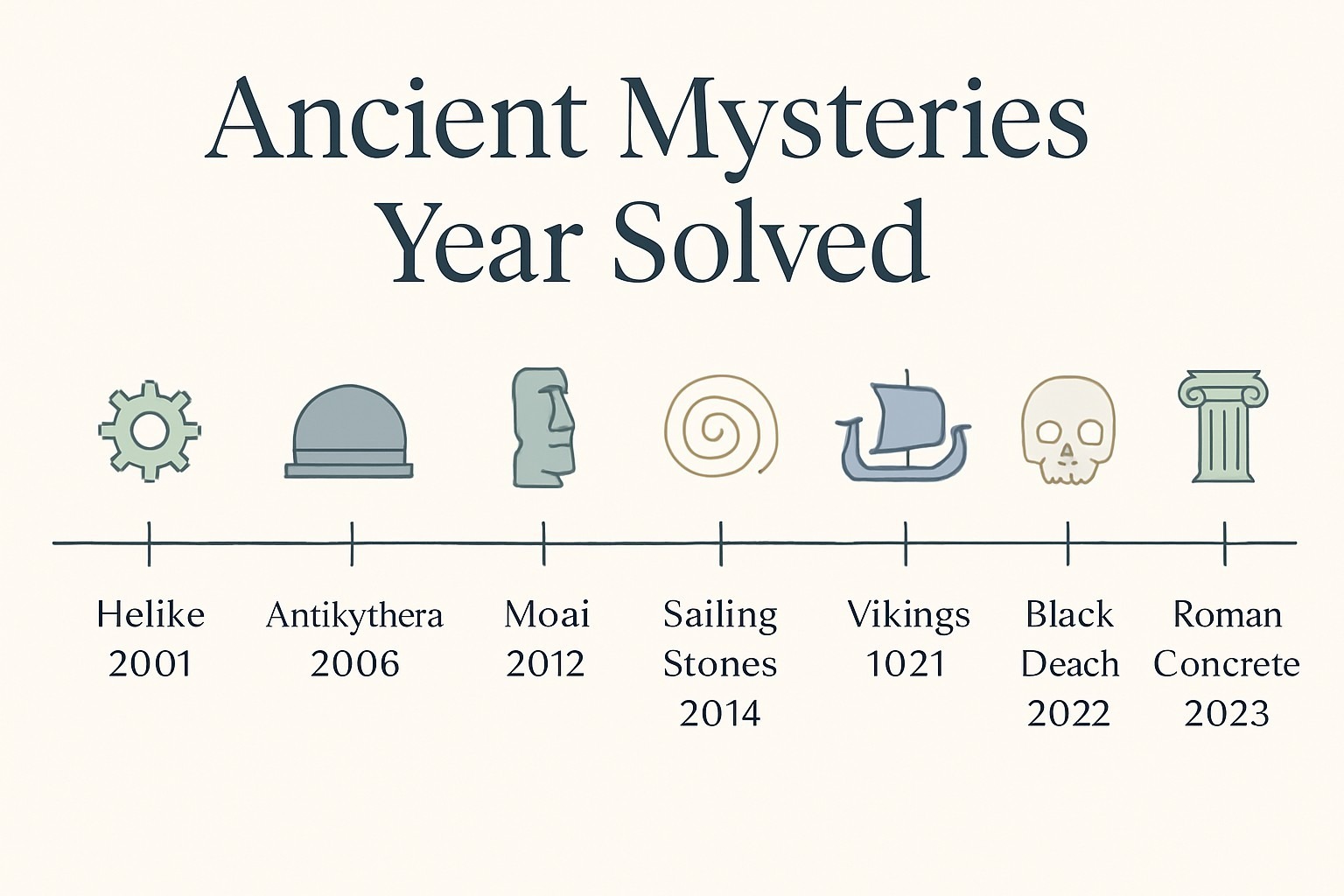
| Mystery | Year resolved | Key tool | Published in |
|---|---|---|---|
| Antikythera Mechanism function | 2006 / 2021 | Micro-CT, eclipse-date alignment | Nature, Scientific Reports |
| Roman concrete self-healing | 2023 | SEM + lime-clast chemistry | Science Advances |
| Moai transport (“walking”) | 2012 | Replica + biomechanics | Journal of Archaeological Science |
| Black Death origin | 2022 | Ancient Y. pestis DNA | Nature |
| Viking arrival in the Americas | 2021 | 993 AD solar-storm tree-ring spike | Nature |
| Lost city of Helike | 2001 | Magnetometry + sediment cores | Helike Project reports |
| Death Valley sailing stones | 2014 | Time-lapse, GPS, ice-pane observation | PLOS ONE |
| Nazca puquios function | 2016 | Satellite radar mapping | CNR / various |
What the solved cases teach us about the unsolved ones
If you stack the eight verdicts above, a pattern jumps out. Every resolution arrived through a method that simply did not exist when the mystery was originally posed. Sponge divers in 1901 could no more read the Antikythera Mechanism’s gears than a Victorian could sequence a tooth. The lesson is humility about today’s “unsolvables.” The Indus Valley script, the purpose of Göbekli Tepe’s earliest enclosures, the fate of the Sea Peoples, the function of the Phaistos Disc — these aren’t permanent dead-ends. They are waiting on the next instrument. Machine-learning approaches to undeciphered scripts (Brown’s 2024 Vesuvius Challenge unrolled carbonised Herculaneum scrolls and recovered legible Greek) are an obvious near-future candidate.
For curious readers, the cluster of ancient mysteries on this site treats the still-open cases the same way: with primary sources, named scientists, and a healthy refusal to fill silence with mysticism. See also our deeper pieces on the lost cities found by LiDAR and what ancient DNA has rewritten about human prehistory.
Frequently Asked Questions
Q: What is the most famous ancient mystery that has been solved?
A: Most archaeologists point to the Antikythera Mechanism. Until micro-CT scans in the 2000s, no one knew the corroded Greek bronze from a 1901 shipwreck was a working astronomical calculator. It now stands as the oldest known analog computer, calibrated to begin on 12 May 205 BC.
Q: Which ancient mystery was solved most recently?
A: The chemistry of Roman self-healing concrete, settled by MIT and Harvard in January 2023 (Masic et al., Science Advances). The 2022 paper locating the Black Death’s origin in Kyrgyzstan is a close second.
Q: Are any of these “solved” cases actually still debated?
A: Always at the edges. Some scholars argue the moai may have been transported by multiple methods, not only walking, and the exact start-date of the Antikythera Mechanism is debated between 205 BC and 100 BC. But the core questions — what the device did, how the statues moved, where the plague began — are no longer open.
Q: What unsolved ancient mystery is closest to being cracked?
A: The unrolling of the carbonised Herculaneum scrolls, buried by Vesuvius in AD 79, jumped forward dramatically in 2024 when machine-learning teams in the Vesuvius Challenge began reading legible Greek philosophy from inside the still-rolled papyri. A working translation of the full library is plausible this decade.
The famous ancient mysteries that have been solved share more than headlines. They share the same arc: a question posed by people who could not possibly answer it, kept alive by storytellers and skeptics, and finally settled by a generation that built the right machine. The next batch is already in the labs.
Illustrations are AI-generated. Article fact-checked and human-edited.