Black Vulture: The Silent, Voiceless Scavenger of the Americas
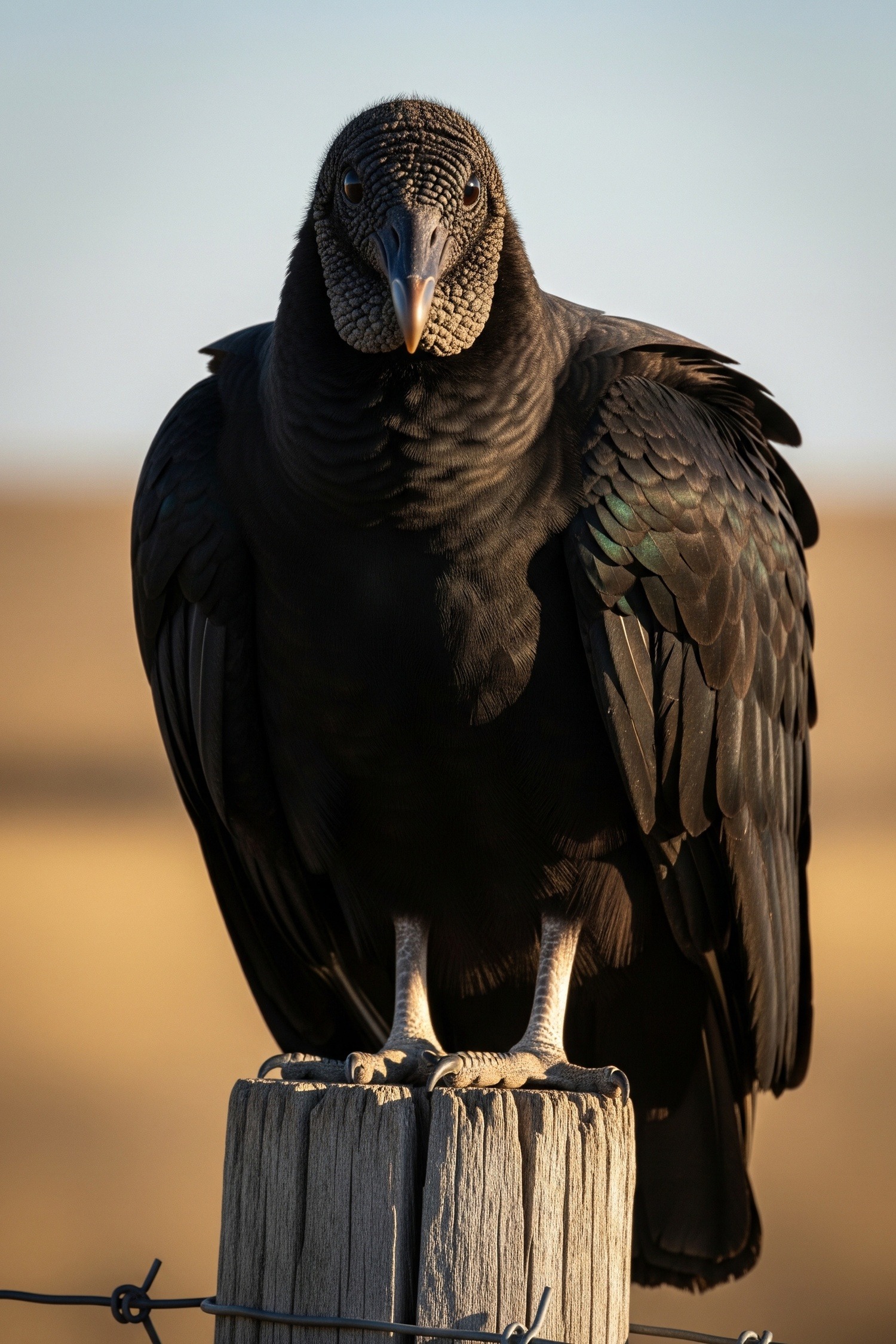
A bald head catches the light. Wings spread nearly five feet wide. The black vulture — Coragyps atratus — sits motionless on a fence post, and you realize something has shifted in your understanding of what evolution actually rewards. This bird has no voice box at all, no mechanism for song or call, just a low rattling hiss. And it’s been winning, consistently, for millions of years.
Most birds possess a syrinx — the avian vocal organ located at the base of the trachea, a structure so sophisticated it allows songbirds to produce two independent sounds simultaneously. The black vulture has none. Zero syrinx, no vocal membrane, no structured sound whatsoever. Ornithologists at the Cornell Lab of Ornithology have documented this anatomical absence in detail, noting that the bird produces only grunts, hisses, and low barking sounds generated by forcing air through its throat.
Key Facts
- The black vulture (Coragyps atratus) has no syrinx — the avian vocal organ — and produces only grunts, hisses, and low barking sounds by forcing air through its throat, as documented by the Cornell Lab of Ornithology
- Black vulture stomach acid is concentrated to pH levels between 1 and 2, corrosive enough to neutralize anthrax, botulinum toxin, and cholera bacteria
- Black vultures cannot smell carrion themselves and instead follow Turkey Vultures (Cathartes aura) — which have unusually large olfactory bulbs — to food, then displace them through aggressive group behavior
- A 2016 study in the journal Animal Behaviour found black vultures recognize individual flock members and preferentially follow birds with a reliable history of finding food
- A 2018 U.S. Department of Agriculture Wildlife Services report documented verified black vulture attacks on livestock across 17 U.S. states, with Virginia, Kentucky, Tennessee, and the Carolinas reporting the highest incidences
In short: The black vulture (Coragyps atratus) has no vocal organ — no syrinx, only hisses — yet thrives by following Turkey Vultures to carrion, displacing them through group dominance. Its stomach acid (pH 1–2) neutralizes anthrax, botulinum, and cholera. A 2016 Animal Behaviour study showed it recognizes individual flock members, and 2018 USDA data document live livestock predation across 17 states.
The Black Vulture’s Ancient, Voiceless Design
What makes this silence meaningful is what the bird does instead. For a creature that spends so much time in close social proximity to others of its kind — roosting communally, feeding together, raising chicks — this seems like a profound limitation. It isn’t. The black vulture compensates with body language of extraordinary precision, using wing position, head angle, and proximity to communicate dominance, submission, and intention with a clarity that language, arguably, only muddies. Watch one land near a carcass and you see the intelligence immediately. It doesn’t rush. It circles, assesses, watches the other birds already feeding. Then it makes its move — deliberate, calculated, unhurried.
The bird’s naked black head — that wrinkled, leathery skin with no feathers — isn’t just a visual oddity. It’s functional architecture. When a vulture plunges its head deep into a carcass, feathers would trap bacteria and decay. Bare skin dries faster, stays cleaner, and allows ultraviolet radiation from the sun to kill pathogens that would hospitalize most other animals.
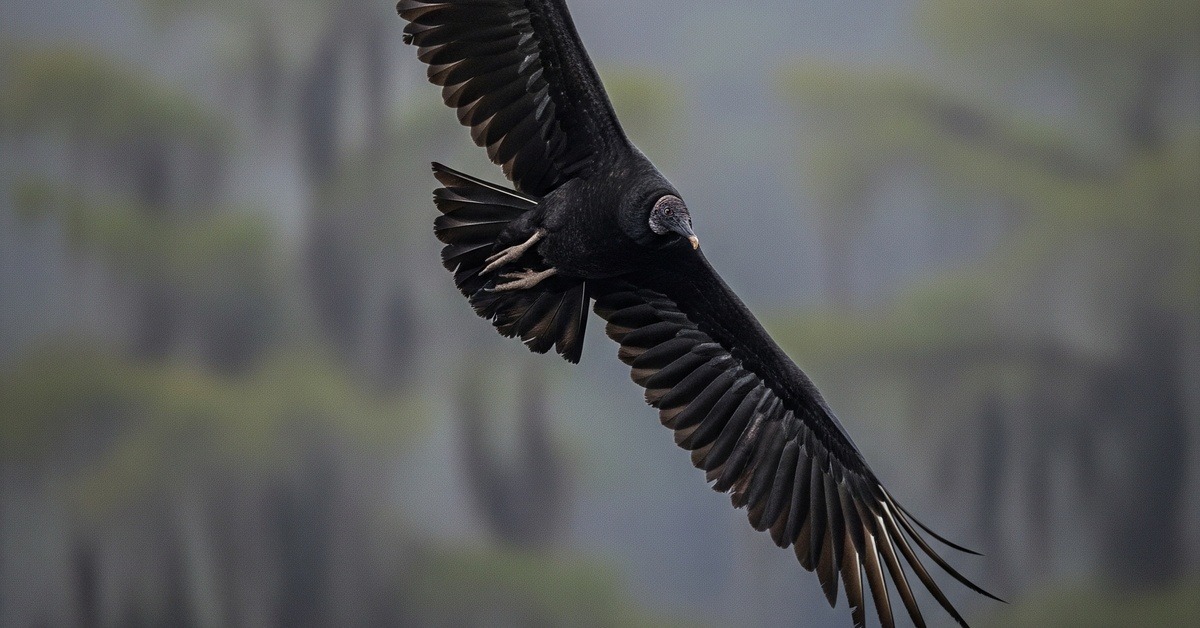
Their stomach acid is extraordinarily concentrated. pH levels between 1 and 2, corrosive enough to neutralize anthrax, botulinum toxin, and cholera bacteria that would be lethal to mammals. They’re not just scavengers.
They’re biological containment systems.
Social Hunters Who Follow the Nose of Others
Here’s the paradox at the heart of black vulture ecology: this bird, one of the most successful scavengers on the continent, cannot smell carrion. At all. Its Turkey Vulture cousin (Cathartes aura) possesses an unusually large olfactory bulb — rare among birds — capable of detecting the volatile compounds released by decomposing flesh from over a mile away, even through a dense forest canopy. The black vulture has no such gift.
So it cheats. Black vultures actively follow Turkey Vultures to carcasses, using them as unwitting guides, then use their superior size and aggressive group behavior to muscle the finders off the food. Turns out this isn’t a flaw in their design — it’s the whole design. Ecologists at the Smithsonian Tropical Research Institute have been studying this for decades: what behavioral ecologists call kleptoparasitism, the theft of resources found or prepared by another species. Much like ancient predators working in coordinated groups, collective behavior turns individual limitation into systemic advantage.
The social intelligence required to execute this strategy consistently is underappreciated. Black vultures form tight, multigenerational family groups. Juveniles — which don’t develop the fully black head until around their second year — are tolerated at feeding sites specifically because their parents are present.
Adults have been documented sharing information about food locations by leading roost-mates back to carcasses. This implies spatial memory, social recognition, and something close to intentional communication. A 2016 study published in the journal Animal Behaviour found that black vultures recognize individual flock members and preferentially follow birds with a reliable history of finding food. They track reputation. In a bird with no voice.
Not Just Scavengers: When the Bird Hunts
A farmer in Georgia watching a dozen black vultures descend on a dead calf might see chaos. What he’s actually watching is coordinated intelligence — a social network in action, built on decades of family bonds and hard-won spatial knowledge of the landscape. But the reputation of the black vulture as a strict carrion-eater is, it turns out, significantly incomplete. Documented cases of live predation by black vultures have accumulated steadily over the past three decades, and the picture that emerges is more complex — and more unsettling to livestock farmers — than cultural memory suggests.
Why does this predation happen? Because opportunity presents itself, and the black vulture is nothing if not opportunistic. According to a 2018 report by the U.S. Department of Agriculture’s Wildlife Services program, black vulture attacks on livestock resulted in verified losses across 17 U.S. states, with Virginia, Kentucky, Tennessee, and the Carolinas reporting the highest incidences. The targets are consistent: newborn calves, fawns, piglets, and adult animals weakened by injury or illness. The black vulture’s hunting technique, when it does hunt, relies on group coordination. Multiple birds approach a newborn or weakened animal simultaneously, disorienting it. They target the eyes and the soft tissues around the mouth and nose first — not because of cruelty, but because these are the most accessible entry points.
A single black vulture weighing under five pounds can’t bring down a calf. A group of twelve working in unison is a different proposition entirely. Farmers who’ve witnessed it describe it as methodical, almost eerily calm. No frenzy. Just process. This behavioral flexibility — scavenger when carrion is available, predator when opportunity presents — is precisely why the black vulture has thrived while so many other large birds have declined. Rigidity is a vulnerability (and the black vulture has none of it). National Geographic’s species documentation confirms that while the black vulture is primarily a scavenger, it is classified as an opportunistic predator when live prey is accessible and vulnerable.
What the Black Vulture Reveals About Ecosystem Health
Strip the black vulture from an ecosystem and you begin to understand what it was doing there. 2016. University of Utah. Researchers estimated that a single large vulture congregation can consume an entire deer carcass — bones included — within 24 hours, a rate of decomposition that would otherwise take weeks of bacterial and insect activity. That speed matters. Carcasses left to decompose slowly become persistent sources of disease: anthrax, rabies, cholera, and bovine tuberculosis can all persist in unprocessed remains. Vultures, with their lethal stomach acid and rapid consumption rates, are functioning as biological firewalls.
In regions of Africa where vulture populations have collapsed due to poisoning — often by poachers who kill them to prevent the birds from alerting rangers to illegal kills — disease transmission rates in wildlife populations have increased measurably, according to research published in the journal Oryx in 2019. And yet, the black vulture is, so far, not in that crisis. Coragyps atratus is listed as Least Concern by the IUCN, and its range has actually expanded northward in the United States over the past 40 years, driven by a combination of warming temperatures, increased deer populations (and thus more roadkill), and the bird’s own adaptability to suburban and semi-urban environments.
They’ve been documented nesting in abandoned buildings, under highway bridges, and in drainage culverts. They roost in groups of hundreds in city parks. The black vulture doesn’t need wilderness. It needs death — and death, in a world of 8 billion humans, is never in short supply. That ecological resilience is extraordinary. But it also masks a subtler concern: as black vultures expand into new territories, they bring their appetite for live prey with them, and the livestock conflicts that follow have become a genuine management challenge for wildlife agencies from Pennsylvania to Texas.
Legal Protections, Farmer Conflicts, and the Politics of Scavengers
The black vulture is protected under the Migratory Bird Treaty Act of 1918 — a fact that surprises many of the livestock farmers who’ve lost calves to them. Killing a black vulture without a federal depredation permit is a violation of federal law, punishable by fines up to $15,000 per bird. The U.S. Fish and Wildlife Service issues these permits, but the process is lengthy, the criteria are strict, and the permits don’t prevent future attacks. The Kentucky Department of Fish and Wildlife Resources documented over 300 individual livestock loss complaints involving black vultures between 2015 and 2020, with estimated economic losses running into the hundreds of thousands of dollars.
For small-scale farmers, a single coordinated attack on a newborn calf isn’t just a wildlife encounter — it’s a month’s income gone in an afternoon. Non-lethal deterrents have shown variable results. Effigy vultures — realistic hanging replicas of dead black vultures — have been used since at least the early 2000s to discourage roost establishment and feeding. A 2012 study by the USDA National Wildlife Research Center found that effigies reduced black vulture activity at target sites by an average of 62% in the short term, though birds typically habituated within a few weeks.
Pyrotechnics, lasers, and exclusion netting around calving areas have all been tested with mixed success. The problem is that you’re trying to out-maneuver a socially intelligent bird that has been solving ecological problems for millions of years longer than modern agriculture has existed. And the data left no room for alternative interpretation — the bird was simply too adaptable, its social learning too advanced, for any single deterrent to work indefinitely.
Wildlife managers in Virginia and North Carolina have begun working directly with farming communities to develop early-warning systems — documenting the specific family groups responsible for repeat attacks and tailoring responses to individual roost locations. It’s slow, resource-intensive work. But it reflects a growing recognition that the black vulture isn’t going anywhere, and the conflict requires management, not elimination.
Where to See This
- The Great Smoky Mountains National Park (Tennessee/North Carolina, USA) offers reliable year-round black vulture sightings — look for communal roosts near park visitor centers in early morning, particularly in autumn and winter when groups of 50 or more birds are common.
- The Pantanal wetlands of Brazil and Bolivia host some of the highest black vulture densities in South America; wildlife operators based out of Cuiabá, Mato Grosso, regularly include vulture behavior in ecological tour programming.
- The Cornell Lab of Ornithology’s All About Birds platform (allaboutbirds.org) maintains detailed range maps, vocalisation recordings (yes, even the hisses), and citizen science reporting tools that allow you to track real-time population movement across the Americas.
By the Numbers
- Wingspan of up to 1.5 metres (approximately 59 inches), with a body weight typically between 1.8 and 2.3 kg (4–5 lbs) — deceptively light for a bird that dominates feeding sites.
- Stomach acid pH of 1–2, among the most acidic recorded in any vertebrate — capable of destroying anthrax spores and botulinum toxin that would be lethal to most mammals.
- Recorded soaring speeds of over 60 mph (96 km/h) on thermal updrafts, despite a relatively low wing-loading ratio compared to raptors of similar size.
- Range of approximately 22 million km² across the Americas — from southern Canada to Tierra del Fuego — making it one of the most geographically widespread vulture species globally (IUCN, 2022).
- Over 300 verified livestock attack complaints filed in Kentucky alone between 2015 and 2020, per the Kentucky Department of Fish and Wildlife Resources.
Field Notes
- In 2009, ornithologists observing a roost site near Gainesville, Florida, documented juvenile black vultures returning to their natal roost group up to three years after hatching — an unusually extended period of family association for a non-cooperative breeding species, suggesting multigenerational social bonds that researchers hadn’t previously quantified.
- The black vulture urinates on its own legs — a behaviour called urohidrosis. The evaporation cools the bird in heat, and the caustic uric acid in the urine kills bacteria picked up from carcass contact. It is, simultaneously, air conditioning and antiseptic.
- Unlike most bird species, black vultures maintain long-term monogamous pair bonds and both parents incubate eggs and feed chicks — a level of co-parenting investment more commonly associated with large parrots and albatrosses than with scavengers.
- Researchers still can’t fully explain why black vulture roosting aggregations sometimes include thousands of individuals. Whether these mass roosts function primarily as information centres (birds following successful foragers), as thermoregulation structures, or as something else entirely remains genuinely unresolved — and the answer may be all three simultaneously.
Frequently Asked Questions
Q: Is a black vulture dangerous to humans?
Direct attacks on healthy adult humans are essentially unrecorded. The black vulture poses no realistic threat to people in normal outdoor settings. Its defensive behaviour — projectile vomiting of stomach contents, which are highly acidic and foul-smelling — is its primary deterrent against close-range threats. Children and small pets in areas with established black vulture populations warrant routine supervision, but the bird’s predatory attention is focused on weakened or newborn livestock, not on humans.
Q: How do black vultures find food if they can’t smell it?
The black vulture relies almost entirely on vision and social information-sharing to locate carrion. Its strategy is to watch Turkey Vultures, which can detect decomposition compounds olfactorily from over a mile away, and then trail them to the carcass site. Once there, the black vulture’s numerical advantage and aggressive group behaviour allow it to displace the very birds that led it to the food. It’s a system that works so reliably that Turkey Vultures essentially function as an unpaid scouting network for black vulture feeding groups.
Q: Are black vultures really a threat to livestock, or is that exaggerated?
It’s not exaggerated — but it is frequently misunderstood. The vast majority of black vulture feeding on livestock involves animals that were already dead or dying before the birds arrived, which is normal scavenging behaviour. Verified live predation does occur, and it’s well-documented across the American South and Midwest, but it’s concentrated in specific family groups operating in specific territories during calving and fawning seasons. Blanket fear of the species obscures a more tractable management challenge: identifying and monitoring the specific groups responsible for repeat predation incidents.
Editor’s Take — Dr. James Carter
What stays with me isn’t the vomiting or the naked head or even the no-voice-box strangeness, though all of that is extraordinary. It’s the reputation problem. Here’s a bird that neutralises anthrax, prevents disease outbreaks, maintains landscape hygiene at a scale no human intervention could match — and it’s despised for it. We built entire visual vocabularies of death and doom around it. The black vulture has been cleaning up our messes, silently and efficiently, for millions of years. Watching a species disappear at this speed in regions where they’ve been poisoned to nothing, you stop calling it a trend — you start calling it a loss.
The black vulture doesn’t ask for appreciation. It never has. It shows up where things have ended, does its work, and lifts off again on a thermal, wings angled, that bald head catching the sun. Ecosystems are quietly unraveling in places where vulture populations have crashed — disease spreading through carcasses that nothing will touch, landscapes slowly poisoned by what accumulates when the recyclers disappear. The black vulture is ugly, silent, and utterly indispensable. What does it say about us that we only notice the things we find beautiful?
Illustrations are AI-generated. Article fact-checked and human-edited. Our editorial standards.