Crocodile vs. Python: A Prehistoric Clash Still Playing Out
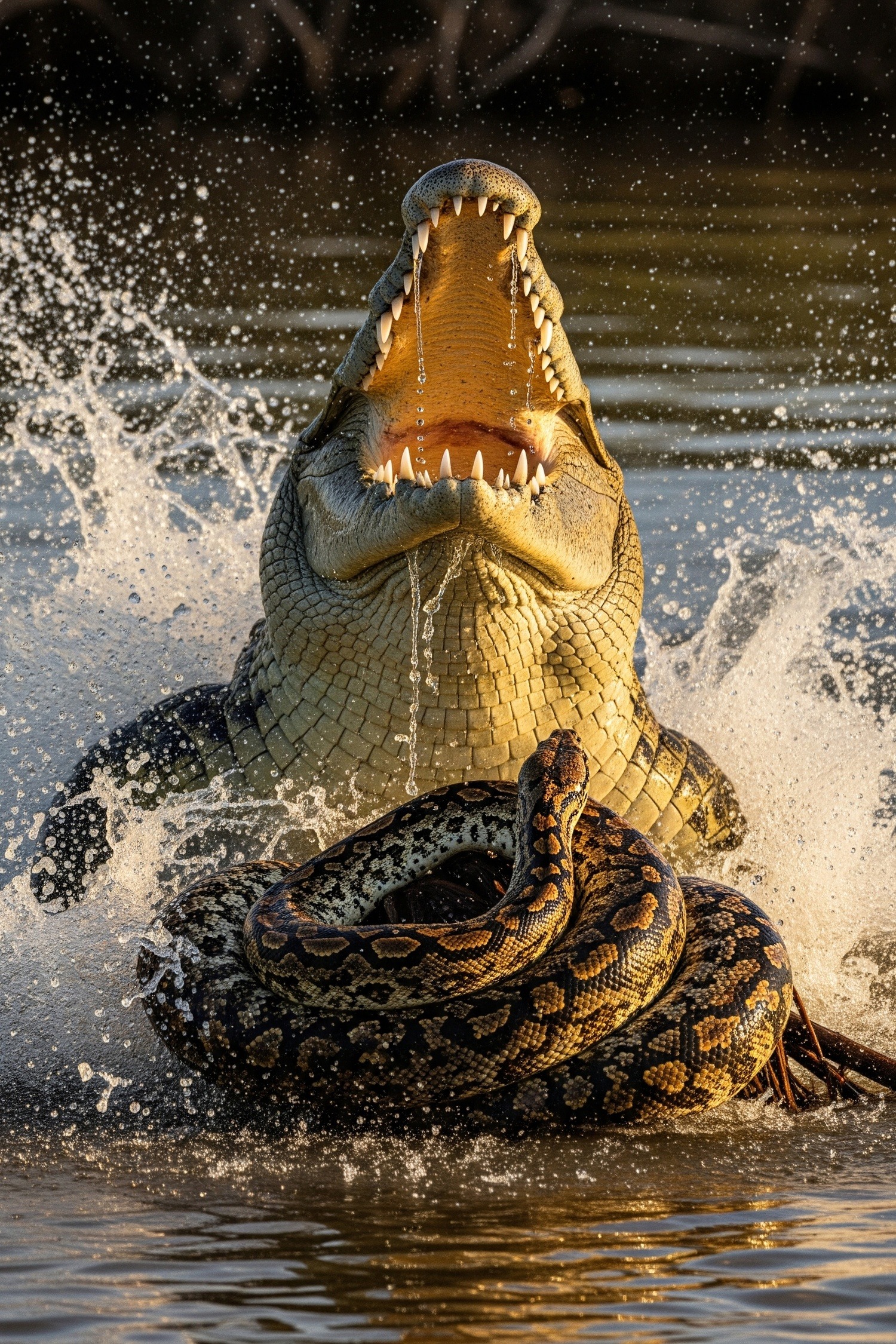
Two apex hunters. One flooded wetland. The math is brutal from the start — yet the outcome of a saltwater crocodile vs python encounter is rarely what instinct tells you to expect. The coil tightens. The jaws don’t care. This isn’t a collision between two equals testing each other. It’s a collision between two entirely different philosophies of killing, and one of them has been refining its technique for roughly 80 million years.
In the tropical north of Australia, monsoon rains flood the lowlands each wet season. Scrub pythons and saltwater crocodiles share the same murky territory. Both are ambush hunters. Both have been refining their techniques for tens of millions of years. Yet when these two animals meet, something unexpected happens — not a stalemate, but not a foregone conclusion either.
Key Facts
- The saltwater crocodile has a recorded maximum bite force of approximately 16,460 newtons, the highest of any living animal tested (Florida State University, Dr. Gregory Erickson, 2012).
- A large saltwater crocodile can exceed 1,000 pounds and six metres in length, with the largest recorded, Lolong, measured in the Philippines in 2011.
- Australia’s scrub python (Simalia kinghorni) can reach six metres and exceed 30 kilograms, the country’s longest snake.
- Crocodilians have existed in broadly their current form since roughly 80 million years ago, the Late Cretaceous.
- Australia introduced full federal protection for saltwater crocodiles in 1971 when Northern Territory numbers had fallen to an estimated 3,000; current estimates exceed 100,000.
In short: In a saltwater crocodile vs python encounter in northern Australia’s wetlands, the crocodile usually prevails thanks to a bite force near 16,460 newtons, armoured osteoderms, and the death roll. A scrub python can briefly neutralise the bite by coiling the snout, but cannot sustain its grip against a thrashing crocodile.
When Armour Meets Muscle: The Crocodile’s Edge
The saltwater crocodile — Crocodylus porosus — holds a record that stops most biologists mid-sentence. In 2012, researchers at Florida State University, led by Dr. Gregory Erickson, published bite-force measurements across all 23 living crocodilian species. The saltwater crocodile came out on top with a registered bite force of approximately 16,460 newtons — or roughly 3,700 pounds per square inch. That’s enough to crush the femur of a large mammal with the same effort a human puts into biting a cracker.
The measurement was taken from a large captive male and has since been confirmed by multiple field studies as representative of the upper range for wild adults. For further context on how crocodilian physiology produces this force, the saltwater crocodile’s Wikipedia entry documents the anatomical structures — jaw adductor muscles layered like steel cables — that make such numbers possible.
The crocodile’s body isn’t just powerful. It’s specifically designed to be difficult to kill. Osteoderms — bony plates embedded in the skin — run along the animal’s back like natural chainmail. A large saltwater crocodile can exceed 1,000 pounds and six metres in length.
More importantly, it can suppress its heartbeat to as few as two or three beats per minute during extended submersion and hold its breath for over an hour. That last detail matters enormously when the opponent’s primary weapon is suffocation. A python kills by constricting — every exhale tightened against, breath by breath. Against a crocodile, that strategy hits a wall almost immediately. The animal’s barrel chest, reinforced by osteoderms and dense muscle, resists compression in ways that soft-bodied mammals simply don’t.
The Python’s Play: Reach, Coil, and Brief Hope
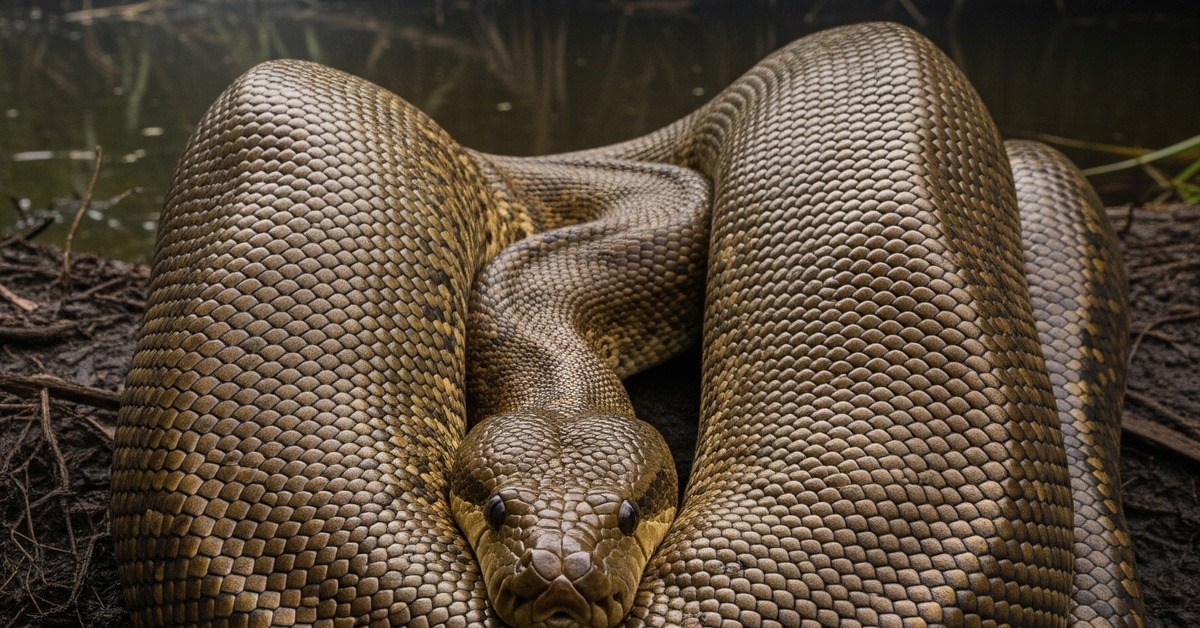
Australia’s scrub python — Simalia kinghorni, sometimes called the amethystine python — is the country’s longest snake. It’s capable of reaching six metres and exceeding 30 kilograms in the tropical rainforests and wetlands of Queensland and the Northern Territory. These aren’t passive, defensive animals. They actively hunt wallabies, large birds, and occasionally freshwater crocodilians. They’re opportunistic in the truest sense.
Documented encounters show that a large scrub python doesn’t simply flee when a saltwater crocodile approaches. Some of the most compelling footage, filmed by wildlife researchers in Kakadu National Park in the 2010s, shows pythons attempting to loop coils around a crocodile’s snout — a defensive tactic that, for a few extraordinary seconds, genuinely neutralises the croc’s primary weapon. It’s a strategy that makes sense on paper. Remove the bite, and the crocodile’s advantage collapses. Here’s the thing: if you’re drawn to the idea of ancient reptiles deploying surprisingly sophisticated survival tactics, it’s worth noting that similar strategic complexity appears in the green anaconda’s aquatic ambush hunting in the Amazon — another giant constrictor whose success depends on controlling the encounter environment entirely.
The problem for the python is duration.
Controlling a crocodile’s snout requires sustained, enormous muscular effort. The crocodile, meanwhile, is rotating, rolling, and thrashing — movements it’s been using to dismember prey for roughly 80 million years. The death roll isn’t just powerful; it’s architecturally destabilising. A python’s grip depends on maintaining coordinated coil positions across its entire body length. One violent axial rotation from a 500-pound crocodile disrupts that geometry instantly. The python’s coils, once precise, become loose and ineffective. Several documented cases in northern Australia end not with either animal dead, but with separation. The python releases. The crocodile moves off.
Neither animal emerges undamaged. And that outcome, in itself, says something remarkable about both creatures — about the kind of evolutionary equilibrium that develops when two apex hunters share space for geological spans of time.
A Conflict Older Than Most Continents’ Current Shape
The reason this encounter carries such visceral weight isn’t the violence alone — it’s the age of it. Crocodilians have existed in broadly their current form since the Late Cretaceous, roughly 80 million years ago. The lineages ancestral to modern pythons diverged sometime around 50 to 60 million years ago, though the fossil record for large constrictors is fragmentary. What’s certain is that these two groups have been sharing wetland environments — and therefore competing, colliding, and occasionally preying on each other — for longer than most of Earth’s current mountain ranges have existed.
A 2021 study published by researchers at Charles Darwin University noted that the behavioural responses large crocodilians display toward constrictor snakes suggest learned wariness rather than pure instinctual aggression — a distinction that implies cognitive flexibility far beyond what most people attribute to either animal. (And this matters more than it sounds: it means we’re not just watching predator-prey mechanics; we’re watching cultural knowledge encoded in behaviour.) The saltwater crocodile vs python dynamic isn’t just about muscle. It’s about two deep lineages reading each other across millennia. Watching a species avoid another with this consistency, you start to understand that evolutionary time doesn’t just change anatomy — it changes how animals think.
The Florida Everglades offers a disturbing modern parallel. Burmese pythons — an invasive species established in southern Florida since the 1980s — have been documented preying on American alligators, the saltwater crocodile’s closest New World relative. In those encounters, the outcome is far less decisive in the crocodilian’s favour. Alligators bite with roughly half the force of saltwater crocodiles, and the Burmese python — which can exceed five metres and 90 kilograms — is substantially larger than any scrub python in Australian wetlands. The Everglades encounters, documented by the U.S. Geological Survey, have ended both ways: python consuming alligator whole, and alligator dismembering python. Neither animal has evolved defences against the other. That’s what invasive predator dynamics look like.
Australia’s native confrontations, by contrast, have been shaped by millions of years of mutual pressure. That shared evolutionary history matters because it likely explains why Australian scrub pythons don’t preferentially target saltwater crocodiles. They avoid them with a consistency that suggests genuine risk assessment. The crocodile, by contrast, will opportunistically take a python when encounter conditions favour it — ambush position, shallow water, size advantage. The asymmetry is telling. It points to who’s been setting the terms of this relationship for most of its history.
Saltwater Crocodile vs Python: What the Data Actually Shows
Hard data on saltwater crocodile vs python encounters is surprisingly thin — not because the encounters are rare, but because they happen in some of the most remote, flood-prone terrain in the world. Most documented encounters come from trail cameras, drone footage, and incidental observations by rangers or tourism operators. Kakadu National Park, Arnhem Land, and the Cape York Peninsula wetlands are not places where researchers set up systematic observation grids. Size is the decisive variable in almost every documented case. A saltwater crocodile below two metres and a scrub python above four metres produces a genuinely uncertain encounter. Flip those dimensions — a five-metre crocodile and a three-metre python — and the outcome becomes highly predictable within seconds.
Why does documented variation exist at all?
Because the crocodile’s bites, death rolls, and armour don’t operate in a vacuum — they operate against a moving, coiling target that occasionally succeeds in neutralising the initial advantage. The Charles Darwin University herpetology programme has conducted some of the most rigorous fieldwork on saltwater crocodile behaviour in Kakadu, with longitudinal studies running from the early 2000s through the 2020s tracking individual crocodile movement and feeding patterns. Their data doesn’t isolate python encounters specifically, but it does reveal something relevant: large male saltwater crocodiles in the 4–5 metre range show markedly less avoidance behaviour toward large prey items than females or subadults do — a finding consistent with the filmed encounters in which it’s almost always a large male initiating engagement with a python.
Documented cases from Queensland Wildlife Services between 2008 and 2019 show no confirmed kills of large saltwater crocodiles by Australian pythons, though there are several records of pythons causing lacerations and minor injuries before escaping. The crocodile bites. The python attempts to coil. The crocodile death-rolls. The python releases or is dismembered.
But juvenile saltwater crocodiles face a completely different calculus. Researchers at Charles Darwin University have noted that a two-year-old crocodile averaging 60–80 centimetres is well within the prey size range of a large female python. This means the dynamic reverses completely at the juvenile stage — and explains why saltwater crocodile nest sites are defended so aggressively by adult females, who’ll charge and snap at anything approaching the hatching zone, including snakes several times their own length.
The Wetland as a Living Laboratory of Deep Time
Northern Australia’s seasonal wetlands aren’t just a backdrop for dramatic animal encounters. They’re functioning examples of an ecosystem type that has existed, in broadly similar form, for tens of millions of years. The Mary River Wetlands in the Northern Territory, listed as a Ramsar wetland of international importance, support one of the highest densities of saltwater crocodiles on Earth — an estimated 1,700 individuals in roughly 1,000 square kilometres of floodplain. Scrub pythons share that habitat, along with freshwater crocodiles, monitor lizards, and a dozen other reptilian predators.
Standing in a flat-bottomed aluminium boat at dusk, watching crocodile eye-shine multiply across the dark water while something large moves through the paperbark reeds behind you — it’s possible to feel the geological depth of this place in a way that no museum exhibit quite replicates. These animals are not relics. They’re the ongoing project.
The conservation picture complicates that awe. Northern Australia’s saltwater crocodile population has recovered dramatically since hunting bans took effect in 1971 — numbers had fallen to near-catastrophic lows by the late 1960s, and the rebound since protection represents one of conservation’s genuine success stories. Python populations face different pressures: habitat fragmentation, road mortality, and illegal collection for the exotic pet trade. If python numbers decline significantly in northern Australia, the crocodile’s role as an ecological regulator changes, because pythons suppress mammal populations that crocodiles also depend on. Predator ecosystems don’t have neat, isolated threads. Pull one and the whole structure shifts.
Stand at the edge of the Mary River at the end of the wet season, mud still oozing between your boots, and watch a two-metre scrub python move through the shallows twenty feet away. Nothing hurries. Nothing announces itself. The water is completely opaque. Whatever is in it is already aware of you — and has been for much longer than you’ve been standing there.
Where to See This
- Kakadu National Park, Northern Territory, Australia — the best saltwater crocodile and scrub python habitat on Earth, accessible year-round but most rewarding at the end of the wet season (April–May) when animals concentrate around receding water bodies. Crocodile boat tours depart from Cooinda Lodge daily.
- Charles Darwin University’s Research Institute for the Environment and Livelihoods (CDU RIEL) conducts ongoing crocodile ecology research in the Northern Territory — their published work is accessible through the CDU research portal and represents the most current field data on saltwater crocodile behaviour in Australia.
- For remote, guided wildlife immersion, the Mary River Wilderness Retreat offers professional naturalist-guided wetland tours that regularly produce sightings of both species in the same habitat — the closest most visitors will come to witnessing this ancient dynamic directly.
By the Numbers
- ~16,460 newtons: the recorded maximum bite force of a saltwater crocodile, measured by Dr. Gregory Erickson’s team at Florida State University in 2012 — the highest of any living animal tested at that time.
- 6 metres and over 1,000 kg: the maximum recorded size of a wild saltwater crocodile (Lolong, measured in the Philippines in 2011, now deceased).
- 6 metres and ~30 kg: the maximum recorded size of an Australian scrub python — longer than many crocodiles by reach, but outweighed by a factor of more than 30 at maximum adult sizes.
- 1971: the year Australia introduced full federal protection for saltwater crocodiles, after hunting had reduced Northern Territory populations to an estimated 3,000 individuals; current estimates exceed 100,000.
- ~80 million years: the approximate age of the crocodilian lineage in broadly its current anatomical form, making it one of the longest-surviving large predator body plans in vertebrate history.
Field Notes
- In 2014, a trail camera operated by Queensland Parks and Wildlife rangers in the Cape York Peninsula captured a 4.2-metre saltwater crocodile dragging a subadult scrub python — estimated at around 3 metres — into the water in under eight seconds. The entire encounter, from first contact to submersion, produced no vocalisations from either animal.
- Saltwater crocodiles don’t simply bite and hold. The death roll — a violent axial rotation of the entire body — is used specifically to disorient, dismember, and exhaust prey. Against a python already committed to a coiling strategy, a single death roll can reposition the entire snake by more than a metre in less than two seconds.
- The same osteoderms that protect adult saltwater crocodiles from python coils also make them effectively immune to the venom of Australia’s highly toxic elapid snakes — the bony skin plates prevent fang penetration entirely, giving the crocodile a passive defence against a threat it’s never been documented actively responding to.
- Researchers still can’t fully explain why some large scrub pythons in northern Australia actively approach crocodiles rather than avoiding them — whether this reflects individual learned boldness, size-based confidence thresholds, or simply insufficient information about predation risk remains an open question in Australian herpetology.
Frequently Asked Questions
Q: Who wins a saltwater crocodile vs python fight?
In most documented encounters, the saltwater crocodile wins — particularly when the crocodile is a large adult. The crocodile’s bite force of approximately 3,700 pounds per square inch, combined with the death roll and heavily armoured skin, makes it extraordinarily difficult for a python to subdue. The python’s squeeze is most effective against animals that breathe regularly; crocodiles can suppress their need for air for over an hour, neutralising the constriction strategy at its core.
Q: Can a python actually kill a crocodile by constriction?
It’s theoretically possible under very specific conditions — a juvenile crocodile, a very large python, and an encounter in shallow water where the crocodile can’t use its full range of movement. In practice, the crocodile’s osteoderms resist compression, and the death roll disrupts any coil positioning the python manages to establish. The python’s best-documented tactic — coiling around the snout — neutralises the bite temporarily but requires sustained muscular effort the python can’t maintain against a thrashing, rotating crocodile body.
Q: Are saltwater crocodile vs python encounters common in Australia?
They’re not daily occurrences, but they’re not rare either in the shared habitat of northern Australia’s tropical wetlands. Most go unobserved simply because the terrain is remote and the encounters often happen at night or in opaque floodwater. What’s commonly misunderstood is that these aren’t two animals with no prior evolutionary relationship — they’ve been sharing wetland ecosystems for tens of millions of years, and both species show behavioural patterns that suggest genuine awareness of the other as a threat, not just neutral co-existence.
Editor’s Take — Dr. James Carter
What I keep returning to isn’t who wins. It’s the duration. These two lineages have been reading each other in wetland environments for longer than mammals have been the dominant land animals on Earth. The fact that a scrub python has a documented tactic — target the snout, neutralise the bite — tells you something about the depth of that relationship. That’s not instinct operating in a vacuum. That’s tens of millions of years of selective pressure, visible in a single coil in a flooded Queensland wetland at 3 a.m.
What the saltwater crocodile vs python encounter ultimately reveals is something unsettling about our sense of time. We tend to think of wildlife encounters as events — discrete, dramatic, concluded. But this one has been running continuously, in floodplains that look essentially unchanged, since before the Himalayas existed. The crocodile’s armour, the python’s coil, the flooded plain between them — none of it is new. We arrived recently to this story, with our trail cameras and bite-force sensors, and started calling it a clash. The animals involved have never stopped treating it as simply Tuesday.
Illustrations are AI-generated. Article fact-checked and human-edited. Our editorial standards.