How Coconut Palms Cross Oceans and Rebuild Coastlines
Imagine a seed that needs no map, no compass, no human hand — just salt water, ocean currents, and time measured in months. The coconut palm has been executing this dispersal strategy across the Indo-Pacific for millions of years, and every successful arrival rewrites a coastline’s future. Coconut palm ocean dispersal isn’t a botanical curiosity. It’s a slow-motion invasion that stabilizes the very shores it colonizes.
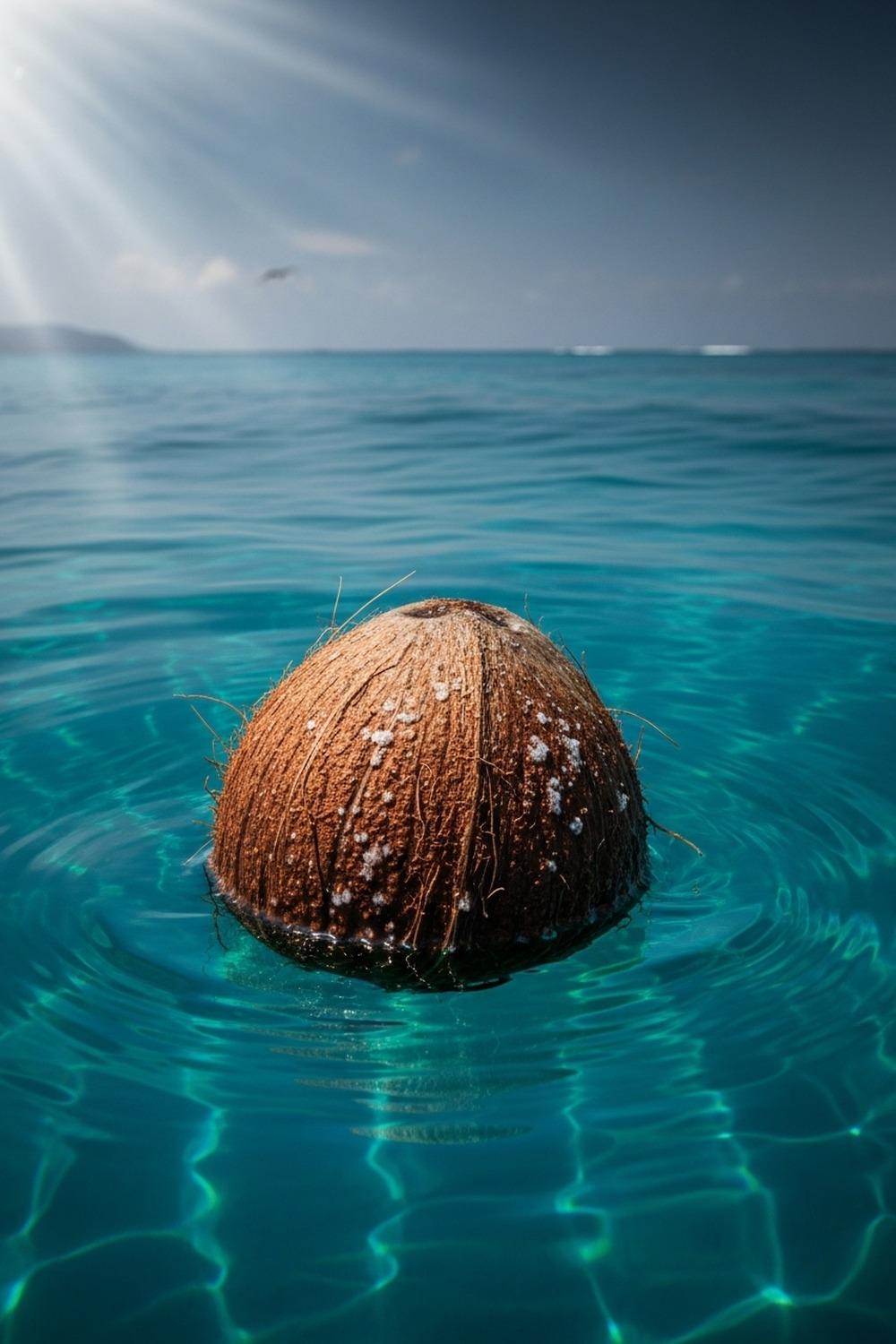
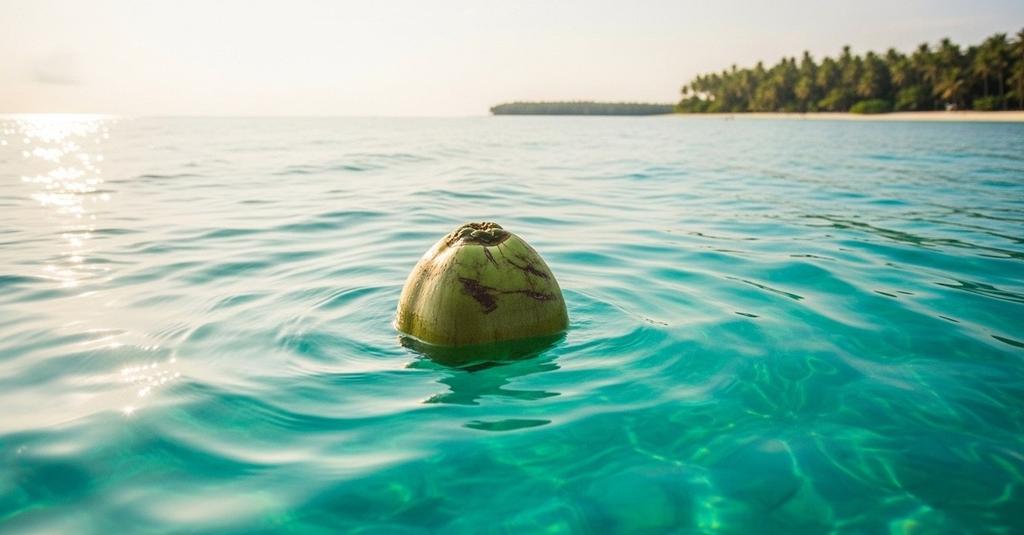
The mechanics look simple enough on the surface. A fruit detaches from a palm fringing some forgotten atoll. It enters the water. And then — this is the part that matters — it doesn’t sink. For four months, sometimes longer, it drifts across thousands of miles of open ocean with nothing inside it but time and nutrients, waiting for land.
No expedition organized this. No botanist orchestrated the timing. Scientists have spent the last sixty years piecing together how the seed survives the journey. But here’s what they’re still mapping: what happens to a coastline when one of these palms finally takes root.
Key Facts
- Viable coconut seeds survive 110 to 120 days of saltwater immersion in laboratory conditions, per Smithsonian Tropical Research Institute tests.
- Botanist Frederick Fosberg documented in the 1960s that viable coconuts could drift at least 3,000 miles under favorable Pacific currents.
- A 2017 Central Marine Fisheries Research Institute study found cleared Kerala coastlines eroded 18.4 centimeters yearly versus 2.1 centimeters where palms remained, a ninefold difference.
- A 2011 UC Berkeley analysis led by Kenneth Olsen used microsatellite DNA to trace two distinct coconut domestication events, in the Indo-Atlantic and Pacific.
- Fossil coconut relatives dated to roughly 37 to 55 million years ago appear in Rajasthan, India, and Eocene-age deposits of New Zealand.
In short: Coconut palm ocean dispersal lets a buoyant, self-provisioned seed drift across thousands of miles of salt water to colonize new shores. Coconuts survive 110 to 120 days at sea, can travel over 3,000 miles, and once rooted cut coastal erosion ninefold, holding shorelines together for over 55 million years.
The Engineering That Lives Inside a Seed
Start with the coconut itself. Technically a drupe, not a nut — encased in a fibrous husk called a mesocarp that traps air pockets the way a raft traps buoyancy. The whole structure floats. Inside, a sealed endosperm of liquid and solid meat provides the embryo everything it needs across the entire voyage, which can stretch over a hundred days without a single nutrient input from the outside.
Botanist Frederick Fosberg documented this in the 1960s through fieldwork across the Pacific. His conclusion: viable coconuts could survive ocean drift of at least 3,000 miles under favorable current conditions. That single finding reshaped how scientists understood island colonization across Polynesia and Melanesia. Later, the Smithsonian Tropical Research Institute ran laboratory germination tests and confirmed what the ocean already knew — seed viability persists after 110 to 120 days of saltwater immersion, provided temperatures stay within the tropical band.
But here’s the thing: the coconut doesn’t just tolerate saltwater. It reads like something engineered for it.
The fibrous husk resists waterlogging for weeks before gradual absorption begins. The embryo stays insulated inside a thermal buffer that nearly qualifies as a sealed chamber. Even the shape helps — that oblong geometry creates drag in heavy swells, reducing the mechanical stress that would crack the germination pore. Rotation slows. Stress drops. The seed survives.
It’s not accident. It’s millions of years of selection pressure, and it works.
How Water Routes Become Highways
In 2009, researchers from the University of Hawaii modeled ocean drift trajectories using prevailing currents — the North and South Equatorial Currents, the Kuroshio, the Agulhas. What changed in that study was the recognition that routes weren’t random.
A coconut leaving Southeast Asia could reach East Africa in under 100 days. The pathways were almost embarrassingly efficient. Turn out the ocean runs its own logistics, and the coconut had learned to trust them.
What Gets Built When the Seed Arrives
When a coconut finally washes ashore and germinates, what follows isn’t growth in any passive sense. It’s active coastal engineering. The palm sends a tap root deep into sandy soil within the first year, then follows with a dense mat of fibrous lateral roots extending outward up to ten meters. This root architecture binds loose coastal sediment, slowing erosion rates dramatically on beaches that would otherwise retreat several centimeters per year under wave action.
You see this pattern on coastlines from Kerala to the Coral Triangle. And it shares something with how other organisms quietly reshape their environments over time — consider the underground-fruiting palm of Borneo, which redirects its entire reproductive strategy belowground as adaptation (and this matters more than it sounds: it’s evidence that palms as a family have an extraordinary range of structural solutions to extreme conditions).
A study by the Central Marine Fisheries Research Institute in India measured the difference in 2017. Along Kerala’s coconut-dense coastline, sections with intact palm groves lost an average of 2.1 centimeters of shoreline annually. Cleared sections lost 18.4 centimeters. That’s nearly a ninefold difference in erosion rate, driven almost entirely by root structure and canopy wind-break effect.
The palms weren’t decorating the coast. They were holding it together.
Local fishing communities in the Lakshadweep Islands noticed this long before researchers measured it. Elders on Agatti island describe deliberate transplantation of coconut seedlings along eroding northern beaches going back at least three generations — an empirical coastal engineering solution developed entirely without formal science training. They didn’t need a study.
They had the shoreline itself as evidence.
The Genetic Record Reads Like a Map
In 2011, a landmark analysis by researchers at UC Berkeley, led by botanist Kenneth Olsen, used microsatellite DNA markers to trace two distinct domestication events. One in the Indo-Atlantic region. One in the Pacific. The finding suggested independent cultivation in at least two separate coastal civilizations before further spread through human assistance and pure natural dispersal.
What’s remarkable is how clearly the genetic clusters map onto known ocean current systems. National Geographic’s coverage of coconut genomics documented wild coconut populations on isolated atolls showing genetic signatures consistent with drift arrival, not human introduction — confirming that unassisted coconut palm ocean dispersal genuinely created new populations on landmasses with zero prior human contact.
Why does the timeline matter? Because the geological record extends much deeper than human history.
Fossilized coconut remains dated to approximately 37 to 55 million years ago appear in Rajasthan, India — then a coastal region — and in Eocene-age deposits of New Zealand. These aren’t the same species as the modern cultivated palm, but they’re close relatives. Their distribution confirms that hydrochory — water-based seed dispersal — has been a defining feature of the coconut lineage for tens of millions of years. Coconut palm ocean dispersal isn’t a recent strategy.
It’s ancient. It’s refined. And it still works.
When you see coconuts lining a Maldivian atoll or a remote Papua New Guinean beach, you’re not looking at a cultivated crop that escaped. You’re looking at the endpoint of a dispersal event that began on a coastline that no longer exists, carried by a current system that’s been running the same route since before humans evolved. Watching a coastline shift from erosion to stability because of a seed that traveled further than most humans travel in a lifetime — the mathematics of that should humbles something in us.
What the Rising Sea Changes
And then the urgency arrives. The same coastlines that coconut palms have been colonizing and stabilizing for millennia now face sea level rise at rates the palms weren’t designed to handle. A 2021 study in Global Change Biology by University of Queensland researchers modeled shoreline change across 221 Indo-Pacific atolls and found that even a 0.5-meter rise in mean sea level would push saltwater intrusion into the freshwater lens that coconut roots depend on, triggering dieback in low-lying groves within 30 to 50 years.
The numbers compound. The Maldives — where coconut palms cover an estimated 60% of terrestrial vegetation on inhabited islands — faces a projected mean sea level rise of 0.3 to 0.6 meters by 2100 under moderate IPCC scenarios. If even a third of current palm cover is lost, the erosion rates measured in Kerala become directly relevant to island survival.
Coastlines that currently lose 2 centimeters per year could accelerate toward the 18-centimeter rate recorded in cleared sections. For islands averaging 1.5 meters above sea level, that arithmetic closes fast.
Coastal engineers in Tuvalu are already experimenting with transplanting salt-tolerant coconut ecotypes — varieties selected from populations that grew historically closest to the waterline — into eroding northern coastlines. It’s a bet that the palm’s own adaptive range might outpace the rate of change. In an island nation with no higher ground to retreat to, it’s not a small bet.
What Travels Inside the Husk
A coconut arriving on a new shore doesn’t come alone. The fibrous husk is a micro-ecosystem unto itself. Studies by James Cook University researchers in 2018 identified over 80 species of invertebrates, fungi, and bacteria capable of surviving in fresh coconut husks after ocean transit — including nematodes, mites, and at least three species of weevil with no prior documented presence on the islands where the coconuts landed.
This isn’t contamination. It’s dispersal ecology at its densest.
The coconut is a biological ark, albeit a very small one. For decades, the accepted model in island biogeography held that remote island ecosystems were built largely through rare, accidental long-distance dispersal events — birds carrying seeds in gut or feather, insects blown off course by typhoons. But the coconut complicates that model by demonstrating a highly reliable, high-frequency dispersal mechanism that carries not just one species but a passenger community. Every coconut palm ocean dispersal event that successfully establishes a new grove potentially introduces dozens of associated organisms to a previously uninhabited shoreline.
Stand on the beach at Sipadan Island, off the northeast coast of Borneo, in early morning. The coconut palms here are so dense their canopies overlap thirty meters above the tideline. Beneath them, hermit crabs pick through fallen husks. Skinks hunt the root base shadows. The whole system arrived, ultimately, on the tide. It’s alive in a way that’s almost architectural — built layer by layer from a single drifting seed.
Where to See This
- The Lakshadweep Islands, India (best visited October to March) — some of the densest natural coconut palm shorelines in the world, with clearly visible root stabilization along eroding northern beaches. Entry requires an Indian government permit.
- The Smithsonian Tropical Research Institute (STRI) in Panama maintains ongoing research into tropical seed dispersal and coastal ecology — their public lecture series and open-access publications are a strong starting point for readers wanting the scientific depth.
- Look for freshly washed-up coconuts with intact husks on any remote Indo-Pacific beach after a storm surge — if the germination pore is uncracked, the seed may still be viable. Many beachcombers have accidentally observed germination starting within days of a coconut reaching dry sand above the tideline.
By the Numbers
- Up to 120 days of saltwater immersion survived by viable coconut seeds in laboratory conditions (Smithsonian Tropical Research Institute).
- 3,000+ miles: documented maximum drift distance for a viable coconut under favorable current conditions (Fosberg, 1960s Pacific fieldwork).
- Approximately 55 million years: age of the oldest known fossil relatives of the coconut palm, identified in Eocene-age deposits in Rajasthan, India, and New Zealand.
- 9× higher erosion rate recorded on cleared Kerala coastlines versus palm-covered shorelines in the same region (Central Marine Fisheries Research Institute, 2017).
- 80+ species of invertebrates, fungi, and bacteria documented surviving inside fresh coconut husks after ocean transit (James Cook University, 2018).
Field Notes
- In 2018, a coconut collected from a beach in Fiji was traced genetically to a parent population in Vanuatu — over 1,400 kilometers away — confirming an unassisted natural dispersal event with no evidence of human transport. The tree that germinated from it is now approximately four meters tall.
- The coconut palm is one of the only plant species whose seed contains its own liquid food reserve large enough to fuel both the ocean voyage and the first weeks of rooting in poor coastal sand — no soil nutrients required until the lateral roots establish.
- Hermit crabs actively assist coconut germination on some atolls by chewing through the fibrous husk, reducing the physical barrier to water reaching the germination pore — a form of unintentional mutualism that may meaningfully increase establishment rates on remote islands.
- Researchers still can’t fully explain why coconut populations on certain isolated Pacific atolls show genetic diversity far higher than drift models predict — either currents delivered far more colonization events than the models suggest, or there are dispersal mechanisms we haven’t identified yet.
Frequently Asked Questions
Q: How far can coconut palm ocean dispersal actually carry a viable seed?
Laboratory studies confirm viable germination after 110 to 120 days at sea, and current modeling by the University of Hawaii places theoretical maximum drift distances above 3,000 miles under favorable Indo-Pacific current conditions. In practice, most successful natural dispersal events occur over shorter distances — a few hundred to a thousand miles — simply because the odds of a suitable landfall increase the longer a seed drifts. Long-distance arrivals happen, but they’re the exception.
Q: What actually keeps a coconut from sinking during ocean travel?
The fibrous mesocarp — the thick husk surrounding the inner shell — is the key. It’s packed with air pockets that give the whole fruit a density lower than seawater, keeping it afloat without any additional mechanism. The husk also resists waterlogging for weeks, maintaining buoyancy through the critical early phase of the drift. Gradually, water absorption begins, slightly reducing buoyancy — but in most cases, the seed reaches shore before that becomes critical. The inner shell and endosperm remain sealed and viable throughout.
Q: Does coconut palm ocean dispersal mean all coastal coconuts arrived naturally, without human help?
Not exactly — and this is where most people’s assumptions get complicated. Genetic analysis has confirmed two distinct domestication centers, and human-assisted transport spread cultivated varieties widely across the Indo-Pacific, Pacific, and eventually the Caribbean. But wild populations on remote atolls with no history of human settlement carry genetic signatures consistent with natural drift arrival. Both processes happened, often in the same region. Separating natural dispersal from ancient human introduction requires DNA analysis, and even then the picture is sometimes ambiguous. It’s not either-or.
It’s both.
Editor’s Take — Alex Morgan
What strikes me most about this story isn’t the distance — it’s the erosion data. A ninefold difference in coastline loss between palm-covered and cleared beaches is the kind of number that should be appearing in sea level rise policy briefings, not just botany papers. The coconut palm has been doing coastal engineering for 55 million years. We’re only now starting to measure how much of our shoreline survives because of it — and what we stand to lose if rising seas take the palms before the palms can take hold elsewhere.
A seed that crosses an ocean and then holds the land together against the same ocean that carried it — there’s something almost paradoxical about that arrangement. The coconut palm doesn’t just survive hostile conditions. It converts them. And as sea levels rise and tropical coastlines face pressures that no root system was designed to resist, the question scientists are quietly beginning to ask is whether we can learn enough from 55 million years of botanical engineering to help the palm keep doing what it’s always done. The tide doesn’t negotiate. But the palm has been meeting it on its own terms for longer than our species has existed.
“
Illustrations are AI-generated. Article fact-checked and human-edited. Our editorial standards.