Pallas’s Cat: The Cold-Weather Predator Built for Survival
Pallas’s cat survival adaptations represent something rarely seen in nature — a design so refined across five million years that evolution essentially stopped bothering to revise it. The animal flattens itself against frozen ground and vanishes. Its coat is thicker than any other wild felid’s. Its ears sit flat against its skull. Its body plan burns less fuel than any similarly sized predator in the high steppe. But here’s what actually matters: none of these features explains how it survives alone. Together, they form a system.
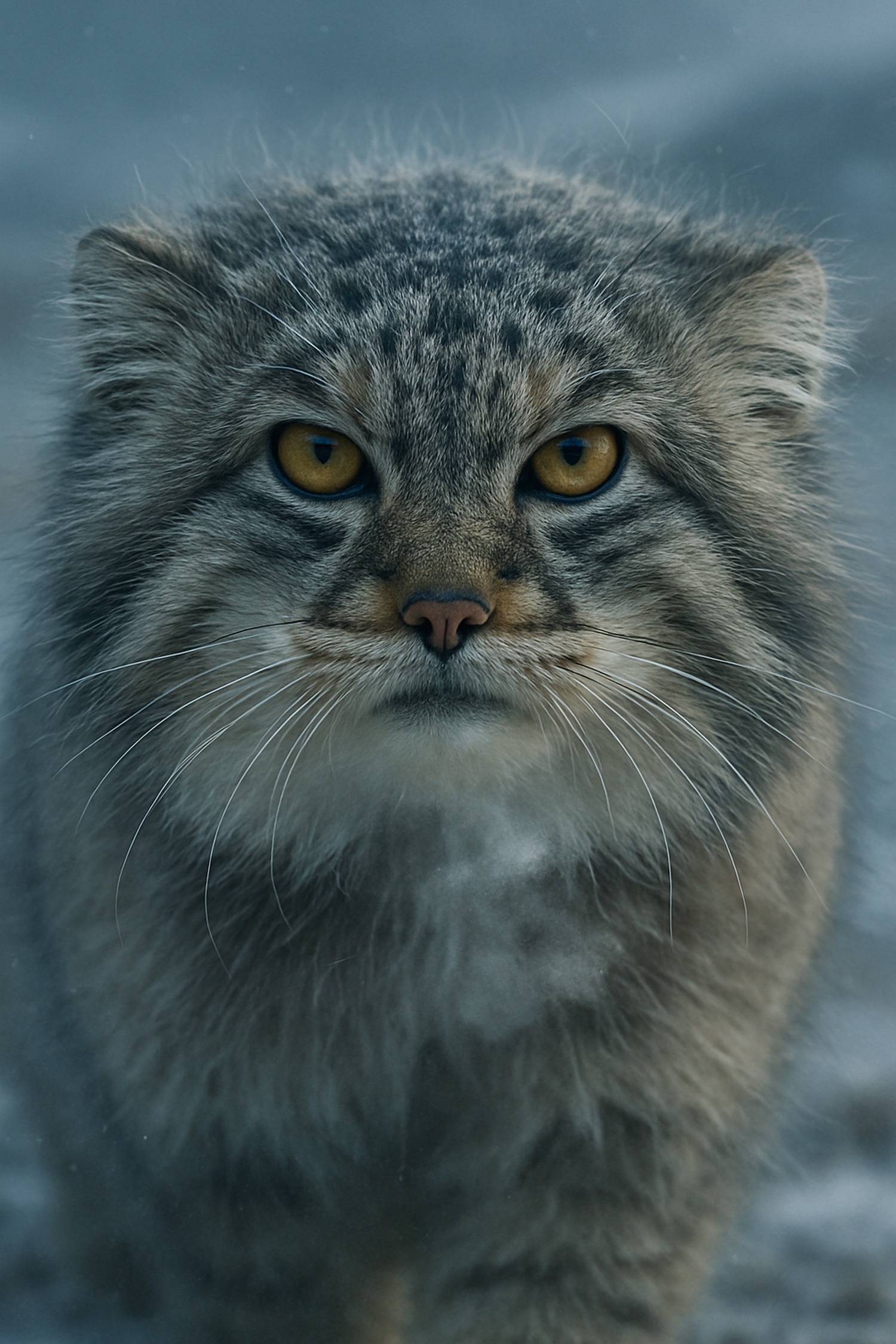
Deep in the grasslands of Central Asia and across the wind-scoured Tibetan Plateau, a small feline sits motionless at altitudes where the air is thin, the ground is iron-hard, and winter temperatures drop below -50°C. It weighs less than five kilograms. It stares at the world with fixed, pale eyes and an expression of permanent irritation. And it has survived, virtually unchanged, for an astonishing stretch of geological time.
Key Facts
- Pallas’s cat (Otocolobus manul) was first described by German naturalist Peter Simon Pallas in 1776 after expeditions across the Russian steppes.
- Molecular clock analyses suggest the Pallas’s cat lineage split from related felid groups about 5.19 million years ago during the Miocene epoch.
- Adult Pallas’s cats weigh less than five kilograms and survive winter temperatures that can drop below minus 50 degrees Celsius.
- The species has the densest fur of any wild felid, with hairs nearly twice as long as those of a domestic cat.
- A 2018 Snow Leopard Trust study in Mongolia found that Pallas’s cat winter hunting energy expenditure was markedly lower than that of comparably sized mustelids.
In short: Pallas’s cat, Otocolobus manul, is a small Central Asian felid first described in 1776 whose lineage split from related cats about 5.19 million years ago. Weighing under five kilograms, it survives temperatures below minus 50 degrees Celsius through the densest fur of any wild felid, a compact body, and a specialized diet of pikas and voles.
A Cold-Weather Blueprint Millions of Years in the Making
Formally Otocolobus manul, the Pallas’s cat was first described by German naturalist Peter Simon Pallas in 1776 after expeditions across the Russian steppes. But the animal’s actual origins reach far deeper. Fossil evidence places the genus among the earliest diverging branches of the modern Felidae family, with molecular clock analyses suggesting the lineage split from related groups approximately 5.19 million years ago during the Miocene epoch.
Research published by the IUCN Cat Specialist Group has confirmed that the species’ morphology — its compact frame, its flattened face, the unusual ear placement — has remained remarkably stable across that vast time span. That’s not accident. That’s a design that works.
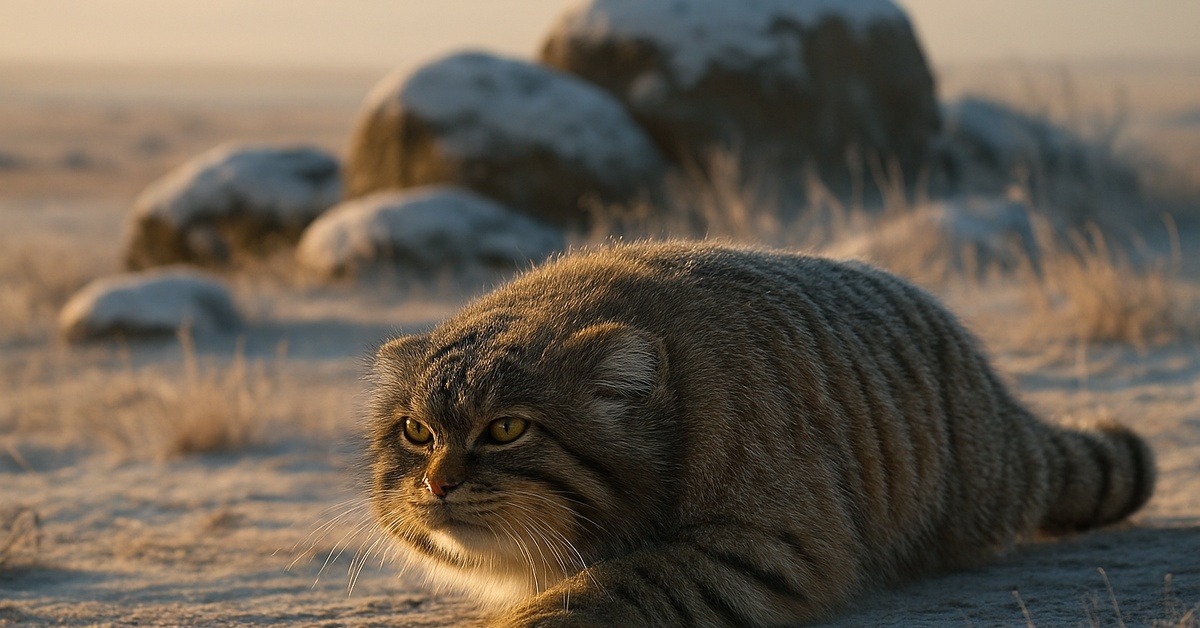
The name Otocolobus literally means “ugly-eared” in Greek, which is both uncharitable and instructive. The ears don’t point upward like those of most cats. They sit wide and low on the skull, giving the animal an oddly human profile from the front. That placement isn’t aesthetic — it’s functional. Flat ears present less surface area to the wind and allow the cat to keep its entire silhouette below the top of the grass line while it stalks prey.
In an open steppe where there’s nowhere to hide, being two centimeters lower than expected can be the difference between a meal and an empty stomach.
Watch one hunting on video and the effect is almost hypnotic. It doesn’t run. It flows. Belly pressed to earth, limbs moving in a slow, measured sequence, the cat closes distance on a pika or vole with the patience of something that has learned — across millions of years — that panic costs energy it cannot spare.
The Fur, The Frame, and the Physics of Staying Warm
What makes Pallas’s cat survival adaptations so structurally impressive is the combination. Take the fur — it’s extraordinary. The coat is the densest of any wild felid on Earth, with individual hairs measuring nearly twice the length of those found on a domestic cat. The underfur is thick and tightly packed, trapping a layer of still air against the skin that functions as a thermal buffer against conditions that would shut down most other small mammals within hours. In winter, that coat accounts for a significant proportion of the animal’s visible bulk, making a five-kilogram cat look considerably heavier.
Below the fur, something equally important happens. The Pallas’s cat carries a low-slung, compact body plan that minimizes the ratio of surface area to volume — the same principle that explains why large animals lose heat more slowly than small ones. Its legs are short. Its torso is dense.
A study conducted by researchers at the Snow Leopard Trust in 2018 monitoring sympatric predators across Mongolia noted that the Pallas’s cat’s energy expenditure during winter hunting bouts was markedly lower than that of comparably sized mustelids occupying similar habitat. That efficiency appears to derive directly from body morphology rather than just behavior. Much like the extraordinary economy of motion seen in other highly specialized mammals, the Pallas’s cat burns the minimum possible fuel to stay alive.
Even its vision is calibrated to its environment. The cat’s pupils contract to small circles rather than vertical slits — unusual among felids, and likely linked to its crepuscular and diurnal hunting patterns in open terrain where judging distance against bright, snow-reflected light is a genuine challenge.
Hunting Where Nothing Else Hunts
Dense populations of small burrowing mammals — pikas, voles, ground squirrels — exist across the Tibetan Plateau and Central Asian steppe. They form the near-exclusive prey base for the Pallas’s cat. This predator-prey relationship has co-evolved over millions of years into something close to perfect dependency. What changed? Everything the moment pika populations crash.
When those population collapses occur, as they periodically do, Pallas’s cat numbers follow within one to two seasons. The link is that direct. National Geographic’s species profile documents how the cat’s entire hunting strategy — the low stalk, the shallow depression it uses as a hide, the explosive short-range pounce — is optimized specifically for prey that lives underground and emerges briefly.
Unlike larger felids that can shift to alternative prey across wide territories, the Pallas’s cat is a specialist. Its home range, typically between 20 and 100 square kilometers depending on habitat quality, is constrained by terrain and prey density. It doesn’t migrate. It doesn’t dramatically switch prey guilds. Instead, it reduces its activity, lowers its metabolic demands, and waits — sometimes for extended periods — in rock crevices or borrowed fox dens where the temperature differential between outside air and ground is enough to sustain a resting animal through the worst of winter. Field researchers working in Mongolia’s South Gobi region have recorded individual cats remaining in a single rocky outcrop for up to four consecutive days during extreme cold snaps.
They weren’t trapped.
They were making a calculated thermal decision.
Pallas’s Cat Survival Adaptations Under Pressure from a Warming World
Here’s the problem with being perfectly built for brutal cold: when the cold starts to change, your perfection becomes a liability. Climate models analyzed by the World Wildlife Fund in a 2021 report on Central Asian steppe ecosystems project that mean winter temperatures across the Pallas’s cat’s core range could rise by 2.5 to 3.8°C by 2050 under mid-range emissions scenarios. In practice, it means snowpack changes that alter pika habitat, shifts in the timing of freeze-thaw cycles that affect burrowing rodent populations, and increasing frequency of ice storms — called dzud events in Mongolia — that seal grass under hard ice and collapse small mammal populations catastrophically. A dzud in 2009–2010 killed approximately 20 percent of Mongolia’s livestock and devastated wildlife populations across the southern steppe. Pallas’s cat numbers in affected areas took years to recover.
Habitat fragmentation compounds the pressure. The cat’s range spans roughly 10 countries — from Iran and Afghanistan east through Central Asia to China and Russia — but it exists at consistently low densities throughout. A camera-trap study conducted by the Pallas’s Cat International Conservation Alliance (PICA) between 2016 and 2022 estimated total adult population at fewer than 58,000 individuals globally, though the researchers acknowledged the true figure carries significant uncertainty due to the animal’s secretive behavior and preference for terrain that resists systematic surveying.
But the trend is clear: range contraction at the edges, increasing pressure at altitude, and a life history that doesn’t absorb population shocks quickly. Low reproductive rate, single annual litter of two to six kittens, high juvenile mortality — this is an organism built for stability, not resilience.
Conservation biologists at PICA are now deploying GPS collar studies across Mongolia and China specifically to understand how the cats respond to landscape-level change. The data, still accumulating, will determine whether corridors between fragmented habitat patches are viable — or whether the species is being quietly boxed into climate refugia that are themselves disappearing.
Where to See This
- Mongolia’s South Gobi Province and the Hustai National Park region offer the most accessible opportunities for wild sightings, though low densities make encounters rare; late autumn and early spring are optimal when cats are most active during daylight hours.
- The Pallas’s Cat International Conservation Alliance (PICA) — at pallascats.org — coordinates international research, camera-trap networks, and citizen science reporting across the species’ full range.
- For those who can’t reach the steppe, several European and North American zoos maintain active breeding populations under EAZA and AZA studbook management; the cats are notoriously difficult to breed in captivity, which makes successful programs scientifically significant in their own right.
By the Numbers
- Fewer than 58,000 estimated adult individuals remain globally (PICA camera-trap analysis, 2016–2022), though true population size carries acknowledged uncertainty.
- The Pallas’s cat’s fur can reach 5–6 cm in length during winter — roughly twice the coat depth of a domestic shorthair at peak season.
- Recorded elevational range extends to 5,050 meters above sea level on the Tibetan Plateau — among the highest altitudes documented for any wild felid.
- Litter sizes range from 2 to 6 kittens, but first-year mortality in wild populations has been estimated at over 68%, making population recovery after crashes slow and fragile.
- The species’ known range spans approximately 10 countries and an area exceeding 12 million square kilometers — yet population density throughout that range remains one of the lowest of any felid outside the great cats.
Field Notes
- In 2019, a camera-trap array deployed by researchers from the Chinese Academy of Sciences in Qinghai Province captured the first confirmed footage of a Pallas’s cat actively hunting at midday in winter sunlight at 4,600 meters — behavior previously considered atypical and suggesting greater behavioral flexibility than earlier studies had credited.
- The Pallas’s cat is one of very few wild felids with round pupils rather than vertical slits — a feature it shares with the lion and the cougar, both animals that hunt primarily in open terrain under variable light conditions, suggesting convergent evolution driven by habitat rather than phylogeny.
- Despite its compact size, a Pallas’s cat’s home range can overlap extensively with Tibetan foxes and small raptors without triggering consistent interspecific competition — the three species appear to partition prey by hunting depth, with the cat specializing in surface-level burrow entrances that neither competitor exploits efficiently.
- Researchers still can’t fully explain how juvenile Pallas’s cats navigate their first winter: mortality is extraordinarily high, yet the survivors seem to acquire cold-weather hunting competence faster than expected for a largely solitary species with limited maternal teaching time. Whether this reflects accelerated behavioral imprinting or some form of innate thermal regulation not yet characterized remains an open question.
Frequently Asked Questions
Q: What are the most important Pallas’s cat survival adaptations that allow it to live in extreme cold?
Pallas’s cat survival adaptations operate as a system rather than a single feature. The densest fur coat of any wild felid — up to 6 cm deep in winter — provides primary insulation. A compact, low-slung body minimizes heat loss through surface-area reduction. Flat, wide-set ears reduce thermal exposure while keeping the silhouette low during stalking. And behavioral adaptations, including extended rest periods in rock crevices during extreme cold snaps, reduce total energy expenditure to levels a small mammal can sustain without abundant food.
Q: Can Pallas’s cats be kept as pets, given how much they resemble domestic cats?
They can’t, and attempting it would be harmful to the animal. Despite the superficial visual similarity to a grumpy housecat, Pallas’s cats are intensely wild, deeply stressed by captivity unless managed by specialized facilities, and carry immune profiles poorly suited to the pathogen environments of human homes. Here’s the thing: even accredited zoos report significant difficulty maintaining healthy individuals — captive Pallas’s cats frequently succumb to toxoplasmosis and other infections that wild populations appear to handle through exposure-built immunity. They also have highly specific dietary and territorial needs that domestic settings cannot replicate.
Q: Is the Pallas’s cat endangered, and what’s the biggest threat it faces?
The IUCN currently lists the Pallas’s cat as Least Concern, but that classification masks meaningful regional declines and carries the caveat that population data is sparse across much of the range. The most significant pressure isn’t direct hunting — though historical fur trade harvesting was severe — but habitat degradation, prey base collapse, and climate-driven disruption of the steppe ecosystems the cat depends on. Pallas’s cat survival adaptations evolved for stable, cold conditions; a rapidly warming and increasingly variable climate removes the very consistency those adaptations were built to exploit.
Editor’s Take — Dr. James Carter
What strikes me most about this animal isn’t the fur, spectacular as it is. It’s the stability. Five million years without significant morphological change means the Pallas’s cat found a solution so good that evolution simply stopped tinkering. That’s rare. And the current climate situation isn’t alarming because this cat is fragile — optimized systems don’t adapt gracefully to new parameters. They perform brilliantly right up until the conditions they were built for disappear, and then they fail fast.
The Pallas’s cat doesn’t know it’s an evolutionary artifact. It doesn’t know that the cold it was built for is retreating, season by season, up the slopes it calls home. It knows only the pika in the grass, the rock face blocking the wind, the particular density of silence before a steppe winter locks everything in place. Somewhere in that silence is a question worth sitting with: what else are we losing that we haven’t learned to value until the moment it starts to go?
Illustrations are AI-generated. Article fact-checked and human-edited. Our editorial standards.